
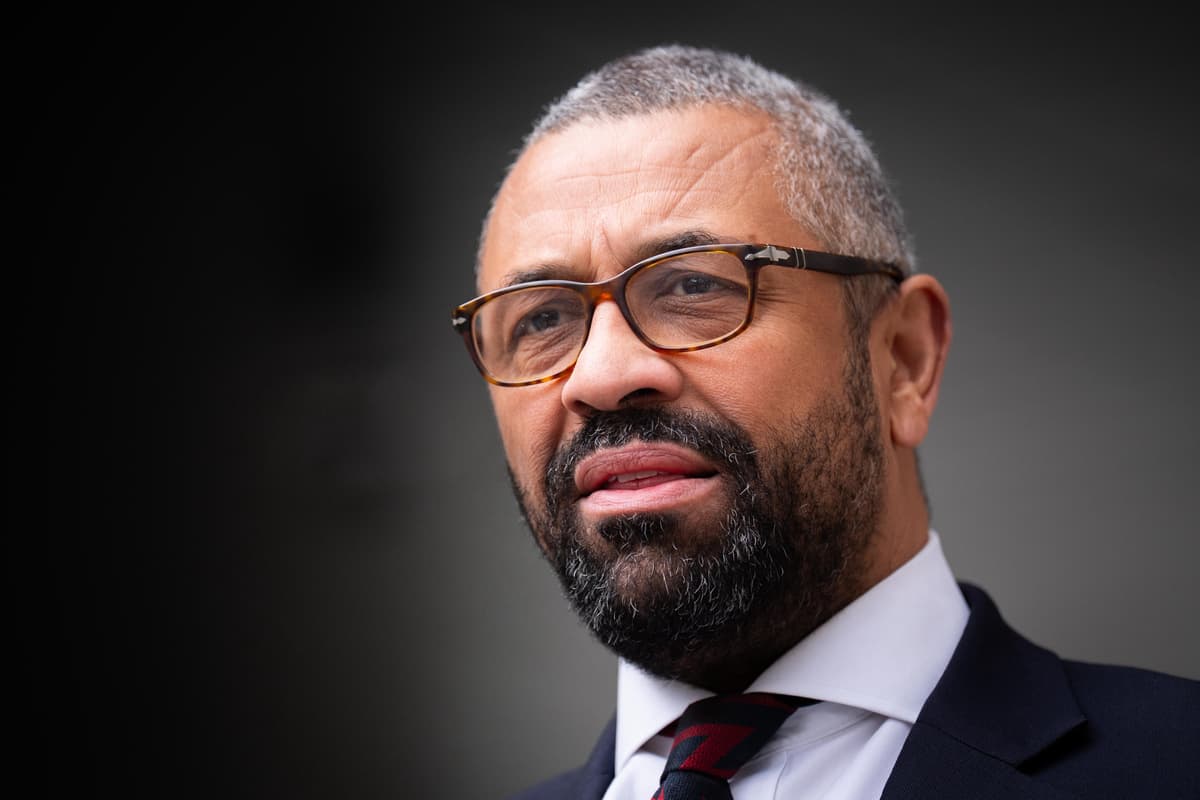
Brexit, ECHR and clean air: Why Tory James Cleverly may fail in his bid to be Mayor of LondonCleverly would need to be more Heseltine than ‘hard line’, writes London political expert Professor Tony Travers
Allow Exco Player content
This content is provided by Exco Player and may use cookies or similar technologies. Please click ‘Allow and Continue’ below to load the content.
Tony Travers2 minutes ago
COMMENTS
Could a Conservative possibly be the next Mayor of London?
James Cleverly’s emergence as the front-runner to be the party’s candidate in 2028 begs the question of how a party that has declined so far in the capital could possibly win back City Hall.
London is a ‘Labour city’ it is often said.
The 2024 general election certainly suggested so, with the party winning 59 out of 75 Parliamentary seats.
The Conservatives managed just nine.
At one point during the run-up to polling day, it appeared possible the Tories might be reduced to four or fewer MPs.
Labour won the Cities of London and Westminster constituency in 2024 for the first timeGetty
The Cities of London and Westminster, home to the Monarch and Parliament, was won by Labour for the first time.
But it was not always thus.
Until the late-1990s, London voting mirrored trends in Britain as a whole: Labour would be ahead some of the time and the Conservatives for the rest. It was a politically balanced city overall, albeit with never-to-be-lost strongholds such as Barking & Dagenham and Kensington & Chelsea.
Moreover, Boris Johnson won the mayoralty for the Conservatives in 2008 and 2012.
Demographic and social change shifted London’s voting leftwards from 1997 onwards.
Latterly, there has been a further shift to the left with the growing success of the Greens, coupled with a more modest move to the right with the appearance of Reform.
London, like the rest of the country, has seen a fragmentation of the ‘two-party’ system, though to a significantly lesser extent than elsewhere.
Some parts of the city, for example, Westminster, Wandsworth, Hammersmith & Fulham, Barnet and Enfield are Conservative vs Labour struggles as they have been for decades.
Boris Johnson was elected London Mayor twiceAFP/Getty
Any Conservative candidate would need to ensure they came second to Labour in terms of first preference votes: if no candidate gets over 50 per cent of the votes, the top two go forward to a second round where all other candidates’ second preference votes for the top two are then counted.
Reform came second, just, in a recent Savanta poll, while the Greens came second in terms of vote share in last May’s borough elections. Nothing can be taken for granted.
James Cleverly, who voted to leave the EU, would need to tread carefully into the role of Conservative candidate.
Read More
James Cleverly’s Ulez attacks would be ‘poison’ to key voters in London Mayor race
Digital ID can be accepted as proof of age for alcohol under new rules
Mr Bean to step into the world of Dennis The Menace and more in Beano crossover
Make 2026 the year of working smarter
It would be no use adopting a ‘Brexit worked wonderfully’ line in a city which voted by a wide margin to remain in the EU.
Indeed, to win second preference votes from Liberal Democrats there are several issues where traditional centrist Conservative politics would be required.
Supporting the UK leaving the ECHR to reduce asylum seeking might win votes in Essex, but would be less attractive to many moderate London Tories.
Proposing to remove the ultra-low emission zone might help win back Reform voters in parts of outer London but would be poison for many Lib Dems.
Pro-EU Conservative Lord Michael HeseltinePA Archive
Cleverly would need to be more Heseltine than ‘hard line’. Boris Johnson was surprisingly socially liberal when mayor, even winning over some Labour voters.
The Conservatives could probably bank on winning most Reform second preference votes, because the latter are most unlikely to vote Labour, Green or Lib Dem.
For a high-profile Conservative candidate, which he is, Cleverly could adopt the mantle of ‘Leader of the Opposition’ in London.
The media would almost certainly treat him thus for the eighteen months before the next mayoral election. Such a platform would make it possible to argue it was ‘time for a change’ after 12 years of a Labour mayor.
But he would also need to come up with convincing policies about policing, housing and transport.
The perception, fair or otherwise, that Prime Minister Andy Burnham is anti-London, which former Communities Secretary and London Labour MP Steve Reed voiced last week, would be another line to take.
Attacking ‘No 10 North’ could prove every bit as popular with London voters as attacking ‘Westminster and Whitehall’ once was for the erstwhile Mayor of Greater Manchester.
Lord Sadiq Khan who is expected to decide next year whether to seek a fourth term in City HallPA
Labour, with Sadiq Khan or another Labour candidate, are odds-on to win the 2028 London mayoral contest.
But all is not lost for the Conservatives. If they could win back City Hall, they would be in a far better position to convince the British electorate that the Conservatives, not Reform, are the dominant party of the centre-right in Britain.
Such a result, given the rise of Reform in former ‘safe’ Labour areas, would help both Kemi Badenoch and Andy Burnham. A year and a half of campaigning lie ahead.
Tony Travers is Professor in the Department of Government at the London School of Economics
MORE ABOUT
LondonLabourMayorConservativeAndy BurnhamWestminsterKemi Badenoch