
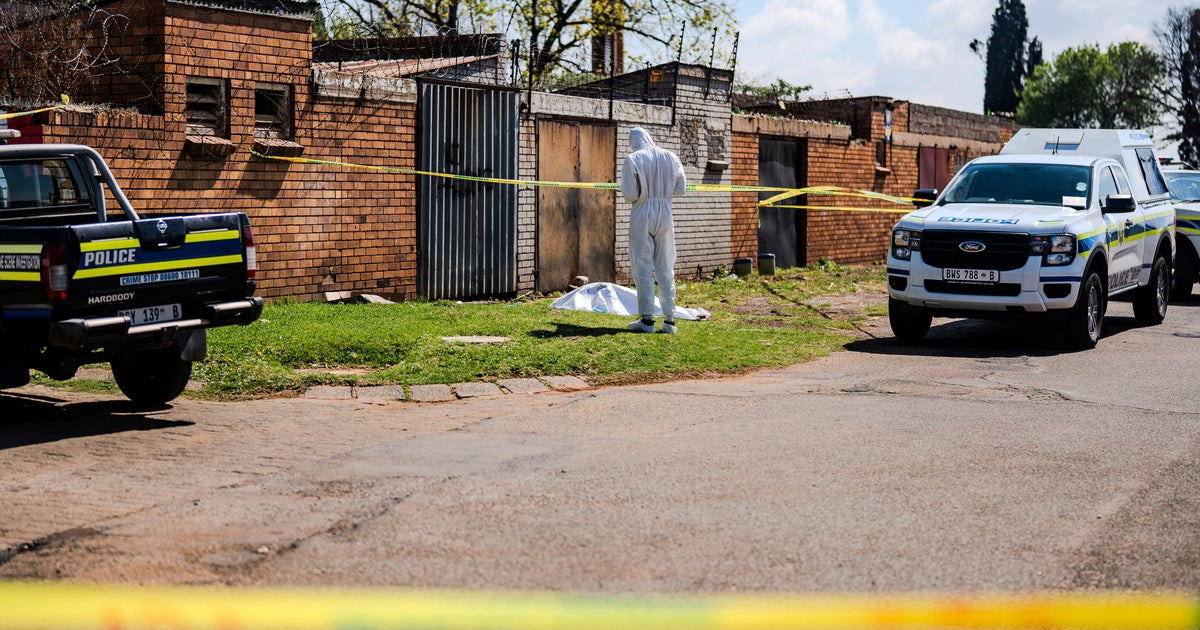
A woman’s body was found on Tuesday in the same area east of Johannesburg in South Africa where the discovery of several other victims in the past two months has sparked fear of a potential serial killer at large and led to a public warning by the police.
According to South African authorities, the cases appear to be linked, although they did not confirm whether they are the work of the same killer.
The South African Police Services (SAPS) has issued a public warning for women to be cautious when doing activities like jogging in the area.
“While investigations are still underway and SAPS has not, at this stage, confirmed that the deaths are linked to a serial killer, the similarities are sufficiently concerning for the police to issue a public warning and intensify investigations,” said police spokesperson Athlenda Mathe.
President Cyril Ramaphosa said on Tuesday that he had directed police authorities to prioritize the ongoing murder investigations.
“I have directed that these cases be prioritized and that no stone be left unturned in bringing those responsible to justice. Our law enforcement agencies are undertaking this work in partnership with citizens, on whom we depend for any information that may help end these attacks on women,” he said in a statement.
The police alert followed the discovery on Tuesday of a body in the Kwa-Thema area, about 34 kilometers (21 miles) from Kempton Park.
Police said the victim was found fully naked and in an advanced stage of decomposition.
On Monday, another body was found in Olifantsontein.
On Saturday, the body of a 38-year-old woman was after she went missing in Kempton Park last week while jogging. A frantic community and police search for Elizabeth “Tsontso” Moselakgomo ended when her half-naked body was found.
Moselakgomo’s disappearance drew public attention after fellow runners launched a social media campaign to find her, which led to the discovery of more bodies.
Acting police minister Firoz Cachalia described the discovery of the bodies as “deeply disturbing.”
“While the investigation must establish whether these cases are linked, the possibility that a perpetrator or perpetrators may be targeting women demands our urgent and determined attention,” Cachalia said in a statement. “A multidisciplinary investigation has been established to examine possible links between the cases, identify those responsible and bring them to justice.”
Gender-based violence in South Africa
The public warning has highlighted long-standing concerns over violent crime in South Africa, particularly against women and children.
The country recorded 5,427 murders between April and July — an average of 45 a day — according to the latest crime statistics.
Femicide rates in South Africa are among the highest in the world, according to the U.N.’s agency for gender equality. Last year, the government has declared gender-based violence and femicide a national disaster, according to the U.N.
A 2024 study in South Africa revealed that three women were killed every day by an intimate partner from 2020-2021. A study in 2022 found that more than 35% of South African adult women had experienced physical or sexual violence at some point.
Amnesty International South Africa said the discovery of the bodies was “just another horrific reminder that women in South Africa are not safe.”
The Commission for Gender Equality has called for urgent preventive action, including a safety audit of the affected areas involving police, municipal officials, transport authorities and community safety structures.
It said the audit should assess lighting, surveillance, pedestrian and public transport routes, neglected spaces, police visibility and access to emergency assistance.
“Women should not have to be killed before an area receives heightened attention,” commission spokesperson Javu Baloyi said.
Agence France-Presse
contributed to this report.
In: