
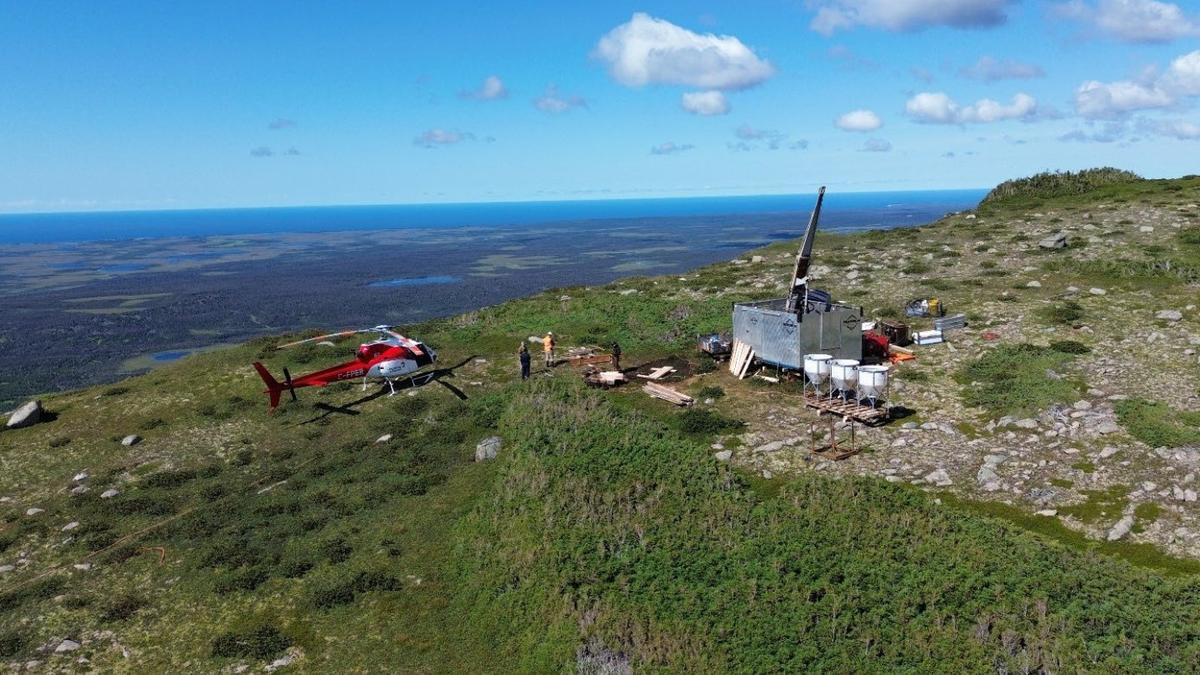
Infini Resources has fired up the drill rig for a significant 5000-metre diamond drilling campaign at its Portland Creek uranium project in Newfoundland, Canada, marking the start of the most extensive exploration program ever undertaken at site.
The current program, which has been expanded fivefold, will include the first-ever drill test of the demagnetised granite, believed to lie beneath the rock scree slope at the Falls Lake prospect. It is an enticing target, given previous soil sampling in the area returned a stunning peak result of 7.5 per cent uranium oxide. That work defined a high-grade surface anomaly stretching some 800m by 100m.
The phase three program represents a substantial test of what the company believes is a district-scale, underexplored hydrothermal uranium system. It follows a suite of modern exploration work, including airborne magnetic, electromagnetic and radiometric surveys, field mapping and a detailed reinterpretation of all available data.
Infini’s exploration model at Portland Creek is centred on a structurally controlled, granite-hosted system. The company’s geologists have used high-resolution magnetic data to identify linear zones where the host granite has been altered by oxidising hydrothermal fluids, a process often conducive to the deposition of uranium.
Infini’s 5310m of phase two drilling has already confirmed the geological model, intersecting fracture-controlled uraninite mineralisation associated with chlorite and hematite alteration.
The drill targets have been carefully selected to test areas where multiple datasets converge. Specifically, the company is targeting zones where interpreted structural intersections coincide with magnetic alteration footprints and known uranium anomalism from surface sampling and radiometric surveys.
In parallel with the drilling, a 1000m trenching program continues to expose bedrock for structural mapping and radiometric assessment, which should help further sharpen drill targeting on the fly.
Our 2026 airborne surveys, field program and reinterpretation of the project’s combined datasets have transformed Portland Creek from a scattering of uranium occurrences into a coherent, district-scale target set with defined geometry at depth and we are now drilling it.
Infini’s 329-square-kilometre Portland Creek project covers a large regional uranium anomaly that was first identified by a government lake sediment sampling program in the 1970’s. Subsequent work has delineated a six-kilometre zone of anomalous uranium and radon gas in lake sediments, soils and airborne radiometric data.
Meanwhile in Saskatchewan, the company has wrapped up the first-ever diamond drilling program at its Reynolds Lake and Reitenbach Lake uranium projects along the margin of the world-class Athabasca Basin. The maiden 16-hole campaign totalled 3314m and was designed to provide the first subsurface test of the project’s uranium potential, with assays pending.
The Canadian push sits against a robust uranium backdrop supported by reactor life extensions, new nuclear builds and rising interest in reliable power as electricity demand grows. Western energy-security concerns are also focusing attention on politically aligned nuclear-fuel supplies, adding strategic weight to successful Canadian exploration.
With the drill bit now turning on its most ambitious program to date, Infini is looking to see if the compelling surface evidence translates into a significant discovery lurking at depth. Given the spectacular grades unearthed at surface and a systematic approach to targeting, punters will likely be laser-focused on the first batch of assays from the lab.
Is your ASX-listed company doing something interesting? Contact: [email protected]
Get the latest news from thewest.com.au in your inbox.
Sign up for our emails