
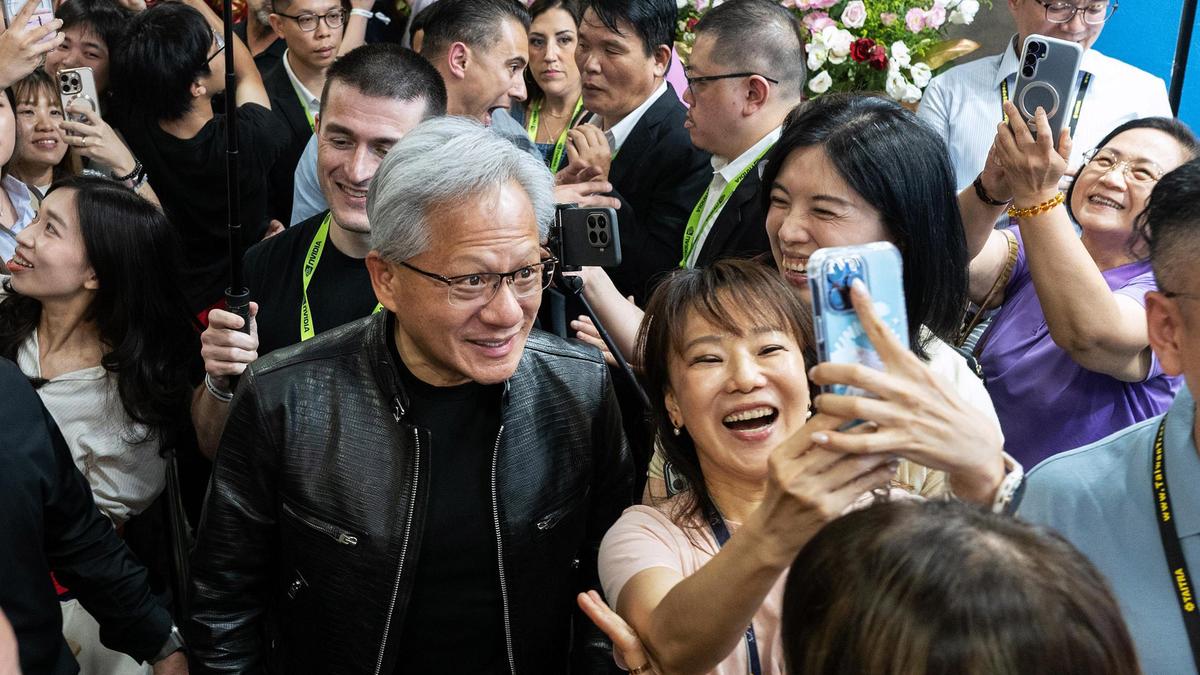
For a few days in June, Taipei, the Taiwanese capital, succumbs to a kind of fever. Hundreds of people throng outside restaurants in the sweltering heat after hearing rumours that Jensen Huang will be dining there. Every few minutes a passing black car prompts a flutter of excitement. Perhaps he is inside.
The boss of Nvidia, the world’s most valuable company, comes back to his native Taiwan every summer for Computex, Asia’s biggest computer-hardware conference. During his stay he will typically peel off to eat at street stalls, walk around and chat to people.
One evening this year he moved amiably through the Raohe night market, sampling matcha desserts and joking with the owners of a grilled-corn stand that he’d buy dinner for everyone in the queue if they’d let him skip to the front.
Crowds of Taiwanese fans followed in his wake, hoping for a selfie, an autograph or an exchange of banter. Later that night Mr Huang wrote “Jensen was here” on the tiles of a restaurant toilet. Straight away a queue formed: people wanted to photograph the precious piece of Jensenalia.
On another evening Mr Huang went to a restaurant with the bosses of some South Korean technology companies. As he stepped out of the car, a crowd surged forward, phones aloft; his security detail struggled to contain the crush.
The technology executives looked bewildered, as though they had accidentally wandered into the wrong event. Mr Huang, by contrast, seemed entirely at ease. He smiled, waved and posed for the cameras before disappearing inside. “His skin is so smooth,” a fan next to me sighed. Some people in the crowd had T-shirts and key rings with Mr Huang’s face on them, which were doing a roaring trade at the convention centre.
His skin is so smooth, a fan next to me sighed.
In the AI gold rush, Mr Huang is the man with the shovels. Nvidia, the company he co-founded, designs and sells the ultra-powerful chips which provide about two-thirds of the world’s AI computing power. Bosses of the world’s biggest technology firms and governments racing to build their own domestic AI infrastructure court him to get their hands on Nvidia’s coveted processors. The markets are in thrall to him: a passing compliment from the leather-jacketed Nvidia boss can send a company’s shares soaring.
Yet that alone does not explain the mania Mr Huang excites in Taipei. Mark Zuckerberg and Sam Altman are powerful technology bosses, but it’s hard to imagine Americans queuing for a glimpse of either, or buying T-shirts featuring their faces (Mr Zuckerberg once described Mr Huang as “like Taylor Swift, but for tech”).
Jensanity, as the fervour is known in Taiwan, is partly local-hero worship. Mr Huang, who was born on the island before emigrating to America, is Taiwan’s greatest business success story. He has also done matchless international PR for the island’s electronics industry, calling it the “epicentre” of the AI revolution. Most of the world’s advanced computer chips are made by one Taiwanese firm, the Taiwan Semiconductor Manufacturing Company (TSMC).
Politicians on the island, which only a handful of governments recognise as a sovereign country, hope its critical role in the AI boom will give it a measure of soft power. This is sorely needed: increasingly assertive behaviour from China means that Taiwan’s security rests, to a large extent, on the willingness of others to defend it — especially America.
Mr Huang hasn’t just raised Taiwan’s profile; he has also made many Taiwanese a lot richer. “Jensen has been great for my portfolio,” one young engineer waiting for a glimpse of him outside a restaurant told me.
The TAIEX — the island’s benchmark stock index — has risen by 90 per cent over the past year, making it the fifth-largest stock market in the world. Much of that increase reflects the extraordinary rise of TSMC, which manufactures chips for Nvidia. Since 2023 the Taiwanese firm’s market value has increased more than fivefold, to around $US2 trillion ($2.8t) and dozens of its local suppliers have prospered alongside it.
But, as I observed over three days shadowing him. Jensanity is also stoked by the Nvidia boss himself. Unlike other Silicon Valley heavyweights, Mr Huang goes out of his way to court the public. One evening in Taipei, while dining in a restaurant with his parents, he emerged carrying trays of steamed buns for the journalists waiting outside.
The public persona is useful to his business. Analysts told me Mr Huang’s rockstar status makes Taiwanese manufacturers eager to work with him, hoping his stardust will rub off on them. That gives Nvidia an advantage when AI supply chains are tight and chip companies are chasing manufacturers, rather than the other way round.
After this year’s Computex Mr Huang flew straight to Seoul, where he wooed the bosses of South Korean memory-chip companies over beer and fried chicken, and was filmed by a local TV channel dancing — a little awkwardly — to K-pop. Not for nothing have the Taiwanese given him the affectionate nickname, “the People’s Dad”.
When I first attended hardware conferences like Computex nearly two decades ago, as a chip designer, they were dull affairs. Socially awkward engineers gathered to inspect server racks, debate thermal specifications and negotiate component prices. Journalists were interested in Microsoft and Google, and the Taiwanese chipmakers that powered the big tech companies’ gadgets remained largely invisible outside the industry.
So far, Huang has kept the intricate supply chain humming. But other challenges are mounting.
But training frontier AI models requires a staggering amount of computing infrastructure, and in the past few years hardware-makers have been thrust into the limelight. The buzz at Computex was palpable, not just owing to the drones flying through the conference centre.
Instead of the desultory exhibition stands I remembered, there were giant, neon-lit pavilions. Humanoid robots wandered the aisles, as exhibitors handed out tote bags and bubble tea. Computex now has a headline act. The queue to get into the main conference hall for Mr Huang’s speech began hours beforehand, and stretched thousands-deep.
When he finally appeared on stage in his trademark black-leather jacket, the hall erupted. Mr Huang began by thanking his suppliers and partners in Taiwan, and logos of the usual electronics manufacturers flashed up on the screen behind him, suggesting they were going to get a shout-out. The first “supplier” he name-checked, however, was a fruit seller at the Tonghua night market. A local dumpling shop came next, followed by a succession of other eateries. The audience lapped it up.
Mr Huang’s journey to the centre-stage of the global economy was an unconventional one. Born in Taiwan in 1963, he was sent to America at the age of nine together with his older brother to live with their uncle. The uncle, mistaking a reform school in Kentucky for an elite boarding school, enrolled them there by accident. Mr Huang slept in a dormitory and was expected to clean its toilets, but was too young to go to any classes there. Instead he studied at the local school, where the other children bullied him for his accent and called him a “chink”. Mr Huang has credited those years with toughening him up.
Two years after the boys arrived in America, their parents flew out to join them and the family settled in Oregon, where he studied electrical engineering before heading south to Silicon Valley. He founded Nvidia in 1993 with two fellow engineers. The chips that would make Nvidia famous, graphics processing units (GPUs), were then a product used mainly for video games, and the market was crowded. Nvidia became dominant by designing better chips and, crucially, getting them to market first.
By the mid-2010s, Mr Huang had become convinced that AI would transform computing and that GPUs, whose ability to perform many calculations simultaneously made them well suited to AI models, would become its essential building blocks. For years that was an unorthodox position to take.
AI was always touted as the next big thing, but its moment never quite seemed to arrive. In November 2022, OpenAI, a modelmaker, released ChatGPT. Demand for Nvidia’s chips, on which ChatGPT was trained, exploded. Nvidia’s market value climbed from $US340b to $US5t in just three years.
Steve Bannon has called Huang an agent of influence for the Chinese Communist Party
The company’s success rests on more than clever chip design: it’s also dependent on the ability to manage relationships with supply-chain partners, and the political environment which affects them all. Heroes of software companies are often portrayed as lone geniuses, but hardware-making is an inherently collaborative project. Nvidia’s latest product, Vera Rubin NVL72, is a complete AI supercomputer for training and running large AI models. It contains 1.3 million components, more than 1000 chips and the software needed to harness them. Building one requires hundreds of suppliers, manufacturers and software companies to work together.
The AI boom has led to a scramble for those components, and a big part of Mr Huang’s job is ensuring that suppliers prioritise Nvidia’s orders. Money helps. Nvidia has used its enormous balance-sheet to sign multi-year deals with manufacturers. He also needs his suppliers to make more. Analysts believe Mr Huang has pushed back several times against TSMC’s caution about investing in new capacity.
So far, he has kept the intricate supply chain humming. But other challenges are mounting, not least the threat of competition from Nvidia’s biggest customers. Alphabet, Amazon, Meta and Microsoft are each seeking to reduce their dependence on Nvidia by developing their own AI chips.
Nvidia’s stock price meanwhile has become a proxy for investor sentiment about how long the AI boom can last, and has dipped several times this year. Mr Huang’s answer is to bind Nvidia even more tightly to the future of AI. Rather than selling only chips, he also wants to provide the infrastructure, software and AI models on which the industry runs.
This strategy will require even more supply-chain diplomacy, and I wasn’t surprised to see Mr Huang schmoozing manufacturing partners in the exhibition hall during his time at the conference. His staff explained that he made a point of visiting suppliers’ booths because his presence draws crowds and gives them publicity.
Shouts of “Jensen! Jensen!” echoed through the hall as he made his way from stand to stand to chat to engineers and executives, high-fiving people along the way. Only late in the afternoon did he seem to tire, sitting cross-legged on the floor of a booth to share a beer with a Taiwanese executive. Hundreds of fans crowded round to capture the moment on their phones.
After his keynote speech I sat down with Mr Huang in a private room in the conference hall. By then he had shed his leather jacket for a navy cotton one. Outside, his staff and security were bustling about, but their boss seemed calm and relaxed.
When I explained that I wanted to understand him rather than Nvidia, he looked faintly embarrassed. He was uncomfortable talking about himself, he said, and apologised in advance if he did a poor job of answering my questions. On stage he’s an exuberant performer, but in private conversation he almost whispers, speaking in slow, measured sentences.
I asked how his life had changed since the launch of ChatGPT. Silicon Valley lore is full of founders who become celebrities overnight. Jensen Huang’s rise has been about three decades in the making, which may have made the transition to superstardom even stranger when it finally came. Nothing, he insisted, had really changed. He dressed the same way and, as he put it, still “puts his pants on one leg at a time”.
Analysts told me Huang’s rock-star status makes Taiwanese manufacturers eager to work with him
The CEO hasn’t just had to get used to being famous; he has also found himself at the centre of a geopolitical contest between America and China. Since October 2022 the American government has been trying to stop its adversary from obtaining advanced computer chips. Nvidia’s suppliers in Taiwan, meanwhile, live under the growing threat of military action by China. Mr Huang suddenly found he needed to build rapport with world leaders, not least Donald Trump, whom he has lobbied to relax restrictions on chip exports.
Hanging out with politicians doesn’t come naturally to him, he said. He has nonetheless proved adept at translating his goals into language that appeals to them. He recasts data centres as “AI factories” — a term that appeals to Trump’s enthusiasm for manufacturing. To foreign governments wary of relying on American companies, he has offered “sovereign AI” — national infrastructure built around local values, and largely powered by Nvidia.
In May he demonstrated his knack for diplomacy when he joined Trump on a trip to China for a summit with President Xi Jinping. Mr Huang appears to have been a last-minute addition to the entourage — many were surprised when Donald Trump announced on Truth Social that “the Great Jensen Huang” was on board Air Force One. In Beijing Mr Huang met Chinese officials and accepted a seat on the advisory board of Tsinghua University, one of China’s most prestigious institutions.
China hawks are suspicious. Steve Bannon, a former White House chief strategist, called Mr Huang an “agent of influence” for the Chinese Communist Party and demanded his arrest. Elizabeth Warren, a Democratic senator from Massachusetts, has said that Mr Huang’s lobbying for the sale of advanced AI chips to China could “turbocharge China’s military and undercut American technological leadership”.
Yet, oddly, for a supposed China-appeaser, Mr Huang has acted as a public booster for Taiwan. He says Taiwan made Nvidia possible and calls it his “business home”. Nvidia is building one of its largest offices outside America in Taipei and plans to invest around $US150b every year.
The balancing act doesn’t always go smoothly — in 2024 Mr Huang angered China by describing Taiwan as “one of the most important countries in the world” (he was forced to clarify that he had been praising the island’s electronics industry rather than recognising Taiwan as a state). Being an AI hardware titan in today’s world, he told me wryly at Computex, is “the biggest communications job ever”.
Mr Huang doesn’t rely on charm alone to get suppliers to do what he wants. According to Rick Tsai, a former boss of TSMC, who has worked with him for decades, he is also “hard driving” and “relentless”. Mr Tsai calls the CEO’s approach to the supplier relationship “rough justice”: an understanding that sometimes one side is right, sometimes they are wrong, but over the long term, the wins and losses roughly balance out.
Huang hasn’t just raised Taiwan’s profile; he has also made many Taiwanese richer
This same brand of rough justice appears to govern life inside Nvidia. Employees say Mr Huang has little patience for excuses and is known to challenge people when something is not working. Around 60 people report directly to him, an unusually high number for a chief executive. He gives feedback immediately and publicly, reasoning that the entire room can learn from the bruising.
I occasionally saw traces of the unfiltered style. At a press conference, Mr Huang rebuked a staffer who moved too quickly to snatch a microphone from an analyst. When a BBC reporter asked about the geopolitical risks facing Taiwan, Mr Huang initially offered a well-rehearsed answer. When the reporter continued to press him he joked that someone should help the BBC come up with a new question. The audience laughed, but the speaker’s annoyance was evident.
Rev Lebaredian, an engineer who has worked at Nvidia for more than two decades and is now a vice-president there, said that Mr Huang’s executive team meetings would look “miserable” to an outsider. All the talk is about problems and things that are failing; good news is rarely discussed.
Yet according to Mr Lebaredian, Mr Huang has created a culture where employees know that although their mistakes will be called out, they will not be punished for making them.
Nvidia’s senior leadership team has remained stable over the past two decades, a rarity in the industry. They have also been well rewarded. Mr Huang likes to boast that he has created more billionaire executives than “any CEO in the world”. Rank-and-file employees have not done badly, either.
When I asked Mr Huang what drove him, he didn’t speak about colonising other planets, defeating death or remaking humanity. Elon Musk was a friend, he noted wryly, but they had different goals.
His, he said, were simpler: he wanted his employees and partners to do well. “Maybe,” he said with a smile, “I’m just not sufficiently ambitious.”
Originally published as How Jensen Huang became AI’s Taylor Swift
Get the latest news from thewest.com.au in your inbox.
Sign up for our emails