
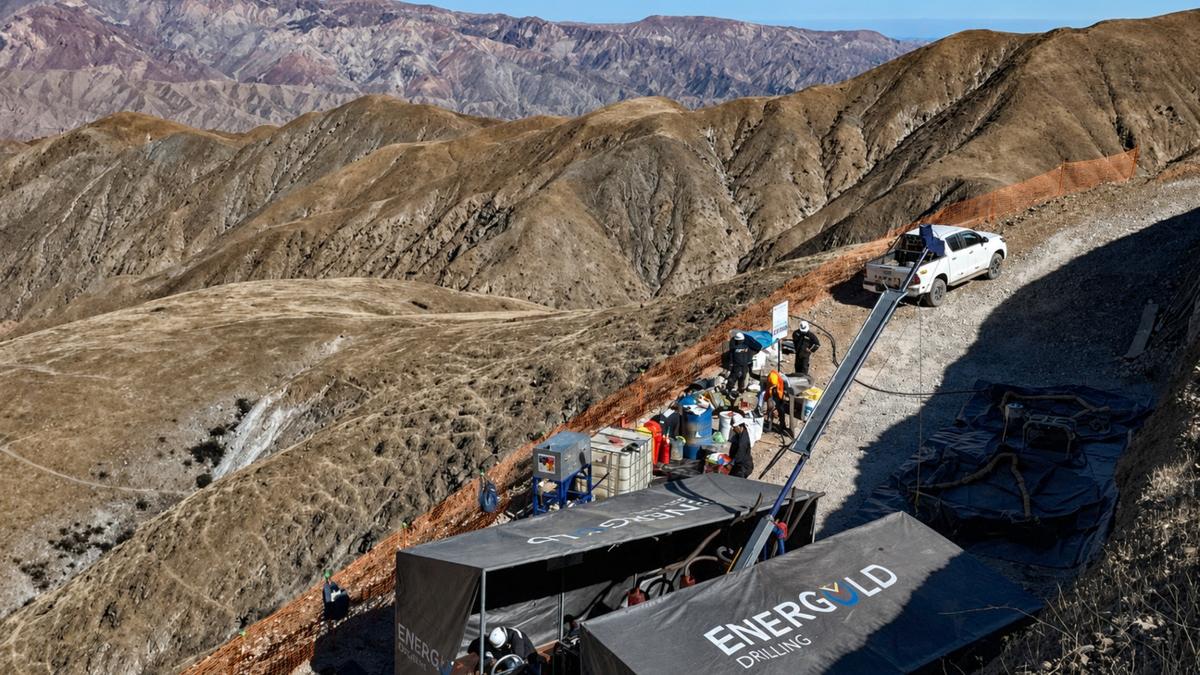
Solis Minerals has kicked off a maiden diamond drilling campaign at its 100 per cent-owned Cinto copper project in southern Peru. The rods are now turning on a program designed to test a string of compelling porphyry copper targets featuring rich surface geochem, including an eye-catching surface sample that clocked a massive 8.7 per cent copper.
The initial phase will see five holes drilled to a depth of 2500 metres, targeting coincident geochemical and geophysical anomalies identified by the company’s groundwork.
Some impressive surface chemistry backs the targets. Historical rock chip and grab sampling conducted over old artisanal workings across a 200m by 100m area lit up with hefty grades, including 7.14, 3.52, 3.23, and 2.34 per cent copper. Follow-up mapping and channel sampling in 2024 then extended the mineralised copper zones several hundred metres to the east.
Highlights from the 2024 program included a solid 23.4-metre intersection grading 0.88 per cent copper and another 16.8-metre interval running at 0.52 per cent copper. The second hit also included a higher-grade zone of 2.2m going 5.8 per cent copper, featuring an impressive 1.1-metre slice of 8.7 per cent copper, 0.535 grams per tonne (g/t) gold, 25g/t silver, 283 parts per million (ppm) lead, 873ppm zinc and 1ppm molybdenum.
In 2025, follow-up channel sampling demonstrated the potential scale of the system, bagging 26.5m at 0.28 per cent copper, including a richer core of 5.4m at one per cent copper.
Solis’ recent work also identified a prominent sub-circular induced polarisation chargeability anomaly measuring a kilometre in diameter in the northwest of the area. According to the company, this finding shows all the hallmarks of a sulphide-rich porphyry lurking below – the potential engine room for a significant mineralised system.
The project’s location is arguably as compelling as its geology. Cinto sits on the prolific Incapuquio fault zone, a major geological structure that plays host to a string of world-class copper mines. The neighbourhood includes Anglo American and Mitsubishi’s 1.1-billion-tonne Quellaveco copper mine grading 0.55 per cent copper, Southern Peru Copper Corp’s 1.2-billion-tonne mine at 0.48 per cent Cuajone copper operation and Freeport-McMoRan’s Cerro Verde mine, which produces a whopping 450,000 tonnes of copper per annum.
Peru is the continent’s second-largest copper producer and is renowned elephant country for the kind of giant porphyry deposits that Solis is now hunting for at Cinto.
The company says its maiden drill campaign is the culmination of exploration that has built a strong case for a porphyry system at depth. Management’s interpretation is that the high-grade, copper-mineralised breccias seen at surface could be the higher, more distal expressions of a larger intrusive system hiding below.
We have commenced diamond drilling at Cinto following the successful mobilisation of our team and equipment to site. The project area has excellent copper porphyry potential with abundant outcropping breccia-style copper mineralisation, geophysical targets, proximity to globally significant copper mines and regional infrastructure.
The drilling strategy has been designed to probe the three best anomalies. The first hole is now underway, with a second planned from the same pad to target a broad IP chargeability anomaly to the south.
A third proposed hole will be directed towards the area under the high-grade channel samples and into a one-kilometre-diameter sub-circular chargeability anomaly that the company has identified as a possible porphyry nucleus. With 11 drill pads already permitted, Solis says it has the flexibility to quickly expand the program if the first three holes hit their mark.
While the drill rods are turning in Peru, Solis is also advancing its wholly owned Mandacaru lithium project in Brazil, with four diamond drill holes now completed to a depth of 200m each, a fifth nearly finished and a sixth hole to follow.
Encouragingly, results have confirmed that mapped surface pegmatites also extend below the surface. Solis says the initial holes intersected wide pegmatites from relatively shallow depths of between 30m and 40m, providing early encouragement. The company expects to release an update from the project, including assay results, in September this year.
With the truth detector now drilling in one of the world’s premier copper jurisdictions, Solis is not sitting on its hands. The combination of high-grade copper at surface, a textbook geophysical anomaly and an address in genuine elephant country makes the Cinto project one to watch.
The market will now be keenly awaiting the assay results from Mandacaru and to see if Cinto’s smoke at surface leads to a porphyry fire at depth.
Is your ASX-listed company doing something interesting? Contact: [email protected]
Get the latest news from thewest.com.au in your inbox.
Sign up for our emails