
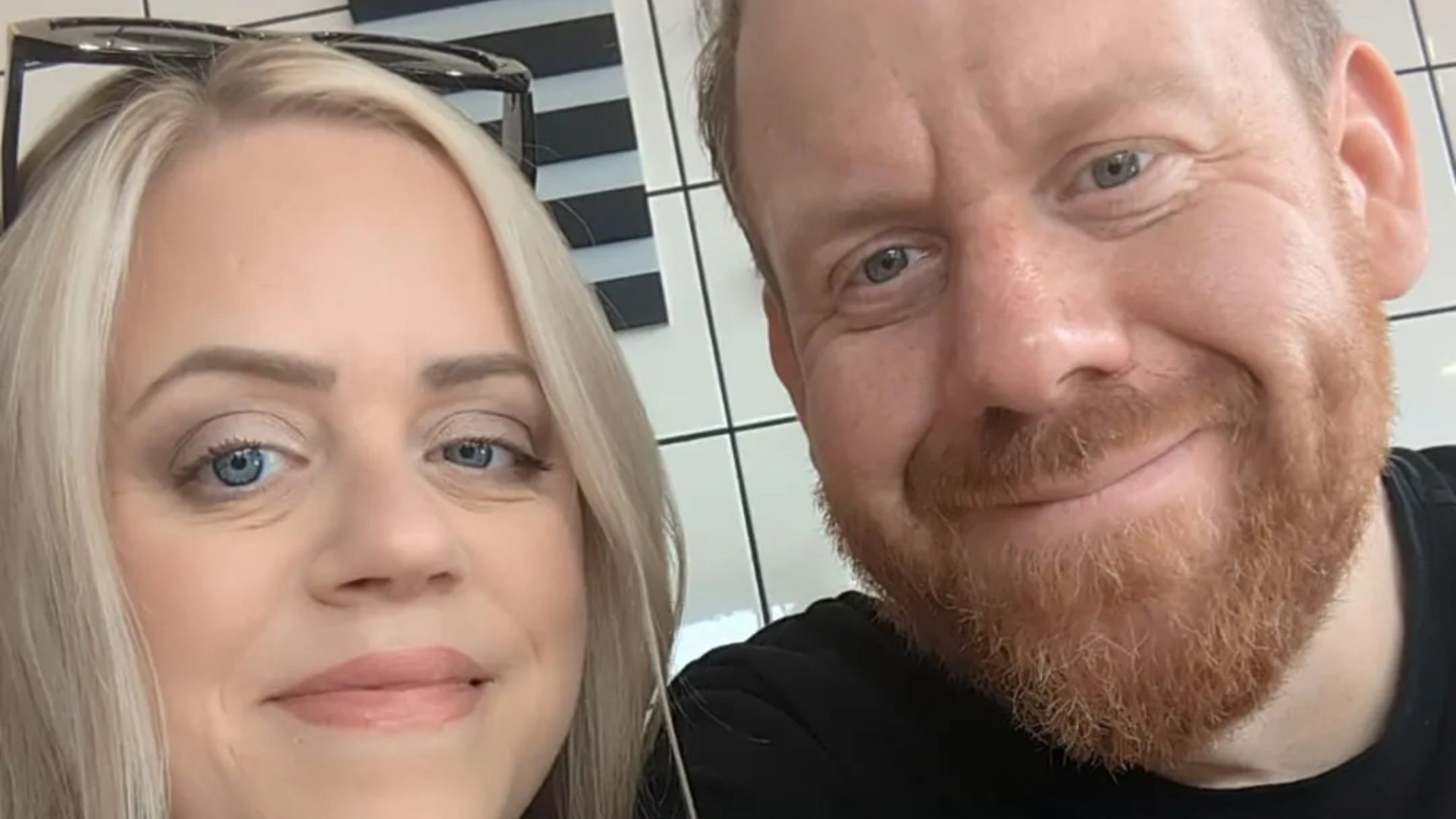
WHEN Paul Lucas lost his penis to cancer he feared his marriage was over.
Paul, now 40, was told he had penile cancer at just 37, and at the time his biggest fear was losing his life.
10
10
The 40-year-old, from Dudley, never imagined he would lose what he believed defined him as a man.
Paul, a local government officer, initially noticed his urine stream had changed in June 2022 before discovering a cauliflower-shaped growth beneath his foreskin.
Then came a foul-smelling discharge, which Paul compared to ‘gone-off fish,’ as well as severe pain.
Terrified, he initially tried to hide the problem and even bought medication online, hoping it was a fungal infection.
Read More of Real Lives
MOUNJARO MOJO
My partner lost 6 stone in 9 months on fat jabs… his penis grew by 2.5 inches
IRON MANHOOD
Record number of men having ‘willy’ surgery on NHS to beat erectile problems
10
10
But his wife Nicky, 38, refused to let him ignore it.
She booked him a GP appointment and, as Paul puts it, ‘marched him into the doctor’s’ in August 2022.
“I tried to back out, but I was more scared of Nicky than whatever the GP would say,” admits Paul.
The GP examined photographs Nicky had taken and asked a colleague for advice.
Most read in Fabulous
MYSTIC MEG
Single? Be less direct and allow yourself to be seduced
MUM’S SHOCK
I’m on child-abuse registry for letting son, 5, do something ‘lots of kids do’
GARDENING GLEE
Eight of the top trends spotted at ‘Disneyland for horticulturalists’ show
POINTLESS PURCHASE
Dunelm shopper left baffled by confusing sticker on wood chopping board
Then came the word Paul feared most, it was indeed cancer.
He was rapidly referred to a urologist in Wolverhampton before being sent to a specialist penile cancer team at Good Hope Hospital.
“I was terrified at the word cancer, and I thought that was the end of me,” he explains.
“I knew nothing about penile cancer at this point, and the treatment sounded horrendous, especially after finding out I could lose some of my penis.”
Doctors warned him that the cancer was fast-growing and invasive, but initially Paul believed there was a chance surgeons could simply remove the growth.
He had read online that a total penectomy, the complete removal of the penis, was rare.
“I didn’t think it would happen to me,” says Paul.
“At the time I remember thinking that they would cut the ‘head’ of my penis off, as that’s where the growth was.
10
10
“It was causing me incredible amounts of pain and discomfort, so I was in a way happy I wouldn’t be in pain.”
But in the days before surgery, he was terrified.
He and Nicky tried to keep themselves occupied by going on walks with alpacas and shopping for little bits and pieces for Christmas.
Then on 7 October, 2022 came the moment Paul says he will never forget.
He kissed Nicky goodbye in the car park at Solihull Hospital, knowing that when he next saw her, he would literally be a different man.
“I was scared,” admits Paul.
“We were newly married, and the lack of information about penile cancer made this worse as all I was seeing was how aggressive the cancer can be.”
Paul wasn’t officially told until 24 hours after surgery that his entire penis had been removed.
But he already suspected what had happened.
“I was aware from the pulling of my catheter tube what had happened, but I didn’t want to ask,” he says.
“Ignorance is bliss.”
He was physically drained but relieved to be alive and reunited with Nicky.
10
10
But he couldn’t bring himself to look at what had happened to his body.
“I was too ashamed and disgusted to look at it,” admits Paul.
On his second night out of hospital, Nicky had to change his bandage.
It was the first time Paul saw his body.
“I hid my face under a pillow and just cried,” he says.
“I asked her to leave me if she wished, without guilt, as she had a life to live and I was now a d*ckless man and felt useless.”
But Nicky didn’t leave.
Instead, she helped him wash, changed his dressings and catheter, and accompanied him to appointment after appointment.
10
10
Paul says the operation didn’t destroy their marriage, but he struggled enormously with the belief that it had destroyed his wife’s sex life.
“I felt a large amount of guilt as she was in a sexless relationship and I couldn’t see a way out or forward,” explains Paul.
“Reconstruction seemed like a fairy tale and not something that happens to normal people that lived in the West Midlands.”
The surgery also changed everyday life.
His urethra was rerouted, meaning he had to sit down to urinate, while using men’s toilets became a major practical challenge.
“Many are dirty, there’s no toilet paper, not many toilet stalls and the locks don’t work,” he says.
And psychologically, Paul was struggling.
Eventually, he sought therapy.
He credits it, alongside Nicky’s support, with helping him accept his new reality.
Then on 17 July, 2023 came the call he had been desperately waiting for: Paul was cancer-free.
Paul considers himself ‘lucky in an unlucky way.’
Thankfully, he didn’t need any further cancer treatment after the surgery.
Penile cancer – everything you need to know
Penile cancer is a rare cancer that mostly affects the skin of the penis and the foreskin.
It’s most common in men over the age of 50, but anyone with a penis can get penile cancer.
The most common symptoms are:
- a growth, lump or sore that doesn’t heal within four weeks
- a rash
- bleeding from your penis or under your foreskin
- a smelly discharge
- difficulty pulling back your foreskin
- a change in the colour of the skin of your penis or foreskin
Other symptoms of penile cancer may include:
- a lump in your groin
- feeling tired
- tummy pain
- losing weight without trying
Some of these symptoms are very common and can be caused by other conditions.
having the symptoms doesn’t definitely mean you have penile cancer, but it’s important to get them checked by a GP.
If your symptoms are caused by cancer, finding it early may mean it’s easier to treat.
So always get these symptoms checked out by your GP.
Roughly half of all penile cancers are caused by human papillomavirus (HPV).
You cannot always prevent penile cancer, but you may be able to lower your changes of getting it:
- protect yourself from getting HPV by getting the HPV vaccination if you can
- use condoms when having any kind of sex, to lower your chances of getting HPV
- stop smoking
- have a circumcision if you have phimosis and this is recommended to treat it
Penile cancer prognosis is generally good for early-stage disease, with high survival rates, but worsens significantly if the cancer has spread to lymph nodes or distant organs.
Source: NHS
But he still had to come to terms with what he had lost.
Then doctors gave him something he initially thought sounded impossible. Reconstruction.
Paul was told there were options for creating a new penis, but the idea seemed ‘so far-fetched’ that he never really believed it would happen.
When his doctor explained the procedure to him and Nicky, Paul says it sounded like something from ‘Star Trek.’
There was just one problem, he needed to lose almost seven stone before he could undergo the operation.
“I hadn’t been that weight since school, so it felt even more unachievable,” he says.
But at the beginning of 2025, with life finally beginning to settle down, Paul decided it was now or never.
Even then, he wasn’t sure whether reconstruction was the right decision.
He had become more confident and feared putting himself through another major operation just as life was becoming ‘normal.’
But one thought ultimately convinced him.
“In 10 years I didn’t want to look back and think… what if?” says Paul.
Paul opted for a complex three-stage reconstruction.
The first stage involved creating the new phallus and urethra, the second will involve creating the glans and sculpting it to look more realistic, and the third will involve fitting an inflatable erectile device.
For Paul’s first operation, surgeons used a technique known as a radial forearm flap phalloplasty.
Skin and tissue from his left forearm were used to create the new phallus, while another section was used to create a new urethra, what Paul describes as a ‘tube within a tube.’
Surgeons also took nerves and an artery from his arm and connected them to remaining nerves and blood vessels in the genital area.
And because Paul had lost so much weight, there was an unexpected bonus.
Excess skin from his stomach was used to reconstruct his forearm, effectively giving him what he jokingly calls a ‘bonus tummy tuck.’
His first reconstruction operation was performed on 27 March 2026 at University College Hospital, Westmoreland Street, and took around nine hours.
The recovery was long and nerve-racking.
Nurses repeatedly checked the blood flow to Paul’s new phallus with a Doppler machine, while for the first two weeks it had to be propped up at a 45-degree angle to help blood flow.
Paul says he became convinced that its weight would somehow make it ‘fall off.’
“I often held my breath during this time,” says Paul.
“Getting dressed and showering, I would often get very light-headed to the point where I felt I would pass out.”
Thankfully, he experienced only minor setbacks, including small infections.
But when he finally got to properly see and feel his new body, Paul had a rather unusual comparison.
“It looks like an anteater’s nose,” he laughs.
“It feels soft and warm to the touch.”
The reconstruction isn’t finished yet.
Paul hopes his final surgery will take place in spring or summer 2027.
For now, sensation is slowly returning.
Paul describes experiencing ‘zaps,’ almost like tiny electric shocks, in his groin and different parts of the new penis as nerves begin growing into the reconstructed tissue.
He hopes eventually to regain erotic sensation.
And remarkably, Paul and Nicky have already had sex using his reconstructed penis.
“My sensation hasn’t returned, and it will take a few years to get a complete erotic feeling, but it was an incredible and very emotional experience the first time we used my new penis to have sex.”
For Paul, it represents far more than the return of his sex life.
“I finally feel happy in my body again and feel attractive for Nicky,” he says.
He says the couple found other ways to be intimate after his penectomy, using different senses and toys.
“In a way my brain became my sexual organ,” he says.
“My brain rewired itself so I was able to get satisfaction not through the usual way of orgasm, but my brain was on fire as we discovered our new way of intimacy.”
Now, Paul says he feels as though he has his future back.
He and Nicky want to make up for the years they lost.
“A penis obviously plays a huge part of that,” he says.
“I cannot wait for all my surgeries to be finished, sensation to return so we can keep having fun and experiment with our new penis.”
But perhaps the biggest change has been in how Paul sees himself.
He once believed that losing his penis meant losing his identity as a man.
Now he sees it differently.
“A total penectomy seems like the end of the world for a man, and I thought that at first,” he says.
“But eventually it made me more considerate, empathetic, and I felt closer to my wife.”
Throughout his cancer diagnosis, the couple has continued to hold on to one another.
“We have literally just held on to each other through the storm,” Paul says.
“I never thought I could love her more, but I do each day.”
And he has one message for other men facing penile cancer.
“I would tell my past self not to doubt yourself and that a man is more than what’s in between your legs and that your wife loves you for you and it’s not just about sex.”
RECOMMENDED STORIES
“Although this experience has been awful, I believe I am a better person, and my relationship with Nicky has never been better.
“Just don’t give in.”