
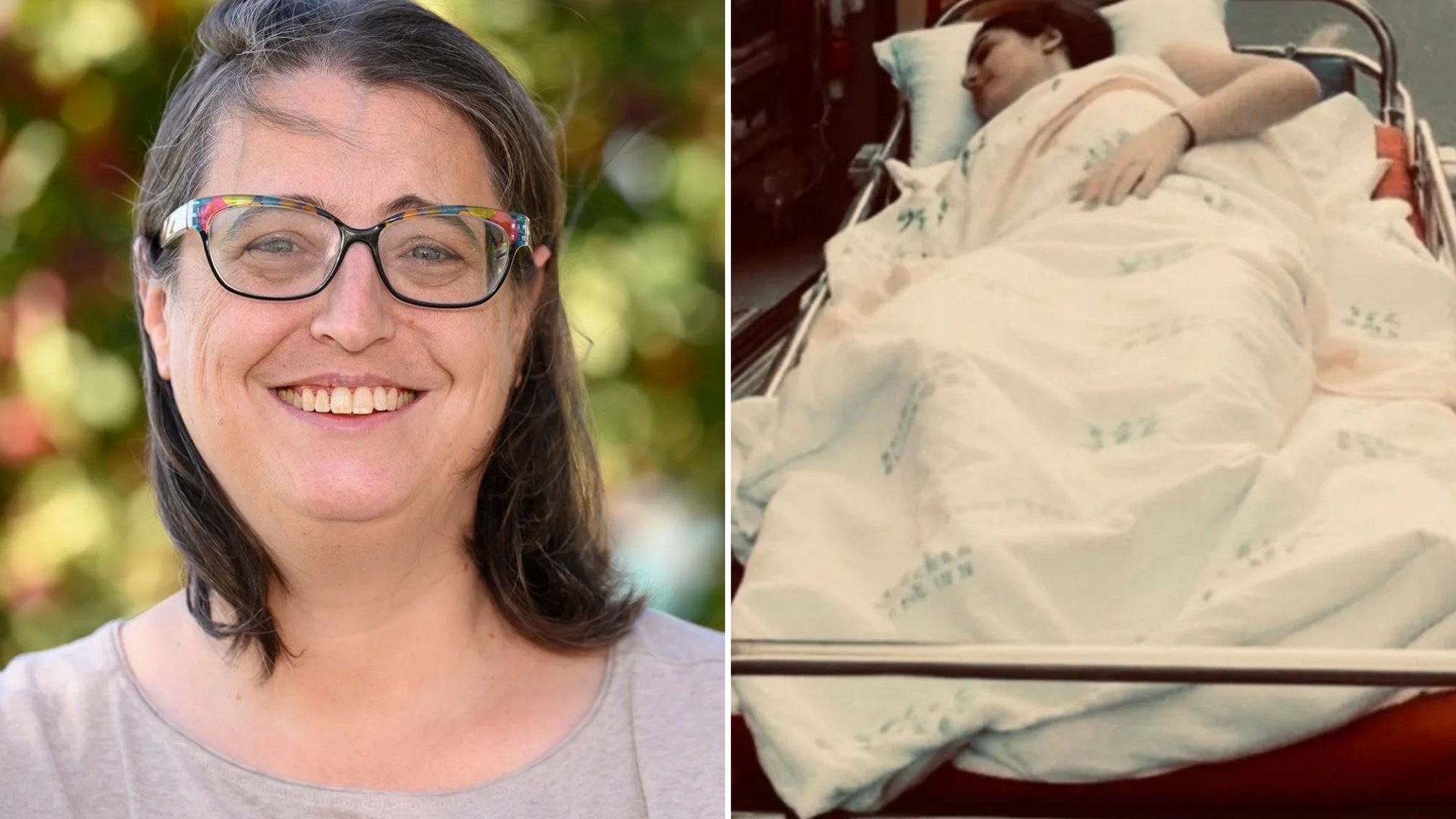
GETTING ready for bed, Cindy Buckshon slips on her breathing mask and settles under the covers.
The mask is a treatment for sleep apnoea, a condition that can cause people to repeatedly stop breathing during the night.
5
5
But Cindy, 49, isn’t using the machine to keep her condition under control – she’s been using it for a far more disturbing reason.
Cindy deliberately contaminated the breathing machine with potentially deadly bacteria in a desperate bid to make herself sick.
The artist from Calgary, Canada, suffers from Munchausen syndrome, also known as Factitious Disorder, and has been deceiving family, friends and doctors into believing she is ill since she was just four years old.
“I spent most of my life pretending to be sick to get attention,” she says. “I’ve faked seizures, fainting spells, stomach cramps and injury. I deliberately planted myself onto concrete just to get red-lighted to hospital and be the centre of attention. It was bliss for me.”
READ MORE REAL LIFE STORIES
SECRET SIBLING
Online DNA test revealed family secret – but revelation about dad floored me
LIFE LESSON
I ‘died’ & met dad then an angel – I was sent back to share one valuable lesson
5
What is Munchausen syndrome?
MUNCHAUSEN syndrome is a psychological condition where someone pretends to be ill or deliberately produces symptoms of illness in themselves.
People with Munchausen syndrome can behave in a number of different ways, including:
- Pretending to have psychological symptoms – for example, claiming to hear voices or claiming to see things that are not really there
- Pretending to have physical symptoms – for example, claiming to have chest pain or a stomach ache
- Actively trying to get ill – such as deliberately infecting a wound by rubbing dirt into it
The condition is complex and poorly understood, though it’s thought it could be brought on by emotional trauma or personality disorders.
Source: NHS
According to the Cleveland Clinic, the condition is rare and often goes undiagnosed so the true number of people with Munchausen syndrome is unknown, but some reports suggest it affects 0.1 per cent of the world population.
Cindy’s battle with the condition started on Christmas Eve 1980, when her mum was suffering from a migraine.
She recalls: “I marvelled at how people fussed over her when she got so poorly, so I sat on the stairs, jealous and angry and started pretending to have severe cramps and flu symptoms. When people asked if I was okay, I felt a warm glow.”
The attention four-year-old Cindy received that night only led her to seek more, so she would deliberately throw herself off the swings at school so she could be treated for cuts and bruises. Her deception continued into secondary school, where she would fake injuries while playing baseball.
Most read in Fabulous
EAST END GIRL
Lacey Turner speaks out on EastEnders cast exodus and her Strictly ‘worries’
MEMBERS ONLY
I thought my marriage was over but my ‘Star Trek’ penis has saved my sex life
MUM’S SHOCK
I’m on child-abuse registry for letting son, 5, do something ‘lots of kids do’
MYSTIC MEG
Single? Be less direct and allow yourself to be seduced
But that wasn’t enough to feed her need for attention, and Cindy quickly realised she would get more if she fainted.
“I’d fall to the floor, and the world would stop,” she says. “Teachers and staff would rush over.
“The attention for being sick was instantly comforting.”
At the age of 15, Cindy hit the ultimate high when she pretened to faint and was rushed to hospital.
5
5
“When the paramedics were yelling for people to get out of the way and I was their focus, I was on an adrenaline high,” she says. “Doctors thought I had a rare condition.”
This gave Cindy the idea of fake fainting, and each time the episodes became even more dramatic, including shaking violently and even urinating on herself.
She says: “I was smashing face first onto concrete steps and paths, leaving me with a shattered nose, scratches, cuts and even concussion. I’d hit the ground so hard I’d bleed or black out, but to me the pain was worth it.”
At 19, after another faked seizure, Cindy was dramatically airlifted to hospital, where she spent seven days being monitored.
She says: “I remember being attached to machines day and night. I wanted that. But I was pretified under 24 hour monitoring the nurses would realise I was pretending and wasting their time while real patients were forced to wait.
“When I got attention and treatment on short visits I felt love and a state of bliss. I knew it was wrong, but I couldn’t stop it.
“I thought my relatives and friends believed me. Years later I learnt many thought I was faking it bit didn’t know what to say. ”
Buzzing from the feeling it gave her, Cindy’s stunts spiralled into something far more dangerous.
“I ate a full jar of Tiger Balm to try and cause a seizure,” she says. “I tried to overdose four times, making sure to call a friend in time to be saved so I’d be taken to hospital and have a ‘charcoal slurry’ to soak up medication I was addicted to doctor-led attention.”
In an attempt to cure herself in her late twenties, Cindy started a job as a bus driver.
She explains: “I knew if I was driving a bus full of people, I’d be able to control my condition and it worked for 12 years.
“The thought of deliberately hurting another person horrified me. It’s why I was safe when I was driving as bonkers as that sounds.”
But following a breakup with a boyfriend, Cindy spiralled was diagnosed at a clinic with bi-polar symptons. This was one af a few times she was genuninly ill.
It was then she asked to see a psychiatrist, came clean about the fake seizures and was diagnosed with Munchausen’s and bipolar disorder.
In 2015, Cindy spent five weeks in hospital followed by outpatient group therapy, but she struggled to keep her condition under control.
She says: “I’d go a year without faking sickness and something would make me want attention.
“If I suffered severe stress or depression it would trigger my Munchausen. I’d make myself ill to to regain control.
“I was in a cycle of staying ‘clean’ from symptoms and then crashing into a spiral of faking it or making myself so sick I actually did need to go to hospital.”
In 2021, Cindy hit rock bottom when she deliberately contaminated her sleep apnoea machine with potentially deadly bacteria.
“I knew I could die,” she says. “That was the moment I looked in the mirror and snapped. I could not face heading into my 50s still trapped in this Munchausen cycle.”
She confided in members of her local church group, who have been a huge support, while her GP – who also diagnosed Cindy with ADHD – has helped her with medication to control her compulsion.
FAMOUS MUNCHAUSEN’S CASES
GYPSY ROSE BLANCHARD
The most recent cases include US mother Dee Dee Blanchard who caused her daughter Gypsy Rose to undergo years of unnecessary painful and invasive tests and treatments, lying about her daughter’s medical history to get medical staff to insert a feeding tube and even remove some of her child’s teeth despite her being healthy.
Despite years of suffering at her mother’s hands Gypsy Rose was imprisoned after being found guilty of being an accomplice to Dee Dee’s murder.
Since her release from prison Gypsy Rose has become a social media influencer, her new life chronicled in the TV series Gypsy Rose Life After Lockup.
BELLE GIBSON
Munchausen by internet is considered the newest form of the syndrome and occurs when those who live with self imposed factitious disorder post fake illnesses in online posts and forums to gain sympathy from followers.
The most well-known case is Australian wellness influencer Belle Gibson who pretended to have been in remission from terminal brain cancer using only diet and alternative medicine. Gibson used her fake illness to gain online followers.
Her story was so compelling that Gibson’s health app The Whole Pantry was championed globally by Apple.
She made millions and released a best selling cookbook.
Her lies were exposed and this led to a global backlash and Gibson being found guilty of fraud.
In February this year the Netflix dramatisation of her story Apple Cider Vinegar became a hit in Britain.
KENDRA LICARI
Now the Netflix documentary Unknown Number The High School Catfish has chronicled the harrowing true story of US teen Lauryn Licari, who, along with her boyfriend Owen McKenny, was subjected to a relentless campaign of cyberbullying via anonymous text messages.
In a shocking twist investigators discovered the perpetrator was Kendra Licari, who had been sending thousands of bullying and sexually explicit messages to her own child, her friends and other community members.
Experts on the show say Kendra’s behaviour shows elements consistent with cyber Munchausen by proxy, using the internet rather than physical illness to subject someone to mental distress.
WENDY SCOTT
Apart from Cindy the only other person to have publicly spoken about factitious disorder is Scottish woman Wendy Scott who passed away aged 50 in 1999.
Over 12 years Wendy sought unnecessary medical treatments for non-existent abdominal pain, undergoing 42 surgeries and being admitted to hospitals over 600 times across Europe.
She was jailed twice for illegally obtaining drugs and accommodations under false pretenses.
In 1982 she founded the London based Munchausen Syndrome Self Help Group but died from advanced intestinal cancer in 1999.
Five years on, Cindy hasn’t faked any seizures or illnesses.
Instead, she has written a book, Liar Liar Gown on Fire, about her experience with Munchausen’s. She is also particpating in a world-leading support group of Munchasen’s sufferers.
She says: “I knew I was breaking taboos by writing the book and was terrified I’d be trolled and hated for what I had done.
“My family is supportive – many only found out I was faking illness when they read the book. They’d suspected but hadn’t known how to raise the issue with me.”
Cindy admits her years of pretending to be sick have left her with lasting physical damage.
She says: “The concussions have left me with some cognitive impairment and memory issues.
“After the first few concussions I realised I was becoming less aware and taking longer to recover.
“I damaged a nerve in my face which means lifting an eyebrow is hard. I also have stitch scars and nasal scar tissue from smashing my face and nose.”
Now, after years of deception, Cindy is determined to be honest about the damage her illness has caused.
She says: “My disorder is a form of mental illness, but it can cause suffering and even death. “Staying symptom free for half a decade shows me a better life is within my grasp.
RECOMMENDED STORIES
“I was a liar and now I’m battling daily not to by finally being honest about my lies. I know the suffering I caused was real. I work daily to remain in recovery and to educate people about this topic.
“I’m so grateful for a second chance at life and I’m so sorry for wasting medical time. I know some people will be horrified and that’s ok. I’m sharing the truth behind my lies. It’s the only way to get better.”