
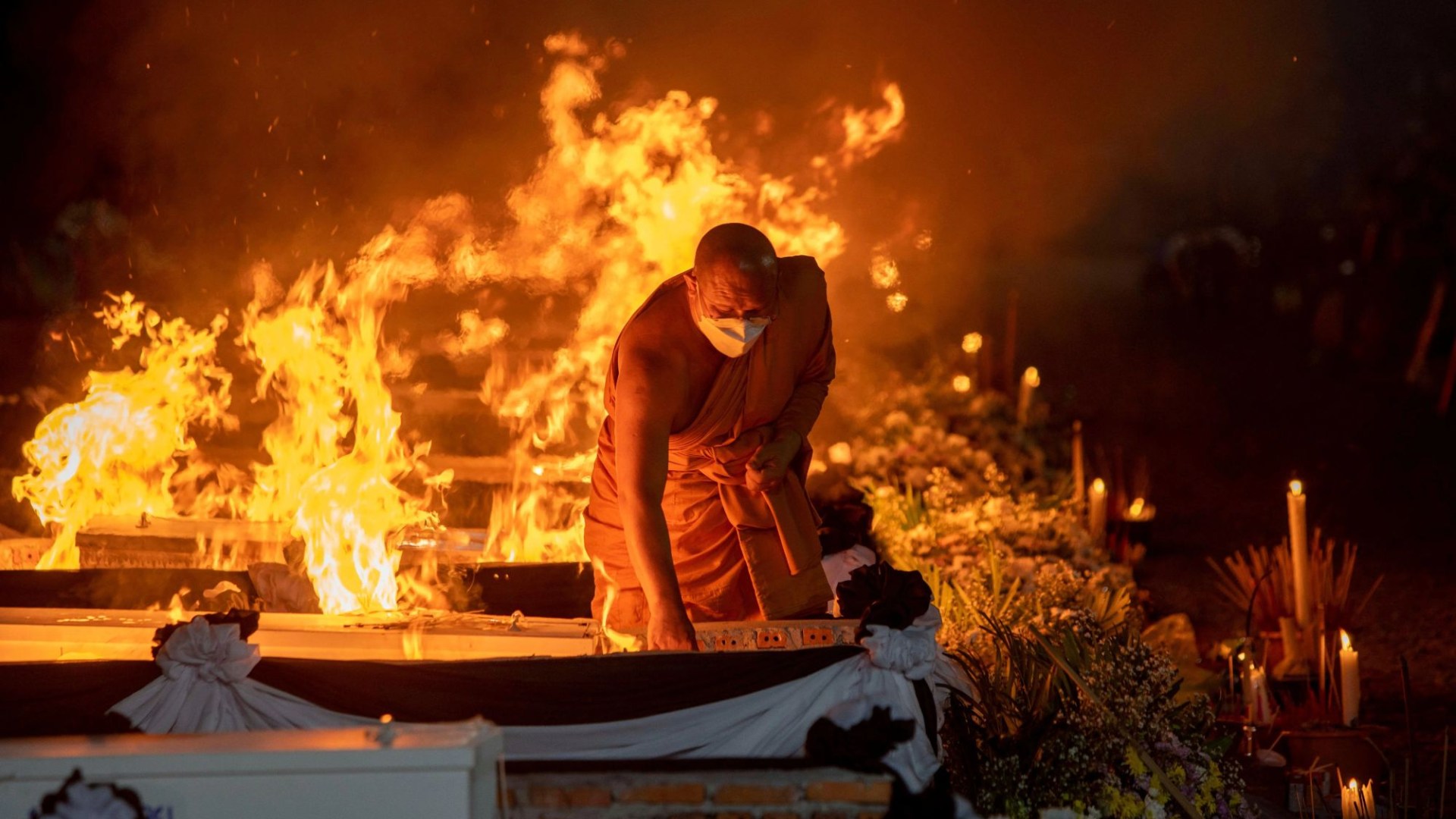
ON October 6, 2022, a former Thai cop drove his pick-up truck to a nursery armed with a pistol, shotgun and knife.
Panya Khamrab, a lifelong drug abuser, attacked children and staff before shooting and ramming pedestrians as he drove home, killing 37 people. More than half of his victims were toddlers.
14
14
It was Thailand’s worst-ever mass killing by a single attacker and sparked calls for an aggressive crackdown on guns.
But four years on, the country has still not escaped the cycle.
Public policy expert Dr. Boonwara Sumano told The Sun: “Gun violence happens almost every day in Thailand, unfortunately.”
Two weeks ago, a Bangkok suburb was confronted by another nightmare when a 14-year-old boy shot eight people dead after storming his school.
He murdered his grandparents, five teachers and a 12-year-old girl.
The perpetrator, Patchata Yimruang, had displayed a number of red flags leading up to the mass shooting, but was still able to access his grandad’s gun cabinet and fatally wield a legally-owned semi-automatic pistol.
14
14
Sumano said: “We’re one of the countries with very high gun-related crimes, and I think this is due to many factors, and most of them are structural ones.”
Thailand’s gun laws are, on paper, relatively strict, but relaxed enforcement on ownership has created gaps in the system.
One of the most glaring is that a licence to own a gun is effectively granted for life.
Sumano said: “In Thailand you have to renew your driving licence every five years, and you actually need a health screen by the doctor to ensure you are still fit to drive.
“But for a gun permit, it’s not in that way.”
The crisis has led Brits to get caught up in deadly incidents and concerned holidaymakers may now opt for safer destination.
In August 2025, a British tourist from Dundee was shot by a cannabis dealer during a road rage incident outside a hotel in Mae Hong Son.
Another was killed when he shot himself in the head during a game of Russian Roulette while high on a cocktail of drugs.
In 2013, 22-year-old Brit Stephen Ashton was killed in a gang shooting on Koh Phangan, a popular destination for tourists famous for its Full Moon parties.
The Siam Paragon Mall shooting in 2023 led the Foreign Office to warn Brtis about illegal firearm accessibility in Thailand and the potential risks in crowded nightlife areas.
In light of recent tragedies and a worsening reputation for gun violence, the government is now considering requiring permits to be renewed every three or five years.
But Sumano says that would only address part of the problem.
Thailand’s estimated civilian arsenal is larger than that of the other nine Asean (Association of Southeast Asian Nations) countries combined, according to a 2017 review by the Small Arms Survey.
14
14
14
14
More than 10 million privately-owned guns are currently in circulation among its 71 million population, according to the Geneva-based Small Arms Survey.
That means there are 15 firearms per every 100 people, which dwarfs the rate of its regional neighbours.
Indonesia, a country nearly four times the population of Thailand, has only 82,000 civilian firearms in circulation.
What’s more, around 40 per cent of civilian-owned guns in the country are not legally registered.
The problem is that many of those unregistered weapons may have originated through legal channels.
For decades, Thailand has operated a gun welfare scheme under which public-sector workers could buy firearms at discounted prices.
After five years, those guns can be legally transferred to new owners.
The scheme was originally introduced to protect civil servants working in remote areas, but it has long since been abused.
14
14
Sumano said: “The development of this scheme, expansion of coverage of this scheme has been so large.”
Even after the 2022 nursery massacre, the scheme was suspended rather than scrapped, then resumed.
Following the latest school shooting, the government again moved to suspend it.
But Sumano argues that temporary suspensions do not go far enough.
She said: “If the government is serious about responding to this gun control crisis, the least they could do is to reduce the coverage of those who could participate in the gun welfare scheme.
“Why would we need even more guns?”
The distinction between legal and illegal firearms in Thailand is not always as straightforward as it appears.
For years, much of the country’s gun-licensing system relied on separate paper permits to buy, possess and carry a firearm.
The lack of a centralised database makes it difficult to track whether someone who has been allowed to buy a gun has actually registered it.
Sumano said: “There’s no linkage of the data. So, I would say a lot of unregistered guns came from the legal channel ones.”
The government is now moving to modernise and scrap the confusing, paper-heavy system.
Experts say that regulators must also track how responsible licensed gun owners are after getting their hands on a lethal weapon.
Professor Trynh Phoraksa, a prominent criminologist and gun control advocate, told The Sun: “Gun regulation should not end when the licence is issued.”
14
14
That means looking at how guns are stored, who can access them and whether owners should have to renew their licences periodically.
Another problem, as in the case of the most recent shooting, is addressing how firearms are stored in the home to prevent them getting into the wrong hands.
Sumano said: “There’s no monitor about safe storage of one’s gun.”
She acknowledged that enforcing safe storage inside private homes would be tricky, but argued more could be done to minimise the risk.
For example, prospective gun owners should have to prove that they have appropriate storage.
In the case of the 14-year-old, the gun was legally owned by his grandfather.
Phoraksa said: “Legal ownership does not automatically mean safe accessibility.”
The distinction is important because a gun can be legally registered to one person while still being accessible to somebody else in the same home.
Phoraksa said the shooting showed why the question should not simply be who owns a gun, but who can get their hands on it.
Regulation is not the only issue Thailand faces.
The country has a tendency to associate guns with power and status, originating from a decades-long military culture.
Sumano said: “There are two norms that would look like conflicting ones but that, in the end, they work together in the same way.
14
14
“One is the culture of worshipping power. Guns and firearms are seen as tools to make you look more powerful and make your social status higher.
“The other is the norm of non-confrontation. Many Asian countries have the same norm of trying to stay polite and not having conflict discussed openly.
“Therefore people will not tell you directly that they are unhappy and all of these disagreements can build up and explode one day.”
Criminologist Dr. Piyaporn Tunneekul believes the problem also goes beyond guns themselves, pointing to rising social and economic pressures, and what she describes as a lack of emotional support within some families.
She said these pressures can affect children’s emotional development and contribute to violent behaviour.
She also warned that public concern tends to spike after a mass shooting before gradually fading.
Thailand’s gun laws are outdated, having been enacted in 1947, and Tunneekul says they urgently need modernising.
Among her proposals are regular licence renewals rather than lifetime permits, tighter controls on welfare gun schemes, stricter ammunition sales and requiring applicants to prove they have secure storage.
The issue of preventing violence before it happens is also becoming increasingly important.
Following the latest attack, some Thai schools have introduced measures including active-shooter drills, metal-detector screening and bag checks.
But Phoraksa said security measures alone cannot address the warning signs that may come before an attack.
He said: “By the time a child enters a school carrying a firearm, several opportunities for prevention may already have been missed.”
Schools also need better ways of identifying and reporting concerning behaviour before it escalates into violence.
Phoraksa explained: “We should stop asking what a school shooter looks like and start asking what a pathway toward violence looks like.”
The challenge now is whether Thailand can turn the public anger that follows each mass shooting into lasting reform.
Phoraksa said: “Thailand needs to move from event-driven to system-driven gun control.”
If it wants to keep its booming tourist industry – especially among Brits – Thailand will need to get a grip on the problem before it spins out of control.