
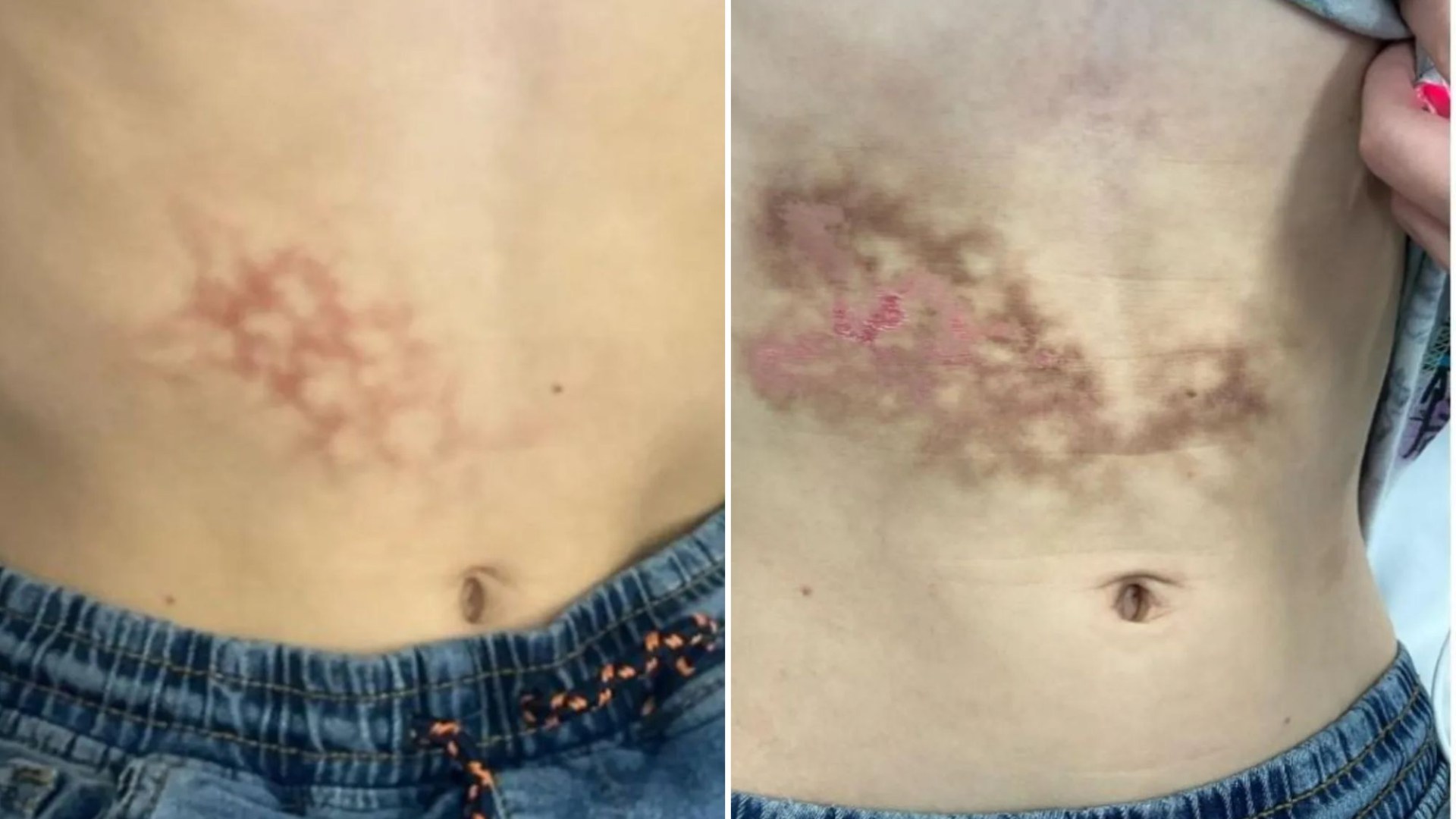
HOURS spent gaming and watching YouTube clips could be putting kids at risk of ‘toasted skin syndrome’ and burns.
The skin condition – known as erythema ab igne (EAI) – is caused by repeated exposure to low levels of heat, which damages the skin over time.
3
3
In the past, it’s been more common in adults who repeatedly use hot water bottles or heated pads.
But erythema ab igne is being increasingly spotted in kids using everyday electronic devices like laptops.
Low-grade heat released by laptops can ‘toast’ skin over time when placed on the body instead of a desk, causing a tell-tale ‘fishnet’ rash.
Kids who spend hours with laptops balanced on their legs while gaming, watching YouTube or even doing schoolwork may be at risk of skin marks and disfiguration, doctors from the University Hospitals of Leicester NHS Trust warn.
Read more on skin
DIRTY DIP
The risks of swimming in ‘safe’ water as two kids hospitalised in seaside town
SYMPTOM CHECK
‘Rain rot’ STI detected in UK as Europe outbreak spreads – 4 subtle signs
They issued the warning after treating a pre-teen boy diagnosed with EAI, who rested his laptop on his stomach for up to eight hours a day.
Writing in BMJ Case Reports, Dr Mara Znagoveanu said the patient had been brought to the children’s emergency department with reddish-brown marks on the upper part of his stomach.
They’d appeared a week earlier and looked like bruises upon first glance.
As he had no history of injuries, illness or other symptoms, neither the boy nor his parents could pinpoint what may have caused it.
Most read in Health
DOC SHOCK
One child, 9, dead and 208 patients harmed by rogue surgeon at major NHS hospital
BREW KNEW?
Terrifyingly-easy cuppa mistake ‘could almost triple risk of deadliest cancer’
GUT PUNCH
Common tummy bug that causes burping and bloating ‘behind 1 in 5 bowel cancers’
TAKE NOTE
The 5 little-known signs of blood cancer as BBC star reveals incurable diagnosis
3
Symptoms of toasted skin syndrome
Because low-level heat damages your skin slowly and doesn’t cause a true burn, you may not feel symptoms at first. If symptoms do occur, you might notice:
- A mild stinging feeling
- Itchy skin
Changes you might see on your skin may include:
- Skin discoloration (darkening or redness) in one area at first
- A netlike or patchy rash
- Thinner skin or thickened, rough skin
The rash may fade when you press on it early on. As the condition progresses, it no longer fades when you press it.
Source: Cleveland Clinic
Doctors noted that the mark looked “lace-like” with “interlacing lines”.
They suspected it may be the result of a liver injury caused by playfighting.
But the boy’s blood test results and abdominal scans were normal, and he was discharged.
Two weeks later, he was brought to hospital again, as the rash had gotten worse and more tender, with areas of skin peeling.
Doctors began to suspect the rash was heat-related.
Their suspicions were confirmed when the boy revealed that he was being home-schooled and completed schoolwork on his laptop.
He explained that he rested his laptop on his abdomen for up to eight hours a day, often while charging it.
The patient was diagnosed with EAI.
He was advised to stop resting his laptop on his body.
Dr Znagoveanu said: “As more commonly reported in adults, EAI may be overlooked in children, especially when the source of heat is less obvious than the traditional sources such as hot water bottles and heating pads.
“The increasing use of electronic devices, particularly during home-schooling, has emerged as an under-recognised cause of EAI in paediatric populations.”
She added that EAI might be misdiagnosed in children, leading to “unnecessary investigations” such as blood tests or scans.
A phone consultation with his dad several months later indicated that the condition had gradually improved and that the rash had disappeared.
Dr Znagoveanu said: “There are currently no formal paediatric guidelines for EAI, and diagnosis remains clinical, based on history and characteristic findings.
“This case highlights the importance of considering EAI in children presenting with reticulated [netlike] rashes, particularly in the context of increasing electronic device use.”
EAI is usually harmless in the early stages, as low-level heat damages skin slowly rather than causing a true burn.
But over time, it can cause tingling, itching, scarring, rough or thickened skin, or sores.
It occurs as a result of repeated exposure to heat in one area of your skin, from car seat warmers, heated blankets and pads, hot water bottles and space heaters.
Over weeks or months, heat can damage small blood vessels and pigment in your skin.
This damage leads to the netlike pattern seen with this condition.
RECOMMENDED STORIES
In many cases, the appearance of the skin will improve once you stop applying heat to it.
But it can take months or even years for skin to return to its normal colour.