
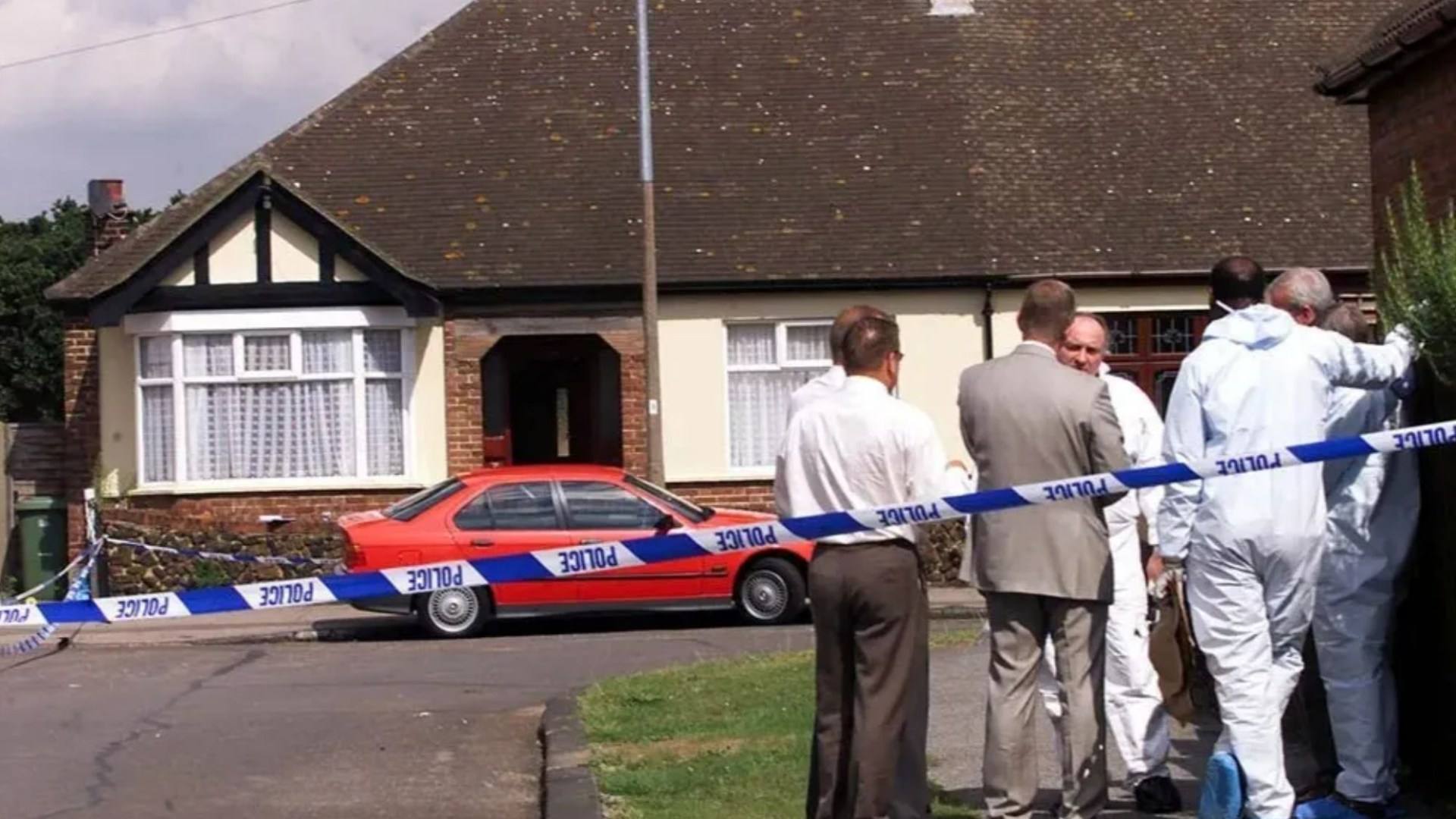
THE gunman was already waiting for his victim when he stepped outside to go to work.
It was shortly before 8am on August 20th, 2000, and Ronnie Fuller was climbing into his white van when a man on a scooter opened fire.
9
9
The 30-year-old painter and decorator was hit four times at point-blank range, but managed to stagger behind his vehicle.
Then came the fifth and final shot.
Neighbours in Grays, Essex, rushed from their homes after hearing the screams of Fuller’s partner, who had been inside with their young son.
They found him bleeding heavily from wounds to his head and chest, barely ten feet from his front door.
The killer disappeared on the scooter and – 26 years later – has never been brought to justice.
Now, Essex Police are appealing for information over the unsolved murder.
While the notorious Essex Boys murders have become the defining story of the county’s bloody criminal history, spawning films, books and endless theories, the murder of Ronnie Fuller was part of an equally violent and deadly gangland feud which, unlike the Range Rover killings, has never been officially resolved.
The war started with a nightclub brawl, involved the death of a feared gangster, an apparent revenge execution and, eventually, a secret police intelligence report that named Ronnie Fuller’s suspected killer.
9
9
To understand why anyone might have wanted Fuller dead, however, means going back ten months — to another violent death and a mass brawl at one of Essex‘s best-known celebrity nightspots.
On October 3, 1999, a 27-year-old man named Darren Pearman got into a row with bouncers at the Epping Forest Country Club, a celebrity haunt near Chigwell where Fuller worked part time as a doorman.
By the late 1990s, the venue had become one of the best-known nightspots on the Essex-London border.
The sprawling complex, built around historic Woolston Hall, had first been transformed into an exclusive members’ club by James Bond star Sean Connery and England World Cup-winning captain Bobby Moore.
Under businessman Peter Pomfrett, it had evolved into a huge entertainment venue comprising three clubs — the Country Club, Casino Club and the 1,500-capacity Atlantis.
Thousands of revellers could descend on the site, while its notorious outdoor “Splash” parties were said to attract crowds of more than 5,000.
But by the turn of the millennium the venue was also becoming associated with gangsters and serious violence.
Few incidents were more notorious than the death of Darren Pearman.
Pearman was no ordinary clubber out for a laugh on a Saturday night.
He moved within the notorious Canning Town underworld and was the son of career criminal Christopher Pearman, who would himself later be convicted of murder.
Exactly what happened that night is clouded by years of gangland folklore.
Accounts from underworld sources claim Pearman and his associates arrived armed and that a machete had even been hidden inside the club before violence erupted.
9
9
The central fact is that Pearman suffered multiple fatal stab wounds during the confrontation, while his younger brother was also seriously injured.
Ronnie Fuller and another doorman were arrested and later charged with violent disorder.
But the case never even reached trial.
Prosecutors ultimately decided that the men had acted in lawful self-defence.
But the bad blood between Pearman and Fuller may have begun even before the fatal confrontation at Epping Forest.
According to accounts which later emerged from underworld figures, Pearman was a close friend of David “Rolex Dave” King, another violent criminal.
The pair were said to have first encountered Fuller at Charlie Chan’s, a nightclub in north London where he was working on the doors.
Former Essex Boys associate turned author Bernard O’Mahoney later claimed a fight broke out after a man was attacked with a glass, prompting Fuller and other doormen to intervene.
9
9
Pearman and King were thrown out.
It was, according to O’Mahoney, a humiliation Pearman could not forget.
O’Mahoney later claimed members of the Canning Town mob had little interest in helping detectives investigate the killing and instead planned to settle the matter themselves.
Whether Fuller was informed by police that he had become a target has never been established.
What is known is that in the months after Pearman’s death, he moved around 20 miles from the Loughton area to Grays in the south of the county.
If the move was intended to put distance between himself and the violence surrounding Pearman’s death, it was not enough.
The gunman had known exactly where to find him and when he would leave for work.
Officers searched for the scooter, carried out house-to-house inquiries and appealed publicly for information.
The trail went cold, but behind the scenes, one name would eventually emerge in police intelligence belonging to another force – it was the name of Darren Pearman’s father.
In October 2001, the Met began a highly secretive intelligence operation examining something even more disturbing than gangland violence itself.
Codenamed Operation Tiberius, its purpose was to establish how deeply organised crime had infiltrated Scotland Yard.
Top brass feared operations were being compromised by corrupt officers passing sensitive information to some of London’s most powerful criminal organisations.
The resulting report, completed in March 2002 and classified SECRET, made an extraordinary assessment.
It warned that organised crime was capable of infiltrating the Metropolitan Police “at will” in parts of East and North-East London, and that even murder investigations had been nobbled.
Buried within the supporting intelligence was an entry concerning Christopher John Pearman.
Born in Stepney in 1952, Pearman’s criminal record stretched back years and included several convictions for burglary and two for importing cannabis.
9
Police intelligence also placed him in serious East London criminal circles.
He was described as an associate of the Bowers organisation – the firm behind a £1.2m heist at Gatwick Airport – and linked to a number of men who themselves became victims of shootings.
It was no surprise that by 2001 Pearman Snr was living with the expectation that somebody might come for him too.
Eight months after Ronnie Fuller’s murder, on April 6, 2001, Pearman was arrested near the Hippodrome nightclub in London’s Leicester Square after allegedly threatening a cab driver with a gun.
When officers detained him he was wearing covert body armour and carrying a five-shot snub-nosed revolver and a lock knife.
It was apparently not paranoia without foundation.
Police intelligence recorded that an attempt had already been made on Pearman’s life, with shots fired into his car after one of its tyres had been deliberately deflated.
Detectives believed the violence surrounding him formed part of a long-running feud, and at the heart of it was the death of his son.
It described the feud which had followed his son Darren’s fatal stabbing at the Epping Forest Country Club and recorded that Pearman’s own life was now believed to be under threat.
Then came an extraordinary assertion.
According to the intelligence report, Ronnie Fuller had subsequently been shot dead by Christopher Pearman himself.
Tiberius claimed the remaining doormen involved in the original confrontation with Darren had, in turn, made clear their intention to kill his father.
None of this amounted to proof that Christopher Pearman murdered Ronnie Fuller and it still remains unclear exactly what, and when, this information was passed to Essex Police.
Operation Tiberius was an intelligence-gathering exercise, not a criminal trial, and its assertions were never tested before a jury.
Pearman has never been convicted over Fuller’s murder.
Indeed, even Tiberius’s description of Darren Pearman’s death conflicts with the later official position that Fuller’s actions that night amounted to lawful self-defence.
And yet Christopher Pearman was never questioned, yet alone charged, with Ronnie Fuller’s murder.
Pearman is currently serving life with a minimum of 23 years and six months over the suspected ‘contract killing’ of Rocky Dawson, 24, in front of the victim’s two children in May 2006.
With its latest appeal, Essex Police hope to finally nail Fuller’s killer.
Essex Police told The Sun: “Over time allegiances change, but the pain of losing someone never goes away.
“If people have information about this murder we would urge them to contact us on 101 or Crimestoppers anonymously on 0800 555 111.”