
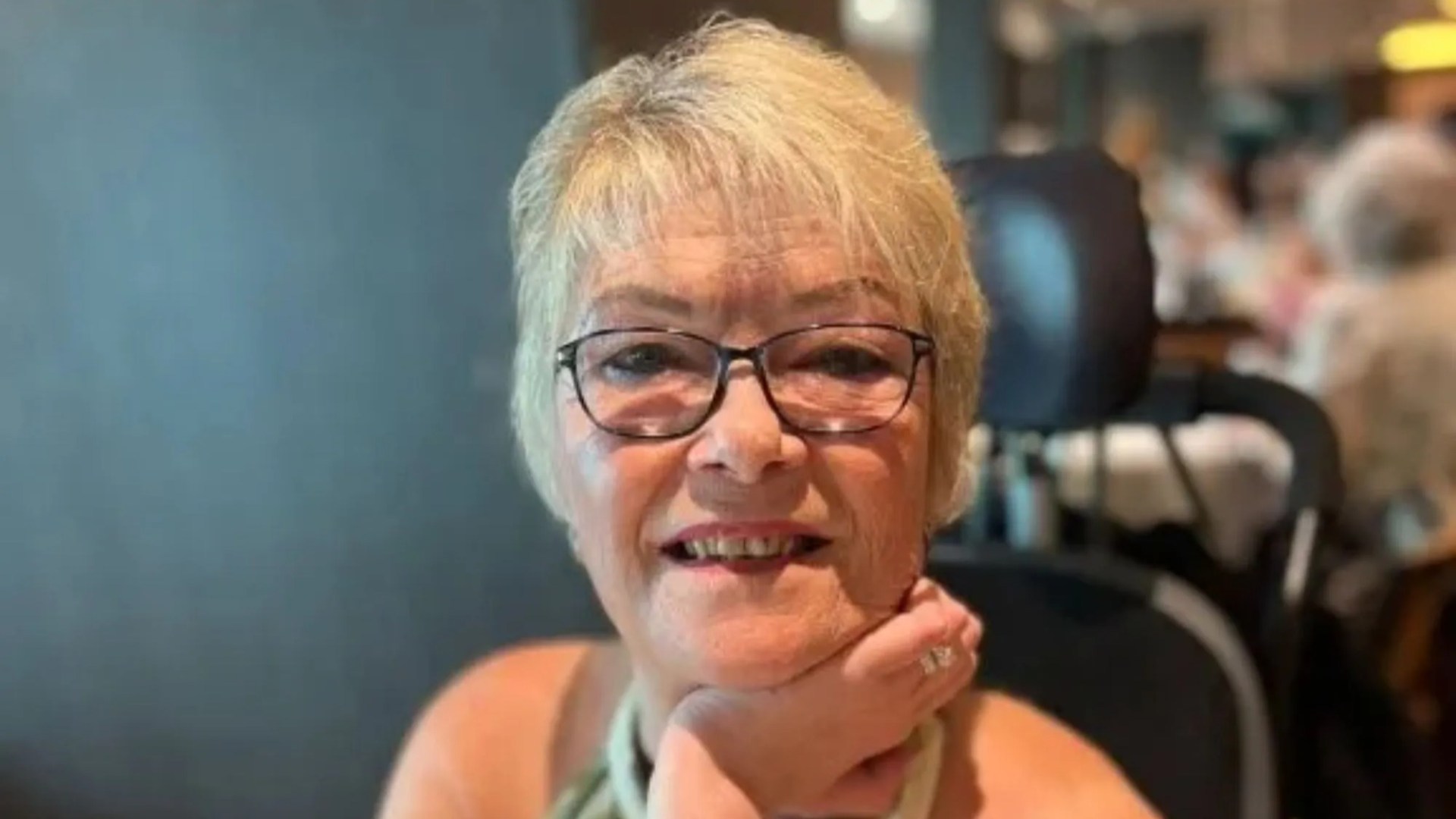
AS Kim Smith sips her morning coffee, she has an extra-special reason to enjoy it.
Eight years ago, mum of two Kim, 65, lost all four limbs and since then, hasn’t even had the ability to make and hold her own brew.
8
8
Thanks to a selfless act of kindness from a stranger she never met, Kim has a brand-new hand.
For the first time since she fell ill, she can hold a cup, clean her teeth and style her hair.
Kim lost her limbs due to a life-threatening battle with sepsis which started with a urinary tract infection (UTI).
It sent her into a deep depression which drove her almost to suicide.
READ MORE ON SEPSIS
‘AWFUL’
Man, 36, diagnosed with sepsis died after A&E discharged him due to overcrowding
‘DISMISSED’
I was labelled anxious when Lottie had ‘tummy bug’… she collapsed & nearly died
But she has now turned her life around and wants to help others and raise awareness of sepsis.
This week sees the launch of her book: ‘From Shadows to Light’.
She has also become firm friends with Jackie Kirwan, 64, the mother of her donor Georgie Peterson, who died in August last year.
Kim, who is mum to Gemma, 37, and Becki, 35, says: “Losing my limbs was devastating and for a while I could not see a way forward.
Most read in Health
WHAT WOMEN WANT
Body type women REALLY want in a man is finally revealed in major study
SHORT CHANGED
The 8 meds in shortage until 2027 or ‘indefinitely’ including heart drugs
FATAL ERROR
My baby died after his NHS hospital alarm was ‘turned down & too quiet to hear’
CRISIS DEEPENS
The 114 medicines in shortest supply in the UK – is YOURS on the list?
“But you never know strong you are until strong is your only choice.
“I want my book to bring hope and light to others who may feel as desperate as I once did.”
Kim was perfectly fit and healthy until she fell ill on holiday with her husband, Steve, 67, in Spain in November 2017.
She at first thought she had a UTI due to a pain in her left side and saw a doctor.
But she quickly deteriorated and was diagnosed with sepsis, which is when the body has an overreaction to an infection in the body, leading to shock, organ failure and death if not spotted fast.
Sepsis is involved in 48,000 deaths every year, and 245,000 people are affected.
8
8
Kim, who is from Milton Keynes, was placed in a coma and her family feared she might die.
She says: “I had kidney pain and I just thought I had picked up a bug on holiday.
“The GP sent me home with a prescription for anti-biotics, but the chemist was out of stock. “Then overnight, I became very ill, very quickly.
“By 4am, I was slurring my speech, my hands and feet were ice-cold, and I had a terrible fever. I asked Steve to get me to hospital fast.”
In January 2018, five weeks after falling ill, Kim was transferred by air ambulance to Milton Keynes Hospital.
The following month, she woke from a nine-week coma and doctors asked her for permission to remove all her limbs.
Kim says: “When I woke from the coma, my hands and feet were black, and I knew they had to go.
“I thought of my family, of how much I wanted to stay alive, and I just wanted to be rid of them.”
The surgery went well and Kim was discharged in May 2018.
Afterwards she underwent rehabilitation at Queen Mary’s Hospital in Roehampton, south-west London.
The following year, she was fitted with prosthetic legs, and she slowly learned to walk again.
But, heavily dependent on her family, she struggled for 12 months with severe depression.
8
Sepsis – the worrying statistics
- There are at least 245,000 sepsis cases in the UK annually, with around 48,000 deaths (that’s five every hour)
- There are almost 50million cases of sepsis globally every year, resulting in 11million deaths
- As many as 40 per cent of cases are in children under the age of five
- One in five deaths globally is associated with sepsis
- Sepsis is the number one cause of death in hospitals
- It is also the most common reason for hospital admission
- Around 40 per cent of survivors have one or more cognitive, psychological or physical after effect
- Sepsis kills more people than breast (11,400), bowel (16,300) and prostate cancer (11,700) combined (39,400) in the UK
She says: “I was grateful for my legs, but I really missed my hands.
“I had to rely on everyone else; I couldn’t even hold a cup or brush my own teeth or hair.
“I gained five stones because I was so immobile.
“I was in a very dark place. I started to have thoughts of taking my own life.”
Then in 2019, with encouragement from her daughters, Kim began raising awareness of sepsis on social media.
She says: “I realised that educating others about sepsis was my new purpose in life. People were so encouraging and positive and I connected with other amputees which helped both me and them.
“Slowly, my confidence grew, I lost weight, and the depression lifted.”
After self-referring, Kim was placed on the waiting list for a hand transplant but had 18 failed matches before the right call finally came, thanks to the kindness of a stranger at the other side of the country.
Georgie Peterson, 33, from Liverpool, had died tragically from a seizure in August 2025 and left instructions for her organs be donated.
Her mum made the decision to donate her hands and days after Georgie’s death, Kim became only the 12th patient in the UK to undergo an op receive new hands.
Only the left hand remained healthy after being transplanted.
Kim says: “I lost one hand but I was over the moon to have the other.
8
8
“I recovered really well and just four weeks on, I was learning to hold a toothbrush and a cup.
“I could brush my hair, write my name and reach an itch.
“For once, I could look after myself. Those small things meant so much.”
Patients on the NHS hand transplant waiting list have a series of hurdles to overcome before they reach the operating table, including a year of psychological and medical evaluation.
They must also decide what type of hands they would be willing to accept, including gender, size, age and ethnicity.
The limbs must also be a biological match to reduce the risk of rejection.
Hand transplants are also trickier than internal organs, because the look and appearance both play a role.
Typically they take around 12 hours to complete in surgery.
Kim says: “One of the problems for donated fingers is that they scrunch up, but Georgie was hypermobile, which really helped in straightening my fingers out and making my rehab so much easier.
“My new hand has changed my life immeasurably. It has given me my independence and privacy back and I am so thankful, every day.”
Through donor nurses, Kim wrote anonymously to Georgie’s mother, Jackie, to thank her and, after thinking it over until the New Year, Jackie suggested they meet up in March this year.
Jackie says: “I liked Kim immediately.
8
“Before her surgery, Georgie had a tattoo, ‘Noli timere’ on her arm, which means ‘Do not be afraid’ – and now Kim has part of it too.
“She said to me, ‘Hold my hand any time you like, it’s Georgie’s hand’.
“It brought me so much comfort to hold her hand and know my daughter lived on.
“It’s exactly what Georgie would have wanted.
“She was kind and generous, she was our ray of sunshine, and to see a part of herself living on, and changing Kim’s life, would make her so happy.”
The two women have become firm friends and have met up several times since. Now Kim has written a book about her journey.
She says: “I want to raise awareness of sepsis and limb donation but also of the importance of carrying on and never giving up hope.
RECOMMENDED STORIES
“Thanks to Georgie, I have a second chance, and I won’t waste a single second of it.”
Kim’s book is available now on Amazon.