
Subscribe to Independent Premium to bookmark this article
Want to bookmark your favourite articles and stories to read or reference later? Start your Independent Premium subscription today.
`;
document.body.appendChild(modal);
modal.addEventListener(‘click’, () => {
document.cookie = ‘mos-plan-select=; Max-Age=0; path=/; expires=Thu, 01 Jan 1970 00:00:00 UTC;’;
});
modal.querySelector(‘.subscribe-link’)?.addEventListener(‘click’, (e) => {
e.preventDefault();
document.cookie = ‘mos-plan-select=; Max-Age=0; path=/; expires=Thu, 01 Jan 1970 00:00:00 UTC;’;
setTimeout(() => {
window.location.href = ‘https://www.independent.co.uk/subscribe?regSourceMethod=Bookmarks’;
}, 500);
});
});
Autonomous delivery robots should be banned from pavements to protect more vulnerable pedestrians, a leading charity has claimed.
The six-wheeled, foot-high devices, capable of travelling at up to 4mph while keeping takeaway meals temperature-controlled, have already launched across several UK towns and cities, including Leeds, Milton Keynes, Bristol, and Manchester.
Yet campaign groups say this rapid rollout has bypassed consultation with those who stand to be hit hardest by the technology — pedestrians with disabilities.
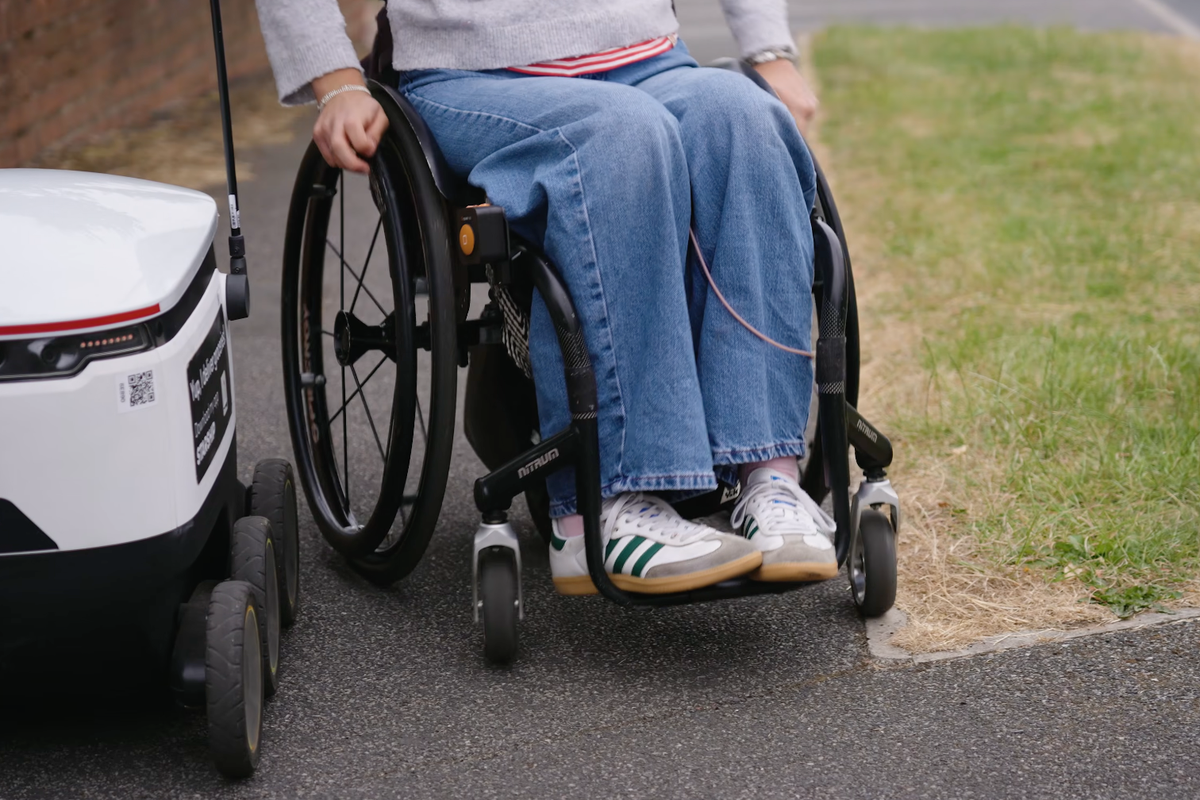
A new video released by charity Living Streets showed the machines blocking a guide dog user and crashing into a person in a wheelchair.
“Our pavements are not for sale and should be for people,” said Tanya Braun, director of external affairs at Living Streets. “Delivery robots are putting pedestrians at risk and creating accessibility issues.”
Braun has accused the tech companies behind the robots of operating within an unchecked legal “grey zone” — where because the government has not established any clear legislation surrounding the use of these robots, firms are effectively free to operate as they wish.
“The companies operating autonomous delivery robots in the UK have not consulted with local communities who have legitimate concerns,” she added.
A YouGov survey released this week revealed that 60 per cent of respondents believe delivery robots should be barred from public footpaths entirely.
Dr Amit Patel, who lost his sight in 2013, described how past encounters with the machines “spooked” his guide dog.
“If you can see, walk, or hear, you probably won’t be affected by delivery robots,” Dr Patel said. “But for those of us who have worked so hard to get our independence back, this is yet another hurdle.”
Dr Patel warned that deteriorating street accessibility is driving vulnerable people out of public spaces entirely.
“Some people tell me that it’s easier and safer to jump in a taxi and go to an out-of-town shopping centre than it is to visit their local high street because it’s just not safe,” he said. “If we want to boost our local economies, we need to fix the legislation around delivery robots.”
Wheelchair users have echoed those concerns, pointing to narrow, cluttered pavements that leave no margin for error when passing automated machinery.
“For many people who use wheelchairs, tricycles, and mobility scooters to get around, too often there isn’t enough unobstructed width on the pavement,” said Ben Foley, campaigns and policy lead at Wheels for Wellbeing.
“There’s a real danger that large numbers of disabled people will have our routes blocked, stopping us from getting to the bus stop, the local shops, our GP surgery, or from taking our children to school.”
Starship Technologies, the market leader behind the robots being used in the UK, was founded by the creators of Skype in 2014.
A spokesperson for the company told The Independent: “Starship agrees we need regulation for pavement robots. But that regulation shouldn’t be putting the UK on the backfoot when it comes to innovation, job creation and reducing carbon emissions.
“Regulation should make sure operations are safe and accessible, and give local communities a say over what works for their areas.”
At present, no dedicated statutory framework governs personal delivery devices under UK road traffic acts.
In an open letter to transport secretary Heidi Alexander, Living Streets demanded an immediate halt to all current commercial operations until safety legislation is enacted.
The Department for Transport said pedestrian safety will guide future legislation, committing to creating a new “low-speed zero-emission vehicle” legal category that could eventually encompass pavement robots.
“Everyone should be able to use our pavements safely, and while we welcome innovation and advances in technology, it’s vital that pedestrians and vulnerable road users are put first,” a government spokesperson added.
“We will carry out trials to see how pavement delivery robots can operate safely alongside pedestrians, so we can make sure the right safeguards are in place and update the law.”