
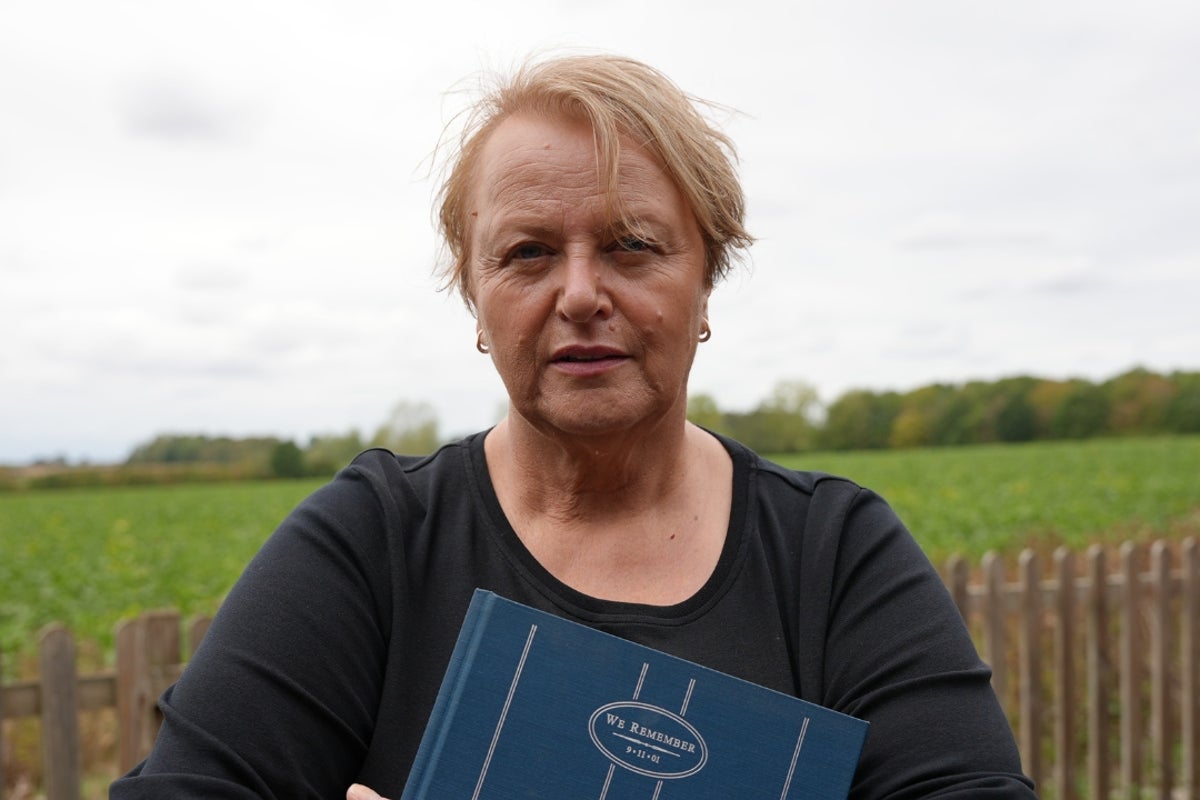
For the past 25 years, Janice Brooks has been reliving the same recurring nightmare.
She is standing in a building in the middle of New York’s Hudson River looking across at the Twin Towers of the World Trade Center. There are no buildings in the middle of the Hudson River – this is how she knows she’s dreaming.
Halfway up one of the towers she sees a man standing in the huge void left in the building by a plane. He has curly black hair and is wearing a blue shirt and a tie. The man cannot stop looking over his shoulder at a wall of flames inching towards him.
Ms Brooks can see the sweat forming on the man’s brow as he edges towards the drop. The man looks down, bends his knees as if about to jump, and then, “Boom,” Brooks claps, “I wake up.”
She is one of the few people who walked away from the 11 September terror attack, making a miraculous escape from the 84th floor of the south tower. Sixty one of her colleagues weren’t so lucky.
Aged 41 at the time, she had moved to New York just three weeks earlier, accepting her dream job as an executive assistant at Euro Brokers at Two World Trade Center. She had already spent a decade in London working for the brokerage firm and had built up close relationships with many of her colleagues.
On the previous Friday night, four days before the attack, Ms Brooks climbed to the top of her 110-storey office building – once the world’s tallest buildings – to take in the view of the city she now called home.
Wind ruffled through her short-cropped hair as she looked down onto the Brooklyn Bridge, turning to see the sunset glinting off the Empire State Building. Her new adventure was just getting underway and she smiled to herself.
On 11 September at 8.46am, when American Airlines Flight 11 struck the north tower, all passengers aboard were killed instantly. The plane severed all three staircases in the skyscraper, trapping an estimated 1,400 people above the 91st floor. None of them survived.
Ms Brooks had been at her desk in the adjacent tower when the first plane struck. Her 84th-floor office faced away from the north tower so she did not see the Boeing 767 aircraft but she heard the explosion. “I could see paper and dust swirling in the air through the windows,” she remembers.
Lower Manhattan was filled with construction sites at the time and she initially thought that was where the noise had come from. This seemed to happen all the time in New York and nobody paid much attention, she says. But this bang was much louder than anything she had heard before.
She went to check with her colleague, Brian Clark, who told her not to panic and promised to investigate. Ms Brooks went back to her desk but soon heard a man’s voice shout, “Everybody out.”
She grabbed her things to go but, before leaving, she hesitated. “Better call the London office to keep them in the loop,” she thought. When the receptionist put her through to the managing director in London, Brooks was casual over the phone, “ Not really too sure what’s happening, but I’m getting ready to leave,” she said.
“F****** hell, Janice. A plane’s gone into the building, get the f*** out of there!” her boss shouted down the line. The London team over 3,500 miles away already knew more about what was going on 200 yards away from where Ms Brooks was sitting. They had been watching in horror as the news was unfolding on TV.
“I don’t remember hanging up. I just remember grabbing my bag and running,” Ms Brooks says. She ran through the dealing area to the main corridor where the designated fire marshals, Steve Chucknick and Jose Marrero, were ferrying people towards the staircase. Both men lost their lives that day.
In the stairwell the chatter was amiable, as if they were simple taking part in a fire drill. People were swapping stories from the weekend, what restaurant they’d tried, or the play they had seen on Broadway. Ms Brooks fell in with a colleague from the dealing floor, a man she recognised but whose name had not stuck yet. He recommended Ms Brooks might want to remove her high heels, which she promptly did.
They made it down to the 72nd floor when the first announcement came over the PA system from a Port Authority official. “We have been asked not to evacuate Two World Trade Center. The space is being used on the plaza for those being evacuated from One World Trade Center. This building is stable. Please return to your office,” Ms Brooks remembers.
For some, this announcement would turn out to be a death sentence.
“Your attention, please, ladies and gentlemen. Building Two is secure. There is no need to evacuate Building Two. If you are in the midst of evacuation, you may use the reentry doors and the elevators to return to your office. Repeat, Building Two is secure.”
One of the announcements from a Port Authority fire safety marshal at 8:55am on 11 September 2001 via the South Tower’s public address system. (Source: 9/11 Memorial & Museum)
On hearing the announcement, Ms Brooks and a dozen others walked down to the nearest bank of elevators in Morgan Stanley’s offices on the 70th floor. They waited to take the elevator back up to their office. Luckily for Ms Brooks, that elevator never arrived.
After a few minutes of repeatedly pressing the elevator button, the group decided to walk back up the stairs. At this point, it was still thought that a small plane had flown into the first tower by accident, that perhaps the pilot had suffered a heart attack. It only became clear that America was under attack at 9.03am, when United Airlines Flight 175 crashed into the south tower.
Ms Brooks and her group had been moving through an adjoining corridor from one stairwell to another, likely on the 76th floor, when the second plane struck.
“There was this almighty bang, the lights went off. I could feel stuff falling down from the ceiling. A couple of the girls at the front fell to the floor,” Ms Brooks says. She could feel the building swaying for about five seconds.
The badly wounded started to emerge from the offices closest to windows. The first woman Ms Brooks encountered had glass in her hair and cuts all over her face.
“Her arm was cut almost neatly, actually from her shoulder to her elbow,” Brooks says. One of the guys took his t-shirt off and wrapped it around her arm, tying it in a knot under her armpit. Half of her foot was missing.
One man had a large shard of glass lodged in his chest that people were helping him extract. Another woman had blood running into her eyes from a cut on her head. “She had long, dark hair and when she shook her hair, glass showered everyone,” Brooks says.
They searched desperately for a way down. They returned to the stairwell they had just ascended but it was gone. “There was just blackness and dark,” Ms Brooks says. After the second plane struck, only one of the three stairwells in their tower remained undamaged.
Ms Brooks’s group managed to find their way through the smoke and rubble to another stairwell. The lights were on and they could see pieces of ceiling, plaster and concrete littering the stairs. There was a broken pipe gushing water down the stairs.
The woman with the severed foot and badly injured arm was trailing blood down the staircase. Ms Brooks remembers walking barefoot through it, trying to stay calm and suppress her screams. Her colleague, whose name she still didn’t know, helped calm her down.
This colleague, Bob Mahon, played an instrumental role in getting the group safely to the bottom. When her pain became too much, Mr Mahon carried the injured woman down the last 10 storeys on his back.
At the eighth floor, they encountered three firefighters ascending, who looked them up and down, noting the walking wounded, then continued silently upward to their fate.
When Ms Brooks eventually reached the bottom of the south tower there were still firefighters, police and Port Authority workers streaming into the building. At the entrance to the south tower, a burly New York cop told her and Mr Mahon, “Keep your head down, don’t look up, and run.”
They ran past St Paul’s Chapel into Vesey Street and kept going until they could see the Brooklyn Bridge. Then, for the first time, Ms Brooks turned to look at the Twin Towers. “I couldn’t believe what I was seeing, where our floor should have been there was a huge gaping hole, and I could see smoke and flames,” she says.
Mr Mahon asked her the time. It was 9:43am. The tower they had just escaped collapsed just 16 minutes later at 9:59am. More than 600 people died, including 61 of their Euro Brokers colleagues – a fifth of the New York branch. Some 30 minutes later, at 10:28am the north tower come crashing down, taking with it more than 1,400 lives. The official death toll for the September 11 attack is 2,977 people.
Ms Brooks now lives in a cottage in Norfolk, in the east of England, with her dog Jesse. Twenty-five years since 9/11, one third of Americans are unlikely to remember the attacks. Around the world, more than half of the population is too young to have a memory of it.
Some years Ms Brooks feels like the date can pass without even an acknowledgement of the attacks. September 11th is not taught in the school curriculum in Britain.
Now aged 66, Ms Brooks works with a charity called Since 9/11, through which she gives talks at schools to educate those born after the attacks about their significance. She does not like reliving that day but in retelling her story, she hopes to bring listeners closer to the event, to personalise the tragedy so that its scale can be understood.
“For me, these talks help to keep the date alive, to keep not only my friends but everyone that died on September 11th alive,” she says.
Each year, as autumn approaches again, her nightmare with the man in the Twin Towers comes back to her more frequently. In a bid to understand that lone man is, Ms Brooks has seen a psychiatrist, who told her she needed to find an ending for this man – to forge a narrative for him that she can wholeheartedly believe and then finally put this nightmare to bed.
She has tried a couple of variations. Perhaps she knew this man with the curly black hair and the tie. Perhaps he does not jump, and he gets to safety.
Recently she was speaking at her local church about September 11th. After she had finished, a member of the audience approached her. “You know that man in the nightmare is you, Janice?” the audience member said.
She reflected on this in the weeks after. But the nightmare persists.
Join our commenting forum
Join thought-provoking conversations, follow other Independent readers and see their replies