
Concerns are growing that invasive Asian hornets are expanding their footprint across England following the species’ first recorded discovery in a previously unaffected county.
A nest of the predatory insects, which are native to China, was identified last week in woodland in Somerset.
A beekeeper in Ashcott, near Street, spotted a hornet close to his beehives and alerted local action teams.
Responders tagged the hornet, which guided them to its nest in a woodland clearing’s bramble patch – which they then destroyed.
It is the 53rd nest discovered across England this year, following 163 nests located in 2025.
Asian hornets present a threat to over 1,000 native UK species they consume, such as honey bees, bumble bees and butterflies.
The public is urged to remain watchful and report potential sightings using the Asian Hornet Watch app.
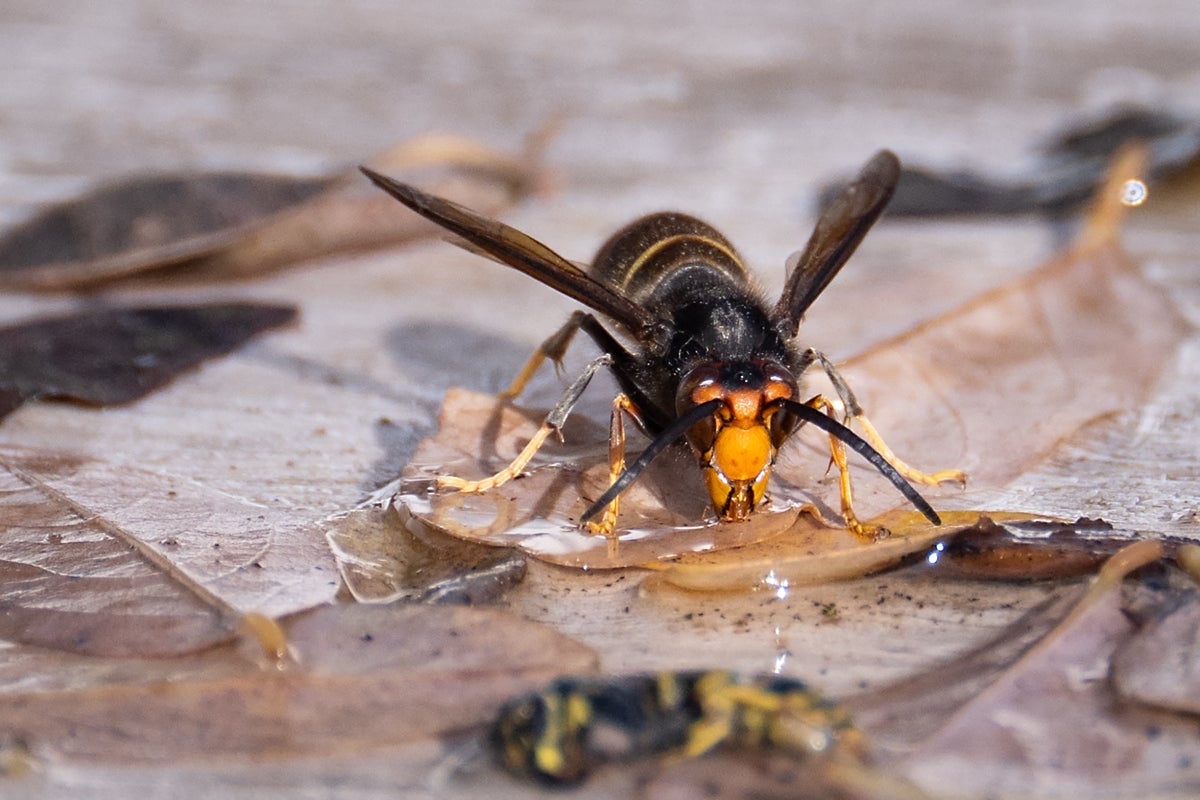
They have bright yellow legs, a black thorax with one orange band, and an orange face.
Lynne Ingram, head of Somerset’s Asian Hornet Action Team, said she hoped it would be the county’s “first and last” nest.
She warned that teams face a race against time to eradicate nests before queen hornets mate and hibernate next month.
A queen hornet consumes 11.3kg of insects — around 90,000 bugs — per season, severely damaging local ecosystems.
“The nest was found in a bramble patch in a clearing in a woodland in Ashcott,” Ms Ingram said.
“It is the first one we have had in Somerset and we hope it will be the last.
“It is concerning that they have reached this county and everyone must be vigilant.”
She said it was “vital” that people take photos and report any nests that they see.
“Our team will come down and destroy it.
“We really need to be finding the nests before the mating queens have emerged and go into hibernation.”
Mark White, from the East Dorset Beekeepers Association, warned in 2025 that hornet numbers were rising “exponentially” in southern counties.
He said that the hornet invasion is not simply a “beekeeper’s problem” but affects all areas of life.
“We have seen an exponential growth in Asian hornet nests, mainly in the south east of England,” he said.
“There’s no natural predator against the hornets around so they are top of the food chain.
“They have got a buffet for the out there and they can pick out what they want – the conditions are right for them.
“In the UK the temperature is akin to where they come from in their native China so it is just like being at home.”
As well as being an apex predator, Asian hornets are “prolific” reproducers, he said.
“People think this is a beekeeper’s problem but it’s an everybody problem.
“They take out all the insects that birds rely on and the insects used for fishing.
“They scavenge so they will eat roadkill off side of roads and they have already affected the grape crops and wine industry in France and Spain.
“Once we know where they are we can try and take their nests out as every nest we take out will not reproduce.
“If you don’t do that it will release up to 300 queens and the maturity will survive hibernation and start to nest the next year.
“Every queen or nest we don’t destroy now is potentially five or six nests next year.”
The Asian or yellow-legged hornet is an invasive species from Southeast Asia.
They entered France in Chinese pottery cargo around 20 years ago, spreading rapidly across the continent.
Preying mainly on honeybees, they have severely damaged colonies in France and Italy.
First detected in the UK in 2016, regular sightings have followed, primarily concentrated in Kent and East Sussex.
Known to destroy up to 50 bees daily, they also inflict a painful sting on humans that can prove serious for allergy sufferers.
Mr White added: “Asian hornets arrived in France in the early 2000s and no one really understood the problem back then.
“But over 20 years on they are all over northern Spain, the whole way across France, the Channel Islands, Belgium, Netherlands and southern England.
“We are learning from France’s mistakes and taking it very seriously but what we need are people’s eyes and ears on the ground so we can spot the nests and tackle them.”
Join our commenting forum
Join thought-provoking conversations, follow other Independent readers and see their replies