
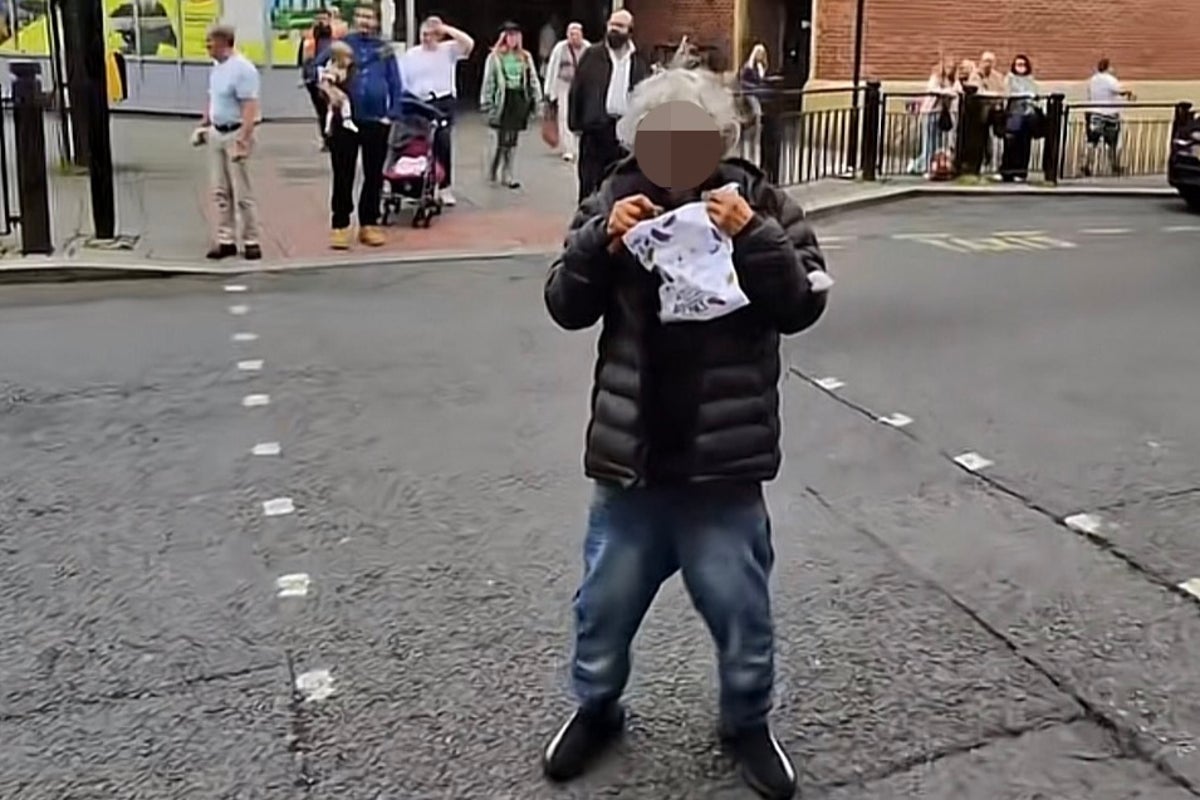
On a cold morning in Newcastle city centre, a woman is sat in a woolly hat and coat, blanket over her lap, playing the accordion. A man walks past and offers her a £20 note before quickly snatching it away when she goes to take it. He then swears at her before walking away.
All of this interaction is captured on camera without the woman even realising. It is then uploaded to TikTok, where it collects 4.2 million views and more than 5,000 comments. The vast majority of them are criticising him – but it doesn’t matter. For him, it is all engagement.
The man is a self-styled “auditor”, a type of content creator who records video in public spaces to test if public employees and police respect the legal right to film. But increasingly, people feel these creators are crossing a boundary from public interest to “exploitation”.
Last week in Newcastle, two “auditors” were issued community protection warnings (CPWs) – a civil warning that can be escalated to a notice and then to a criminal court if repeatedly breached – after the city council accused them of “ruthlessly exploiting” people going through “tough times” for likes. The council said the auditors had filmed vulnerable people using Meta glasses and uploaded them to social media, attracting comments that are often “dehumanising”.
“These are people who are setting out, it would appear, to film people who are experiencing vulnerability and using that to create clicks on social media,” Newcastle city council (NCC) deputy leader councillor Mark Mitchell told The Independent. “To us, that’s really exploitative”.
Videos seen by The Independent on one account include the creator filming vulnerable people while they are intoxicated, sleeping, and being arrested – often accompanied by comments where the individuals are ridiculed.
Mr Mitchell said the issue had become more obvious over the last few months, and that services helping vulnerable people in the city had reported users feeling less comfortable with accessing help because of it.
“Even if that only happens once, that is not acceptable,” he said. “It really is a form of bullying or harassing behaviour. We’re recognising that filming people who are vulnerable, either without consent or whether indeed they may not be able to give consent, is not okay.”
He said the overall issue of filming in public without consent is a “huge issue,” but emphasised what NCC is cracking down on is: “specific behaviour which is deliberate, is being repeated, and is being used for a specific purpose – to upload and get clicks”.
Mr Mitchell insisted the council will seek prosecution if the individuals filming fail to stop and called on the government to tackle secret and “exploitative” filming of the vulnerable in public places for likes on social media.
“A line needs to be drawn, and it is for parliament to consider how they determine where that line is and how you deal with this,” he said. “But the behaviour we’re talking about right now is far, far over any line that I think any reasonable person could draw.”
Police have attempted to take action over covert filming of vulnerable people by content creators in public spaces before. In 2024, a Greater Manchester Police (GMP) investigation saw a 27-year-old man arrested on suspicion of voyeurism and harassment, thought to be the first in the country linked to viral “nightlife” videos on social media platforms, where vulnerable women are filmed without their consent and posted online.
But in January this year, police said the criminal investigation had collapsed due to “limitations within the current legislation”. At the time, detectives said they would assess pursuing civil action.
Chara Bakalis, associate professor in law at Oxford Brookes University, said broadly speaking, filming in public spaces isn’t illegal, meaning police have struggled to take any legal action over secret filming.
“The use of technology is changing our understanding of harm so quickly that the law just can’t keep up,” she explained: “It’s not so much that the law has considered whether this is harmful and decided it isn’t. It is just hasn’t we haven’t even really thought about it in that way”.
But recently, there has been significant public backlash over Meta’s AI smart glasses, which have been labelled “pervert glasses” by critics due to cases of the devices being used to film women without their consent.
Prof Bakalis said Newcastle council’s shift to civil action is exposing a gap in the law and points to the fact that “authorities are really concerned about this”.
“If councils are beginning to use this, then obviously they’re finding that this is an issue that needs to be addressed somehow,” she added.
Prof Bakalis said she believes it is “almost inevitable” that lawmakers will be forced to act over covert filming in public. But questions remain over whether any potential law would cover filming on smart glasses specifically, or filming more generically.
“I think we will definitely see something about the idea of covert filming, and then the uploading of that and sharing of that being criminalised,” she said. “But I also think we will see more directly in terms of Meta glasses – where and when they can can be used and by whom.”
This week, the Liberal Democrats launched a campaign demanding stronger safeguards on smart glasses, including a ban on convicted sex offenders being able to purchase them.
A Meta spokesperson said: “Harassing content doesn’t belong on our platforms. We’re cracking down by removing it, taking action on the accounts behind it, and continuing to refine and evolve our enforcement efforts to stay ahead of anyone who violates our policies.”
TikTok and the government have been contacted for comment.
Join our commenting forum
Join thought-provoking conversations, follow other Independent readers and see their replies