
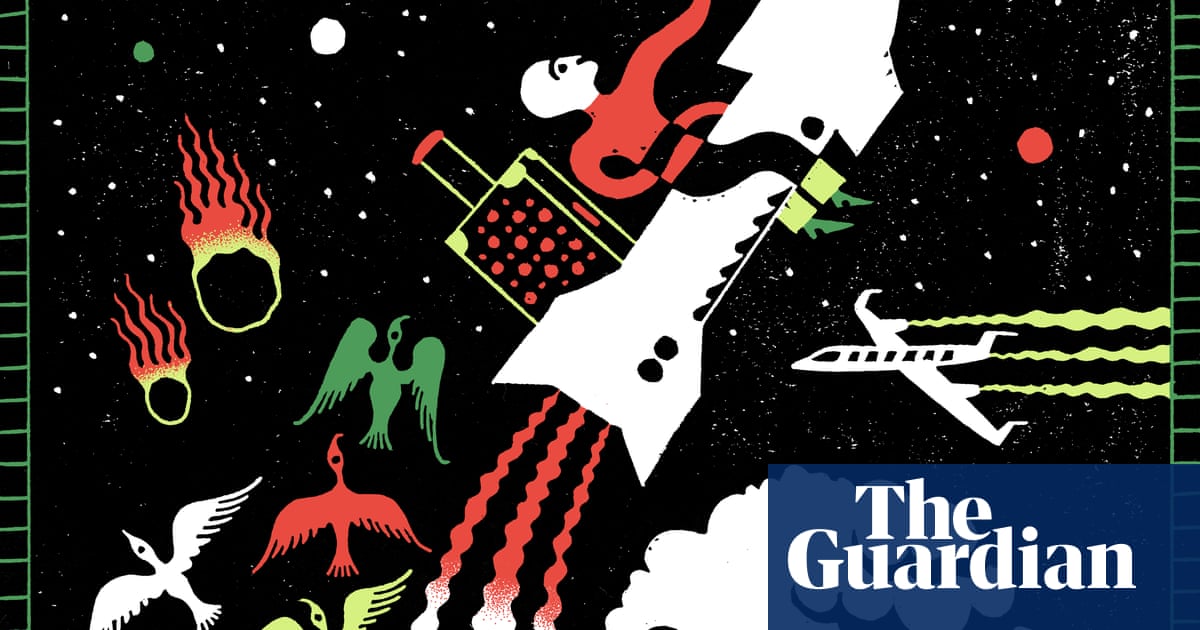
The end times fascists are plotting their escape from our world. Our mission is clear
An unholy alliance is working toward an apocalyptic future from which only a chosen few will emerge unscathed. It’s becoming clear how we stop them
When Jeff Bezos announced his plan for an opulent Venetian wedding in early 2025, many locals found the idea offensive, even obscene. A growing number of residents were struggling to find secure and affordable housing in a city overrun by tourists and Airbnb, and the billionaire was planning to, in effect, rent out the municipality for three days, forking over an estimated $50m for festivities that would clog central canals and block well-trafficked streets. Worse, Amazon’s carbon emissions were soaring, thanks to artificial intelligence and the datacentre build out – and that’s personal in Venice, where the streets already flood dozens of times a year.
Marta Sottoriva, a 35-year-old high school teacher, told us that she first heard about the wedding plans just when Bezos’s rocket company, Blue Origin, was grabbing headlines. Bezos had sent a “crew” of female influencers and celebrities, including his fiancee, Lauren Sánchez, and the pop singer Katy Perry, to the suborbital edge of space in a seemingly pointless publicity stunt. “The idea that you are so rich and powerful that you can use space as a 10-minute trip,” Sottoriva recalled, only intensified the “feeling that our city was being taken away from us in such an arrogant way”. Federica Toninello, another young activist, agreed, telling us that it felt as if both space and Venice were being “colonized”.
Colonizing space is exactly what Bezos hopes to do. Blue Origin, Bezos claims in his well-rehearsed sales pitch, will secure humanity’s survival by allowing a trillion people to one day spread across the solar system. The unbearable horror he imagines himself saving our species from? The threat of what he calls a “civilization of stasis”, otherwise known as having to contend with real ecological limits and devising a way to share the planet’s finite resources. To avoid this reckoning, Bezos imagines a future in which “Earth will be zoned residential and light industrial” and set aside as a sort of preserve out of reach for most of its native inhabitants. The vast majority of humans will pursue the nebulous benefit of “exponential growth” in the forbidding void of space, trapped on Blue Origin spacecrafts. It would seem that Bezos believes the prospect of humanity living sustainably and peaceably on our precious, singular home is a nightmarish possibility unworthy of his consideration.
Predictably, it turned out that most Venetians would rather continue living in magnificent Venice. Unlike Bezos, they don’t fret about hypothetical civilizational stagnation; they worry about economic stagnation as a result of government divestment, a lack of jobs and opportunity, and being forced out of the city and country they love. Young Italians often have little choice but to emigrate to find work; over the last decade, more than 1 million citizens have moved, a third of them between the ages of 25 and 34.
To date, the precarity and anger many Italians feel has mostly benefited the neofascist right. But those same forces also drew people to the anti-Bezos cause, helping to coalesce a budding, self-consciously antifascist movement.
The rise of end times fascism | Naomi Klein and Astra TaylorRead more
The spirited, disruptive “No Space for Bezos” campaign tapped into wells of outrage against billionaires, climate breakdown and militarism – and it also gave the organizers a megaphone to broadcast ideas for different, less lethal ways we could choose to live together. Activists printed posters and stickers showing Bezos’s head on a rocket blasting into space. They made a dummy of Bezos clutching fistfuls of fake money while clinging to a giant buoyant Amazon package, then set it free to float down the canals. They unfurled banners from Venice’s iconic buildings and bridges and across its piazzas: “Tax the rich to give back to the planet.” And they chanted that the money for the wedding would be better spent rebuilding Gaza. For days, they caused gleeful chaos and relentlessly poked fun at the groom and his star-studded guest list, which included his billionaire bunker neighbors Ivanka Trump and Jared Kushner, OpenAI’s Sam Altman and a gaggle of Kardashians.
Not long before the wedding, officials announced that the event was being moved to a less central location due to the protests. Even Bezos’s two yachts, Koru and Abeona, were denied permission to dock locally. Organizers declared victory and celebrated. The international press devoured the visual-rich showdown. And the online right didn’t know who to root for: the Davos elites spraying one another with foam on a superyacht, or the leftist riffraff making agitprop?
Like Donald Trump’s enormous ballroom, Bezos’s extravagant wedding epitomized the obscenities of our networked gilded age. For the Amazon founder, it wasn’t enough to be part of one of Europe’s most beautiful cities – he needed to consume it and swallow it whole. A year later he would do the same with New York City’s Met Gala, sparking similar outrage and grassroots creativity.
The Venice protests, which dwelled on Bezos’s dreams of outer space at the expense of Earth, pointed to something fundamental about the age of end times fascism – a concept at the center of our new book, referring to an unholy alliance working toward an apocalyptic future from which only a chosen few will emerge unscathed. Today’s battle lines are not simply between people who struggle to survive under increasingly degraded and costly conditions and an oligarch class thinking of ever more ludicrous ways to waste their wealth. They are more cosmological than that.
On one side are those of us who have no escape plan, no bunker in the sky or underground, and who therefore are committed to staying right here, in the complexity of our earthbound reality, with one another. We know we need to do what is necessary to make “here” – this planet and all of its ecologies and communities – and safer for the multitude of beings who rely upon them, fully aware this is our one and only home.
On the other are those with rapturous plans to shield themselves and their families from the political and ecological fires burning our planet, whether those plans take the form of heavenly ascension, earthly bunkers and fortressed nations, or fantasies of colonizing space and merging with machines. Instead of improving conditions for actual people on Earth (or even pulling back from pouring fuel on the fires), end times fascists are plotting their escape, indifferent and oblivious to all that’s worth saving.
An absence of awe
Bezos’s fixation on space gets at something else that is key to understanding end times fascism and its fixation on bunkering and abandoning our shared world: the apparent inability of the people driving this project to marvel at, or even notice, the wonders that surround them.
That was glaringly apparent in 2021, when Bezos sent another crew to space. This time William Shatner, best known as Star Trek’s Captain Kirk, was on board (to fulfill one of Bezos’s boyhood fantasies, of course). “Space. The final frontier,” Shatner had said at the start of each episode. But as the now 90-year-old actor watched our blue-and-green planet recede from the window, he was suddenly flooded with terror. “The contrast between the vicious coldness of space and the warm nurturing of Earth below filled me with overwhelming sadness,” he later recalled, explaining that he had gained a much deeper appreciation for our planet’s sublime and fragile gifts.
“Every day, we are confronted with the knowledge of further destruction of Earth at our hands: the extinction of animal species, of flora and fauna … things that took five billion years to evolve, and suddenly we will never see them again because of the interference of mankind,” Shatner wrote. He took the trip expecting to be awestruck by the universe and instead he longed for home the minute he left: “I discovered that the beauty isn’t out there, it’s down here, with all of us.”
Perhaps Shatner’s insight about our precious imperiled planet resonates with the Amazon founder, but the billionaire’s plans for space colonization and his company’s large expansion of carbon-spewing data centers both suggest otherwise. And among tech oligarchs, Bezos is all too typical. Peter Thiel, for one, once revealed that his three best ideas for achieving true freedom are “cyberspace”, “outerspace” and “seasteading” (the idea of building new countries on floating oil rigs). In other words, this man, whose enormous wealth affords him access to the most spectacular settings our planet has to offer, actually believes these three cold, dead places are superior to the Earth we have, verdant and alive.
Something similar seems amiss with Elon Musk, a man who seems to look up at the wonders of the night sky and see only opportunities to fill that inky unknown with his own space junk. The venerable novelist Joyce Carol Oates highlighted these apparent limits in the fall of 2025 when she roasted him ruthlessly on his own platform, X. “So curious,” she wrote, “that such a wealthy man never posts anything that indicates that he enjoys or is even aware of what virtually everyone appreciates – scenes from nature, pet dog or cat, praise for a movie, music, a book (but doubt that he reads); pride in a friend’s or relative’s accomplishment; condolences for someone who has died; pleasure in sports, acclaim for a favorite team; references to history. In fact he seems totally uneducated, uncultured. The poorest persons on Twitter [X] may have access to more beauty & meaning in life than the ‘most wealthy person in the world.’”
The observation clearly got under the tech baron’s notoriously thin skin: he called her “a lazy liar” and began posting approvingly about various movies to prove Oates wrong. Yet in Musk’s euphoria on the day his aerospace company, SpaceX, went public, he made no attempt to hide his boredom with our blue planet and its challenges: “We want to solve [problems] here on Earth and we should solve them. But there also have to be things that get you excited about the future, that make you glad to wake up in the morning because you can’t wait to see what happens next.” It would seem that only abandoning Earth provides that thrill.
Most people have the capacity for awe, to gasp at the jeweled beauty of a songbird or the otherworldliness of a whale’s exhalation or the intricate latticework of an ancient holy site. Children have the capacity for pure awe; so do 90-year-old actors in suborbital space. To experience awe is to dissolve into the swirl of the universe, to feel small in the best way. This sense of interconnection is also why we grieve when we witness strangers suffering, and feel the great sorrow of extinction. The fact that this capacity seems to be missing from the men who hold our collective fate in their hands is a personal loss for them – and an existential crisis for the rest of us.
One dangerous part of the tech oligarchs’ world-abandoning project is that the tools they are building are designed to remake us in their own broken image. Popular platforms and apps train us to share Silicon Valley’s dream of discarnate freedom, perpetually nudging us to forsake real places and in-person connection in favor of simulations – and to view Earth, our bodies and our relationships as prisons to hack and flee. Altman, for one, has made it clear that he sees “certain advantages to being a machine”, and he has repeatedly insisted that his own children will never be smarter than AI, as though intelligence can be reduced to no more than computation. Like similar services, ChatGPT is trained to hijack our empathic response systems so we, too, will elevate machines and imbue them with more significance than they deserve.
The inability to appreciate this planet and its marvelous cast of characters helps explain why they are so prepared to sacrifice it. Indeed, the tech right’s willingness to eliminate our life-sustaining labor and replace human relationships with synthetic ones cannot be separated from their indifference to what little remains of the planet’s fast-vanishing wildlife and plant diversity. They don’t seem to know how to love this place, to savor the pleasure of other people’s company, or to marvel at the mysteries presented by other species.
In short, we are up against an ideology that has given up not only on the premise and promise of liberal democracy but on the livability of our shared world – on its beauty, on its people, on our children, on other species. There is something treasonous in this. Treasonous not to an abstraction like a flag or a nation, for we are not nationalists. But treasonous to the unspoken pact made with the web of life that sustains us.
They are traitors to creation, to the wonders of here.
The antithesis of fascism
There is no cut-and-paste formula for fighting end times fascism. Whether it’s Venetians taking on Jeff Bezos or Albanians telling Jared and Ivanka Trump that their country is not for sale or a small town in Kentucky organizing against a sprawling datacentre, every front in this fight takes on the character and texture of its place. There are, however, some guiding principles that are beginning to emerge across locations, and Zohran Mamdani’s campaign for mayor of New York City – and his approach to governance since his election – embody many of them. Start from love of place, then conjure a radically inclusive future where everyone can afford dignified lives, embrace common goals across difference, get outside and gather offline and in person, take on the powerful joyously, draw on history and don’t be afraid to stir the soul.
Mamdani has pounded away at his core policies to make the city more affordable, and has made good on many of those promises in his pursuit, for example, to lower rent and expand universal childcare. But he has also done something more sublime, dwelling on the boisterous, charming corners of the city that are the reason so many people choose to endure the pressures pushing them to leave.
As Mamdani’s star was rising, fascists and neofascists across the country and around the world did what they do. They sorted and separated, ranked and expelled. They sowed confusion and division by claiming Mamdani wasn’t a real American, and blamed the left for every social problem and grievance. They held up multicultural New York as a supposedly terrifying example of what happens when the “great replacement” succeeds. JD Vance spoke out in defense of people’s right to not want to live next to people from “a totally different culture”, and Stephen Miller railed on X: “NYC is the clearest warning yet of what happens to a society when it fails to control migration.”
As the fascists drew their rigid lines – in versus out, protected versus disposable, “heritage” versus. invader – the campaign to elect Mamdani threw a year-long party that celebrated one of the most racially and ethnically diverse places ever known, five boroughs shaped by wave after wave of new immigrants who have made their homes on Lenape lands. With its every action, the campaign asserted that shared identity can be forged not just by ancestry but by a commitment to a shared home, and to a shared set of values about how to live together in that home.
New York is a city of people carrying countless hyphenations and keeping myriad cultural practices alive. But as Mamdani put it: “No matter what you eat, what language you speak, how you pray, or where you come from, the words that most define us are the two we all share: New Yorkers.”
So Mamdani explained the complexities of ranked-choice voting in the Democratic primary using a line of mango lassis as props. He canvassed for votes at queer clubs, shouted out Haitian revolutionary history at the massive Bayo concert, shared his favorite bagel order, and broke fast during Ramadan over biryani in the Bronx. Once in office, he also turned the now legendary Knicks playoff run and the 2026 World Cup into a summer-long party few will forget. In these ways and others, Mamdani re-enchanted a city that had faced relentless vilification from Washington as dangerous, dirty and dysfunctional.
It was a perfect encapsulation of “hereness” – an idea developed by the Jewish Labour Bund, a Yiddish socialist group that was founded in the 19th century and grounded in fierce commitment to place and community not based on bloodlines. Molly Crabapple, a proud New Yorker and artist who recently published a bestselling history of the Bund, made the connection in a piece published in the Guardian. “Like New York itself, Mamdani’s campaign was multicultural, multiracial, polyglottal,” she wrote. “When Andrew Cuomo tried to bait him as un-American, he released ads in Spanish and Bangla, Hindi and Arabic. He ran a campaign devoted to class-first politics that sought to speak to everyone in their own idiom, while never once apologizing for who he was.
Amid all this celebration of difference, Mamdani’s campaign also emphasized the kinds of daily experiences and anxieties that are common and unifying for nearly all New Yorkers, lingering in the ordinary places that are too often overlooked or reviled. Mamdani rubbed shoulders with commuters on packed subway cars, paid homage to the glories of the Staten Island Ferry, and visited countless bodegas, approaching the strangers he met with nonjudgmental curiosity and a smile so wide it became a punchline on Saturday Night Live.
But the campaign was not only antifascist – in the myriad ways that it celebrated the unruliness that makes New York lovable, it was also the antithesis of fascism. More than a rejection of hate, it was an invitation to kindness, to a world in which we avert our eyes from no one. That meant lifting up and honoring the very people fascists are most eager to eject and discard: the working-class, immigrant workforce that keeps the city functioning. The campaign shined a spotlight on delivery workers getting ripped off by platforms such as DoorDash, on Amazon warehouse workers fighting to have their unions recognized, and on taxi drivers in line at LaGuardia, one part of a nocturnal workforce that makes it possible for New York to boast of being the city that never sleeps.
Faced with the prospect of a fairer city funded by marginally higher taxes, some prophesied a billionaire exodus. Hedge-fund manager Bill Ackman threatened to leave along with other high earners and Fox forecast a “Mamdani Migration”. Luxury real estate agents reported being bombarded with calls from clients wanting to sell their penthouses and move to Palm Beach.
The threats of defection only underscored the mutually reinforcing nature of the two core themes of Mamdani’s campaign – the joyous love of here, even if here is kind of a wreck, and the concrete plans for repair and improvement. Because the more devoted you are to a place, the easier it is to put in the resources and energy required to improve it. It’s a politics based not on wanting to escape this earthly realm, whether our cities or our animate bodies, but on a deep desire to stay, and to protect all that is irreplaceable, human and alive.
This is the very same spirit that we’ve seen motivating people to protect their air and water from sprawling datacenters and to defend their immigrant neighbors from ICE. While reporting on the weeks-long uprising in Minneapolis, the journalist Adam Serwer memorably described the guiding ideology of the resistance as “neighborism”, or the “commitment to protecting the people around you, no matter who they are or where they came from”. It was an openhearted, welcoming ethic that united huge numbers of ordinary people to do something deceptively simple: protect the most vulnerable members of their community from what looked very much like an invading army. That meant everything from braving bullets, to cooking dinner to opening up spare rooms to families who were no longer safe at home.
In these and countless other ways, Minnesotans rose up to insist that their neighbors were already where they belonged, whether they were, as Serwer put it, born in Minneapolis or Mogadishu.
The human networks that neighbors are building, block by block, group chat by group chat, are about more than refusal. In our time of serial shocks and intersecting crises, they are also the basis for a different kind of survivalism. But while the various strains of fascists build bunkers for the few, ours are survival networks grounded in the principle that every one of us, without exception, deserves to live and thrive. They are also bound by a belief that keeping one another safe when the inevitable shocks arrive is a sacred duty. Part of that involves telling new stories, stories that are truthful and inspiring enough to help our depleted fellow humans fall back in love with our one and only home and defiantly recommit to defending it with all they’ve got.
Some worlds must end
Those stories cannot be about returning to something called “normal”, to what passed for calm before Brexit and Trump and Silicon Valley’s authoritarian turn. Those were the years during which too many problems were allowed to compound and fester: fascism is always a warped response to real crises. And end times fascism is a response to real planetary-scale crises, including ever-concentrating levels of carbon in the atmosphere and wealth in the hands of the super-rich. The responses it proposes – mass sacrifices of humans and non-humans alike – are monstrous and must be purged from our midst.
To achieve this, we will have to figure out how to address the underlying crises contemporary fascism feeds off of. Because boundaries are being crossed. Limits are being exceeded. Walls are being hit. Fascists want us to believe that what is hitting the wall is the human story: it’s over, so make sure you are among the chosen who transcend to the next world. Pray to your God for salvation. Implant the chip, merge with the machines. Militarize and purify your bunkered nation. Arm yourself to the hilt and hide behind your fortune. Don’t worry about the humans, the animals, the trees, the rivers and reefs that won’t make it.
But they are wrong. It’s not the human story that is hitting the wall. Rather, it is the story we have been trapped inside of. The one about how greed must be the engine of civilization. About how growth can go on for ever. About how there are always more efficiencies to be found, more workers to be rationalized, more resources to be sacrificed, more people, places and planets to colonize. These myths are hitting the wall of reality and much will have to change as a result.
AI companies will fail. We can salvage something from the wreckage | Cory DoctorowRead more
The logics that must be abandoned should be clear by now. Unlimited violence. Unconstrained exploitation. Insatiable wealth. Unchecked dominance. Those are the drives that make coexistence impossible. Looking forward, two paths beckon. We can abandon and betray this world, or we can break with capitalism and build new economic and political systems that honor life and prioritize care and repair.
Thankfully we are not starting from scratch. Our movement ancestors have left us maps to earthly Zions where everyone is welcome, to inclusive futures where peace and safety are core principles. Not the post-human future desired by end times fascists, but a post-capitalist and pro- (all of) life one. Deeply democratic, socialist, feminist, multiracial, multispecies, internationalist, generous, courageous and animate. Embodied and sensory, proudly earthbound.
And that, fundamentally, is the prospect that terrifies end times fascists more than anything else. It’s why Thiel denounces anyone attempting to regulate fossil fuels and AI as the antichrist; and why Trump and Vance smear nonviolent Minnesotans defending their neighbors as “domestic terrorists”. What keeps these men up at night is … us. It’s the possibility that a popular and vigorous movement will rise up and defend this planet and the many life-forms who call it home.
We didn’t choose to be born into a fight quite so fateful, but we have reached a choice point. We can either follow end times fascists into oblivion, or we can commit to building the unruly, boundary-crossing movement they so deeply fear. One that wrests away their weapons, holds them accountable for their crimes, and defends the paradise of here.
-
This essay was adapted from the book End Times Fascism: And the Fight for the Living World, out 15 September via Farrar, Straus and Giroux
-
Naomi Klein is a Guardian US columnist and contributing writer. She is the professor of climate justice and co-director of the Centre for Climate Justice at the University of British Columbia
-
Astra Taylor is a writer, organizer and documentary maker and a co-founder of the Debt Collective