
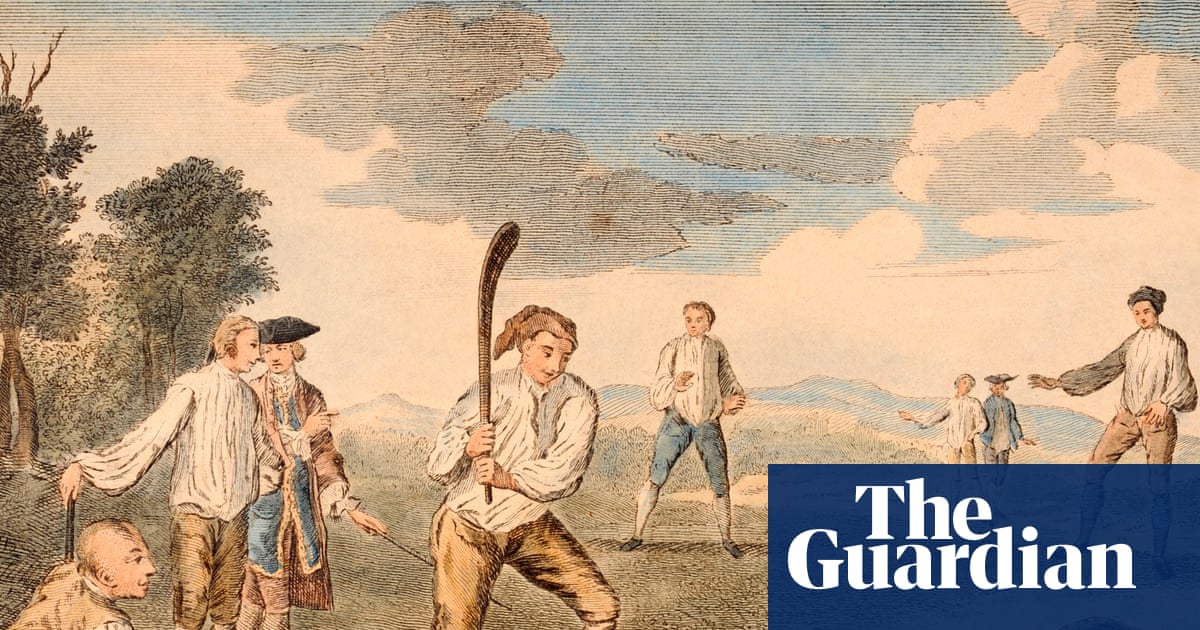
How Lumpy Stevens and two pubs led to the creation of cricket’s middle stump
A Surrey club match in 1776 near the Thames was the scene for the first time cricket employed its holy trinity
Cricket has had a long love affair with the number three. The ethereal batter walking down the steps after the dismissal of one of the Praetorian Guard – a Don Bradman, a Meg Lanning, a (reluctant) Joe Root.
The hat-trick, a bowler’s most showboating achievement – and a quick glass raised here to Henry Crocombe of Sussex, who just completed two in consecutive matches in the County Championship.
The triple century, a ridiculous feat of concentration and doggedness, achieved only 33 times in 2,634 men’s Tests. Then, of course, the three stumps, cricket’s holy trinity and symbolic stamp.
But the off and leg stumps did not always have a partner in crime in the middle. In cricket’s early days the wickets were more like a croquet hoop, with one long bail connecting the two sticks. The middle stump was introduced only towards the end of the 18th century, with the first match recorded 250 years ago last Sunday, on 6 September 1776.
The anniversary did not escape the notice of Chertsey Cricket Club in Surrey who, with Coulsdon (now merged with Chipstead and Walcountians), were one of the two sides to play in the game that changed the course of the sport.
Over to Martin Allen, of Chertsey, who found himself appointed the unofficial club historian. The work of him and his clubmates, trawling through the archives at Lord’s and at the Chertsey museum, has helped put some flesh on the bones of an event largely dwelling in the haze of 18th century record-keeping.
“The story began in late May 1775,” says Allen, “when Chertsey bowler Lumpy Stevens, then considered the best bowler in the country, was playing for London against Hambledon at the Royal Artillery Ground in Finsbury Square. He was bowling to John Small, who was accepted as the best batsman in the country at the time. Lumpy managed to get the ball through the gap between his leg and off stump three times without dislodging the bail.” Small remained at the crease and Hambledon went on to win the match.
Lumpy (as he was often pithily described) was not impressed. A large man, an innovator who helped transform bowling from underarm pea-rollers skirting the ground to underarm balls thrown in the air and allowed to bounce, and a big personality, his displeasure carried some weight.
Allen describes the great and the good of the game getting together that winter in two pubs – the Bat and Ball at Hambledon and the Star and Garter on Pall Mall in London. The result of their mutterings over long nights and tankards of beer was the voluntary introduction of a middle stump for the next season.
However, this was not set in stone and both captains would have to agree for the leg and off stump to be joined by a third. So the season passed with just two stumps in play, the autumn leaves starting to crisp and fall, until finally, on 6 September (or possibly the 5th) when Chertsey and Coulsdon met at Laleham Burway, a patch of land near the Thames, and three stumps were put in the earth for the first time.
Sadly, for such a historic occasion, that is about all we know, and there are no records of who won the game, the scoring presumably notched on a stick or two which was then thrown away.
But bowlers everywhere should be grateful for Lumpy’s large-shouldered complaints which brought them a third stump to aim at, even if they have lost what was the bowler’s prerogative back then, to plant the pitch wherever they fancied it, which perhaps gave rise to the verse: “Honest Lumpy did allow; He ne’er would pitch but o’er a brow.”
By the time MCC took over as custodians of the laws of the game from Hambledon a few years later in 1788, there was still no mention of the middle stump, with the stumps just decreed to be “twenty-two inches out of the ground, the bail six inches in length,” but the change was coming.
Chertsey’s anniversary has caught the imagination and the club has spent the summer celebrating, with visits from the MCC’s men’s and women’s sides and the Lord’s Taverners, under David Gower. Allen went up to the Oval to chat to Dan Norcross for Surrey’s YouTube channel and Sky were present last Sunday to film some of the anniversary match against Coulsdon, which Chertsey won comfortably. The same day, another of the club’s sides travelled down to Hambledon for a celebratory match and the club have also put up a blue plaque on their front wall.
“We are fiercely proud of it,” says Allen, “especially as we missed the chance to celebrate the anniversary of 1771 when Thomas White, who was playing either for Chertsey or Reigate, went out to bat with a bat as wide as the stumps – something that triggered a change in the laws for a bat to be limited to four and a quarter inches wide – which is still the width used today.”
Chertsey’s final claim to fame is that they were invited to France to teach cricket to the French in 1789. Off they went, arriving at Dover to meet everyone else coming the other way. On this occasion it was a boat they were glad to have missed.
-
This is an extract from the Guardian’s weekly cricket email, The Spin. To subscribe, just visit this page and follow the instructions.
Explore more on these topics