
Advertisement
You have reached your maximum number of saved items.
Remove items from your saved list to add more.
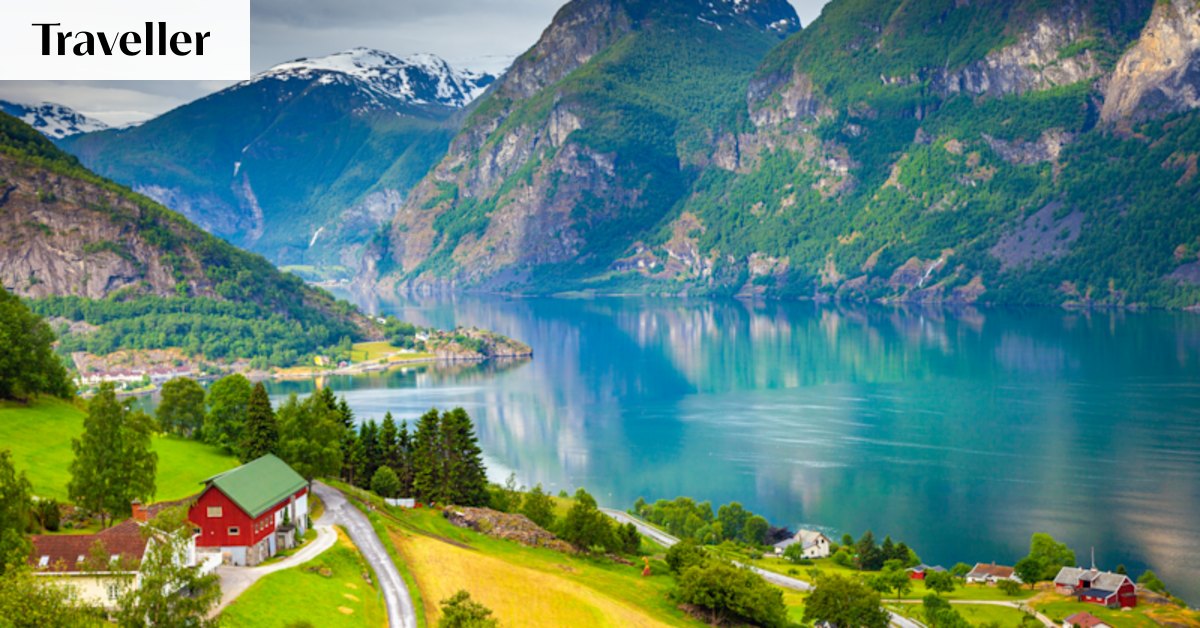
Anders Manum wakes every morning to the tinkle of sheep bells in his meadows and the low relentless roar of Feigefossen, the nation’s second-highest free-falling waterfall, across the fjord. He checks the weather and hoons uphill on a tractor-trike to his farmhouse hotel, Nes Gard, where alongside his guests, he packs a schoolboy lunch of cheese sandwiches in waxed paper.
With his matpakke (literally “food package”), in winter he’ll head with his guests into the fjordland’s mountains and glaciers for a day of remote ski touring. There are no ski lifts out here, no ski crowds. In summer, he takes his guests into high forests threaded with hiking tracks. “We are lucky,” he says, in typically Norwegian understatement.
It’s difficult to overstate the small nation’s good fortune. Norway’s 5.6 million citizens are among the richest people in the world and consistently named in the happiest top 10 nations. Massive reserves of North Sea oil and gas and the rare foresight to invest that abundant wealth in public rather than private wellbeing has delivered the world’s largest sovereign wealth fund, valued at $US2.2 trillion ($3 trillion). But it’s not just about wealth.
There are widely shared principles underpinning the world’s smallest income inequality gap, among them a measurable, deeply held belief in egalitarianism. And as I slip into Nes Gard’s lakeside sauna dominated by a direct sight line to Lustrafjord’s torrential waterfall, it occurs there might be something in the national packed-lunch routine – its simplicity and modesty – that helps explain Norwegian kos, a complex term that translates as something like intense, pure contentment.
Sign up for the Traveller newsletter
The latest travel news, tips and inspiration delivered to your inbox. Sign up now.
For sure, the extravagant beauty of Norway’s landscapes and the national enthusiasm for exposure to the elements is part of the story. Norwegians love their snow sports, which helps explain the nation’s relentless domination of the Winter Olympics. Norwegians love to forage and fish. They love a simple, uncluttered timber hytte (hut) by a lake – running water and electricity optional. They love to swim in their magnificent freezing fjords and smoke fish and sweat in saunas with family and friends.
Advertisement
So ubiquitous is the national pursuit of hytteliv (hut life), it’s been satirised by the Norwegian comedy duo Ylvis in a spoof song, The Cabin (“Sixty square metres of heaven on Earth … my own private pinewood Taj Mahal – except for the shape and the size”). As well as all these private cabins, there’s a network of about 600 affordable public cabins for democratic communion with nature.
Apart from friluftsliv (translating roughly as “open-air living”) and the viral Viking Row stadium chant that buoyed Norway’s FIFA World Cup quarter-finals success, what makes this clever, cool nation tick? How do the world’s richest and happiest people live? And what can travellers learn from them? To find out, we pack our bags and travel virtually the entire sinuous coastline of Norway, from Oslo in the south to the archipelago of Svalbard in the north, and deep into the nation’s longest fjord.
The Norwegian art of taking risks
Nes Gard sits high among the apple orchards of Sognefjord, the longest and deepest of western Norway’s fjords, where Manum’s family has farmed for generations. But there was nothing inevitable about the life he’s built here.
He studied economics – something of a rock star profession in Norway – and was a frustrated public service auditor living in Oslo during the pandemic when the chance came his way to take over the little guesthouse developed by his parents to diversify income on the family farm. “I’m not very good with risk,” the 48-year-old admits, “and it could have all collapsed. But I was ready for a change.”
Advertisement
Using the bean-counter’s most basic tool – Excel – and with an auditor’s attention to detail, Manum has overseen the construction of a few more guest cottages, including a striking mirrored-glass cube in a meadow, a conservatory cider bar, a fjordside sauna and boatshed, and has turned the cowshed into a breakfast room and the pig sty into a cool apres-ski bar. Most of his guests come for winter skiing or summer hiking, and long days outdoors are book-ended by hearty dinners of local produce served in the original whitewashed farmhouse, its dining rooms decorated with heirlooms and a framed family tree – circular, like the growth rings on a fir.
Manum is in good company among the mavericks and entrepreneurs of Sognefjord. One day, we collect boxes of organic produce from Botun, a tiny, intensively cultivated farm run by Mathilde Buch Larsen, a teacher who changed course forever during the pandemic. At a cellar door made from recycled timber, we meet a young couple, Marte Veivag-Aase and Hans “Hansi” Fredrik Bjarkoy, who left corporate careers to launch their own cider label, Kroken Fjordgard, a few years ago.
And over a flight of five ciders, we chat with Age Eitungjerde, a third-generation farmer and maker at Ciderhuset in the postcard-perfect town of Balestrand, dedicated to making his “champagne”-style Banholm ciders and preserving heritage apple varieties. We pack our lunches one day and catch a car ferry with Manum across Lustrafjord (an arm of the Sognefjord) to the church at Urnes, built in the early 12th century by men wielding axes rather than saws.
The nation’s oldest timber stave church is humble and magnificent. Beyond the little church, we follow a muddy sheep path through fir forest thatched by streams shivering with snowmelt, to a high clearing dotted by a couple of fairytale treehouses, one of them set up for holiday rental. They’ve been built by Manum’s friend, Ben Ward, a plucky Briton whose off-grid life in his handmade hytte has been documented in a national television series.
The scale of Ward’s single-handed achievement at his farm, Kroken, and the view from his front porch are dazzling. He’s off-site today but we chat with him by phone about his plans, sitting on the steps of his hytte like happy Norwegians, sun on our backs, eating our cheese sandwiches.
Advertisement
The Norwegian art of living outside the box
Across the Barents Sea, which separates mainland Norway from the High Arctic archipelago of Svalbard, we meet another young man who lives in an even more remote cabin. This one is 78 degrees north, way beyond the tree line, on the outskirts of the former mining town of Longyearbyen, the biggest settlement on the island of Spitsbergen. The North Pole is a mere 1300 kilometres away.
Matous Podolsky lives in a tiny hytte without electricity or running water, in the company of 80 Alaskan huskies he cares for and trains year-round. “Get ready for an instant reaction,” he grins and, sure enough, the dogs start lunging and howling hysterically the moment we bring out the harnesses. Only 16 will get a workout today on a pair of summer buggies on wheels. At other times, Podolsky says he tethers up to 20 dogs at a time to a motorised trike for their daily exercise.
Led by a wise white bitch named Yolanda, our buggy maintains a cracking pace over a rough gravel road, the Arctic wind whipping our ears, to the rusting outbuildings of No.7 mine. It closed in 2025, the last of the coal mines that have operated in Longyearbyen for the past 120 years. These days, it’s travellers and Arctic scientists, not miners, who keep the frontier town humming.
Czech-born Podolsky was working a menial office job when a daydream turned into a dream job in a husky camp at Basecamp Trapper’s Station. He’d never been to Svalbard, had never worked with dogs. Now he can’t imagine life without them. “The dogs give my life purpose,” he says, squinting into the full sun at twilight.
Advertisement
The camp is enclosed in a bowl of massive treeless mountains, streaked with ice and lunar-like gravel. When we approached Svalbard this morning by sea, after an eight-day northern coastal-hop on Hurtigruten’s MS Trollfjord, these mountains were mesmerising and impenetrable en masse. With feet on the ground out here, it’s the enormity of the sky that intimidates. It surely takes courage to live beneath it.
The swashbuckling history of Arctic exploration is littered with characters who refused to live conventional lives, who lived boldly, sometimes recklessly, “outside the box”. The Polar Museum in the Arctic Circle city of Tromso, among the best frontier museums I’ve seen, is full of stories of charismatic explorers seeking immortality, and winter trappers seeking Arctic foxes and polar bears.
There are rooms dedicated to the adventures of the great Norwegian explorers, Roald Amundsen and Fridtjof Nansen, and to folkloric characters such as the extraordinary Wanny Woldstad, one of Arctic history’s few female trappers, and Henry Rudi, “a living legend” who spent 27 winters in the Arctic and is said to have shot 713 polar bears.
Alberto Lozano is checking a tub of seal garum when we meet at Huset, his fine-diner on the gravelly outskirts of Longyearbyen. The pungent condiment sits among other tubs labelled “Reindeer Heart, Smoked and Dried”, “Lacto Fermented Green Tomato”, “Reindeer Tongue” and “Cloudberry Powder”, among others. This library of exotic ferments and flavours shapes Huset’s 14-course “Arctic experience” of roasted ptarmigan (a local grouse) and reindeer, koji-fied monkfish and mountain sorrel, cloudberries and seaweed.
Advertisement
In his profession, Lozano is as much a pioneer as last century’s winter trappers. Born in the south-east Spanish city of Albacete, near Valencia, the chef could have chosen an easier path five years ago than leading a seriously remote, highly ambitious restaurant in the Arctic Circle. “I’m in my 31st year in the kitchen,” he says, “It’s important for me to keep evolving, to keep challenging myself.”
Besides, he loves Svalbard: its uncompromising seasonality, its community of 66 nationalities and strong personalities, the austere beauty of the place. He whips out his phone and shows us a photo of him stirring rice over a campfire, surrounded by family and friends, beside his snowbound hytte on the other side of the fjord. “This is happiness,” he beams. “The small, simple things, the silence, they calm me.”
The Norwegian art of exposure to the elements
Silence, it seems, is a little like snow. To the casual observer, it all looks much the same, feels the same – until you really study it. From Longyearbyen’s no-nonsense port, we board a speedboat with a garrulous Danish captain fresh from duty in Greenland and head north at full throttle. We pass basking walruses the size of sedans, then nothing but ocean and skyscraping mountains. Suddenly, Longyearbyen’s remoteness is eclipsed by a different magnitude of silence and separation.
Ninety kilometres later, we disembark at one of the most remote hotels in the world. It’s certainly one of the few where guests are greeted with guns. Svalbard is prime habitat for the world’s largest population of polar bears, said to outnumber humans in these parts. The lodge’s armed and trained staff are constantly on bear watch, ready with flares and, in extreme danger, with rifles. In Longyearbyen, we’d quickly become accustomed to polar-bear warning signs and bear paraphernalia, but it was difficult to imagine a bear walking down the street (though, yes, it happens).
At Isfjord Radio, however, a bear sighting feels like a distinct possibility at any moment. The radio and weather station turned wilderness lodge – built in 1933, bombed by both sides during World War II, decommissioned in 1999 – is surrounded by tundra, mountains and ocean. A polar bear was spotted not far away just a couple of days ago, we’re told on arrival. Unfazed, reindeer graze outside our rooms. The presence of seals, whales, seabirds and foxes means even a short stroll under escort to the water’s edge at Cape Linne is an adventure.
And every five-course dinner conjured by chef Robert Rydland is a lesson in Arctic flavours and resourcefulness. Tonight’s meal includes fresh sourdough, reindeer tartare and roasted ptarmigan. And waffles with brown-cheese ice-cream. When we wake early, Rydland has already been up for hours making bread and pastries. Later tonight, he’ll go ice-fishing. It’s a common Norwegian trait to live a self-reliant, outdoor life, he says – “we all grow up playing in the woods”, and kids are taught how to use knives and axes from a young age.
For Rydland, the revelation is not so much the landscape as the isolation of Isfjord Radio, as part of a summer team of just six hardy souls. “You really learn a lot about yourself in this place,” he says. “You can’t blame others. You usually have to start and end with yourself.”
For station manager Maiken Løkke, living in the elements triggers a profound sense of peace. “Truly, I’ve never had this stillness of mind. I look out here,” she says, eyeing a zebra-striped mountain range, “and this has to be the closest to perfect peace.” Consider for a moment that she has spent the morning fixing the septic system. She shrugs. “You work hard and learn to be super-efficient here. And you enjoy the small things, the feeling of accomplishment when something is fixed, in a whole new way.”
One day, we climb aboard a Zodiac and sidle up for lunch beside a glacier, splayed like a frozen runway connecting mountains with a mirror-finish ocean.
Rydland produces bowls of warm rømmegrøt, a traditional Norwegian sour-cream porridge, and a plate of lamb prosciutto and flat bread. When we finish, we sit in the crystalline sunshine, silent. Or we think this is silence, until our driver-guide suggests we try his favourite thing – he calls it “Arctic meditation”.
So we sit perfectly still with him – for a minute or maybe 10 – with our eyes closed. Slowly the silence reveals itself as a presence rather than absence. It has weight. There’s no wash, no wind. There’s nothing to hear but the fizz of glacier melt and my own heartbeat. Perhaps this is the sound of Norwegian kos – of pure, simple happiness.
FIVE ESSENTIAL COASTAL STOPS IN NORWAY
Bergen
The gateway city to the Norwegian fjords is as pretty as can be and, in peak cruise season, as crowded as they come. The city caps cruise passenger numbers at 8000 a day, and most of them will be found coursing through the atmospheric harbourside district of Bryggen, founded in the 14th century by traders of the German Hanseatic League. The main Hanseatic museum building is scheduled to reopen in April 2027 after long restoration.
Andalsnes
This small town, largely destroyed during World War II, is the mountainous nation’s mountaineering capital, surrounded by soaring peaks and a river-threaded valley. The colossal Troll Wall, in particular, is visible from the town’s other big attraction: the Golden Train, one of Europe’s most spectacular train journeys.
Reine
Sandwiched between a fjord and jagged mountains in the highly photogenic Lofoten archipelago, and with a signature cluster of rorbu, Norway’s traditional red-painted fishermen’s shacks, Reine is the Norwegian fishing village from Central Casting. Even the stockfish racks are picturesque, still drying fish in the same way since Viking times.
Tromso
About 350 kilometres above the Arctic Circle, this vibrant university city is the gateway to the High Arctic and a splendid base for viewing the northern lights (in the even higher latitude of Svalbard, the aurora is less pronounced). Don’t miss two excellent museums: the harbour front Polar Museum, and the science-focused Arctic University museum. The city’s Arctic Cathedral is a stunning piece of Nordic modernist architecture.
Longyearbyen
There’s a hip Wild West vibe in the biggest town on the island of Spitsbergen, the largest of the vast Svalbard archipelago administered by Norway. The last of the coal mines closed in 2025, though the Dickensian mine shafts and outbuildings are still perched on the surrounding treeless mountains. Adventure tourism and scientific research fuel the economy; this is the site of the Global Seed Vault, for example.
THE DETAILS
EXPLORE
The boutique travel curator Up Norway tailors immersive adventures by ship, train, car and foot across Norway. Its 15-day Norway Beyond the Porthole journey is an example, from $23,349 a person. See upnorway.com
CRUISE
On Hurtigruten’s eight-day Svalbard Line North signature voyage, sail north from Bergen along the Norwegian coast and across the Barents Sea to Longyearbyen. From $5123 a person twin-share. See hurtigruten.com
FLY
Emirates, Qatar and Thai Airways fly one stop between Sydney and Melbourne and Oslo. See emirates.com, qatarairways.com, thaiairways.com
STAY
In western Norway, the 20-room farmhouse hotel, Nes Gard, is an excellent base for exploring Sognefjord, the nation’s longest fjord. In Svalbard, Basecamp Explorer runs the trapper-styled Basecamp Hotel in Longyearbyen, the Trapper’s Station dog-sled camp and excursions, and Isfjord Radio wilderness lodge. In Bergen, the grand 1862 stock exchange houses Bergen Bors Hotel, with meals served in a vaulted, frescoed hall. Nearby, Skostredet Hotel & Spa applies Japanese styling to Norwegian hospitality, with an excellent spa and izakaya. In central Oslo, Hotel Christiania Teater occupies an Art Nouveau theatre and former opera house.
MORE
upnorway.com
visitnorway.com
hurtigruten.com
The writer was a guest of Up Norway, Visit Norway and Hurtigruten.