
Advertisement
What in the World, a free weekly newsletter from our foreign correspondents, is sent every Thursday. Below is an excerpt. Sign up to get the whole newsletter delivered to your inbox.
Dhunche, Nepal: It’s raining in Dhunche, the small capital of Nepal’s Rasuwa district. That’s not unusual. It just makes everything harder.
The rain revives the quicksand left from last week’s raging flood, and picking through it for bodies is dangerous and painstakingly slow for the salvage teams. We’ve seen it.
Since the clouds rolled in, obscuring the aerial paths through the mountains, I haven’t heard a helicopter. Only they can reach the remote villages and destroyed tourist towns on the other side.
Advertisement
Even those living in townships spared by the flood will be relying on airdrops until the government rebuilds bridges.
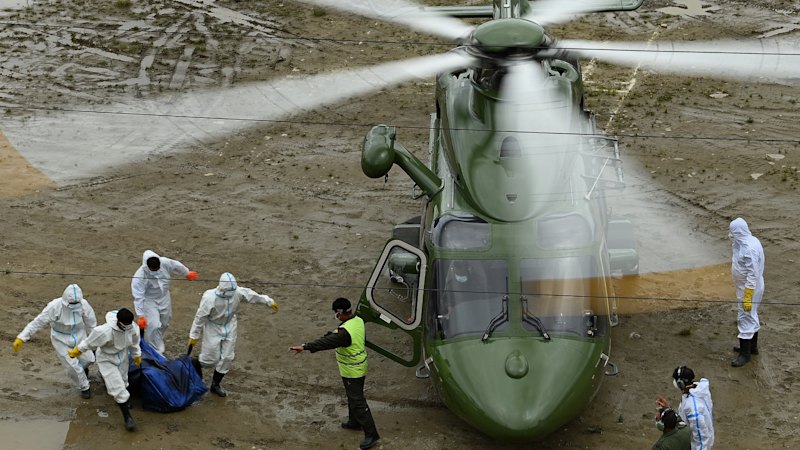
Weather permitting, helicopters take off and land every few minutes from a muddy patch of land at the police camp. We were there earlier as officers in hazmat gear loaded a dozen body bags into a helicopter bound for the mass graves in Chitwan district. The bodies will be exhumed if and when DNA testing confirms their identities.
The whirring blades of the choppers kicked up powerful wafts of rotting flesh. Some of the bags weren’t even close to full, indicating they carried either body parts or children.
Photographer Kate Geraghty and I have been in Nepal for about a week covering this profound tragedy. Innumerable Nepalese have made it possible, none more so than our invaluable fixer, Bishal Karki.
Advertisement
In our Australian newsrooms, teams of journalists, producers and editors have been working around the clock to deliver correct and current news to readers.
The three of us spent the first day or two in Nepal’s capital, Kathmandu, reporting on the disaster while working out how to get north – without a road or spare helicopter – to the worst-hit areas.
Bishal worked out that there was a back way from Kathmandu to Dhunche, a distance of about 50 kilometres as the crow flies, through the mountains. It took us nearly 12 hours, much of that time transfixed by the skilful manoeuvring of our driver, Ram, as he negotiated oncoming traffic on a one-lane road, avoiding plunging into the valleys below.
As darkness fell, the fog was so thick in one stretch that Bishal had to jog in front of our car holding his phone light as a beacon.
Advertisement
It’s important to be on the ground, to speak to people and see things firsthand, although the costs are immense. Australians should know what happened here. The Nepalese want people to know, too. They have opened their homes and hearts to us in their most despairing moments so that you do.
Covering a catastrophe like this is a heavy responsibility. When you can’t conjure the words, or feel that the words simply don’t exist to adequately convey what you see, you feel crushed by it. So you just stay up a bit later until you get close, at least.
No sentence or photograph, though, can fully capture the devastation.
One word that has never felt right since I first saw the online footage along with everyone else last Wednesday is “flood”. It brings images of community groups sandbagging, or vision from a helicopter as it sweeps over inundated homes.
Advertisement
What happened in Nepal wasn’t like that. It was like a tidal wave.
I’m thinking of the empty beds and chairs it left behind.
Outside, it is still raining, and I’m thinking of the survivors without a home.
Advertisement
Read more on the Nepal flood disaster:
- ‘I saw many dead bodies’: Worker’s harrowing escape from flooded tunnel
- Wastelands of mud: The death zone where not one body has been found
- Pilgrims saved: How sheer luck saved seven Australians from catastrophe
- In pictures: Grief and devastation in flood-ravaged villages
- Visual story: How the disaster unfolded
Get a note directly from our foreign correspondents on what’s making headlines around the world. Sign up for our weekly What in the World newsletter.
You have reached your maximum number of saved items.
Remove items from your saved list to add more.
More:
Zach Hope is South-East Asia correspondent. He is a former reporter at the Brisbane Times.Connect via email.AdvertisementAdvertisement