
Advertisement
Teachers at a Melbourne independent school were urged to get children “over the line” into the highest bracket of disability support to attract lucrative Commonwealth funding, an internal document reveals.
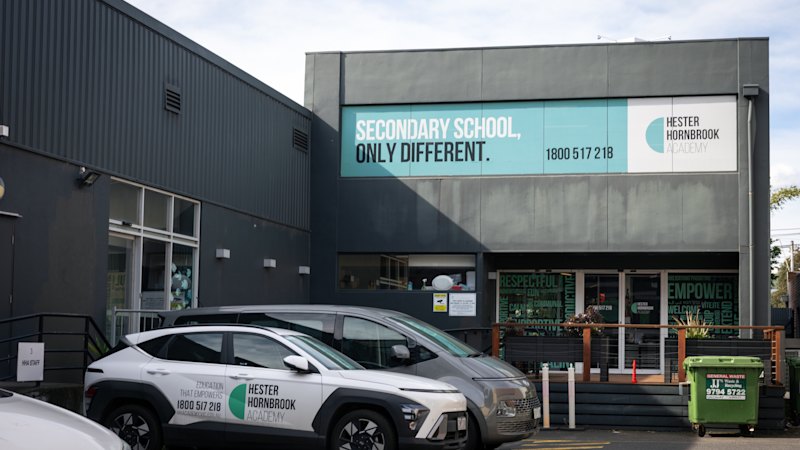
Specialist assistance school Hester Hornbrook Academy is facing a demand from the federal government to repay $23 million in disability funding that flowed from Canberra last year, after Department of Education auditors found it was claiming more than 90 per cent of students were in the highest “extensive” bracket.
But the special assistance school (SAS) denies it pressured staff to reclassify students, saying it asked teachers to ensure that all disability supports provided to young people were properly documented.
More than 20 teachers and other workers at the school have been let go this week – with further job cuts expected – as the school slashes its expectations of disability funding by $10 million as a result of the federal government cracking down on claims made under its funding scheme, known as Nationally Consistent Collection of Data (NCCD).
Advertisement
A school declaring a student is receiving “extensive” disability support can claim more than $45,000 in funding for the child from the federal Department of Education this year under NCCD rules.
A leaked extract from one of the periodic reminders sent from a senior manager to classroom workers appears to reveal the pressure on teachers at Hester Hornbrook, which enrols young people with cognitive disabilities and social or emotional challenges, to maximise the funding amounts flowing from Canberra to the school.
“Over the next week and a half our work in relation to NCCD is about: a. getting students that are close to the line over the line,” the senior leader instructed.
“B. where possible, identifying students that have met Substantial funding but only need a few more extensives [disability supports] to move up into the Extensive category, and supporting classroom teams to get these last few extensives.
Advertisement
“This makes a real difference to funding, so we want to record these additional extensive adjustments that were made.”
The school, founded in 2017 by Melbourne City Mission, caters for young people who are disengaged from mainstream education, charges parents no fees and is largely funded by grants from the state and federal governments.
A Melbourne City Mission spokesperson disputed the idea that staff were being pressured to obtain a higher bracket of disability, saying they were being instructed to “ensure that adjustments that had already been provided in classrooms had been properly recorded and supported by the necessary evidence”.
“Any suggestion that Hester Hornbrook Academy staff were directed to manufacture adjustments or artificially increase students’ classifications is incorrect,” they said.
Advertisement
The spokesperson said the board and management of Hester Hornbrook were working together to address the operational challenges currently facing the organisation.
“We fully acknowledge that the appropriate use of disability-related funding is an important issue,” they said.
“We reiterate that Hester Hornbrook Academy does not accept the Education Department’s draft
determination and is carefully considering the options available to us under the Australian Education Act 2013.”
The academy has grown rapidly, from fewer than 40 students at one site in South Melbourne to more than 700 enrolments across five campuses last year, and says it has successfully changed the lives of more than 2000 young people who would have struggled to complete their school in the mainstream.
The school’s Commonwealth grant revenue – 82 per cent of its total income – has soared from under $21 million in 2023 to more than $36 million last year, according to financial reports lodged with the charities regulator.
Advertisement
Hester Hornbrook students were funded about $64,000 each in 2024, more than three times the average rate of children at Victoria’s government schools. Saints College, an SAS school with regional and city campuses, received just over $50,600 per student in 2025.
Other SAS schools have students funded at a higher level, with Berry Street School – which receives additional loading for its size and location, as well as its high numbers of Indigenous and disadvantaged pupils – recording per-student income in excess of $76,000. There is no suggestion that Saints College or Berry Street has over-claimed its NCCD funding.
A parent with the child at the school, Kathy, who asked to use her first name for privacy reasons, said she’d lost sleep since learning Hester was being ordered to repay funding, out of fear for her son’s schooling.
Kathy said she enrolled her boy, who is neurodivergent, as he felt unable to attend three mainstream schools he’d previously been enrolled in due to his social and emotional challenges.
Advertisement
“Mainstream schools simply are not designed for young people with invisible disabilities,” she said.
“Hester Hornbrook’s the only school that offers young people like my son some hope and a chance to thrive.”
Kathy said her son had now been at Hester for about 12 months and attends school five days a week.
“He’s started talking about what he wants to do when he finishes school,” Kathy said.
“Whereas before he got to Hester Hornbrook I was in no man’s land and thinking about having to stop work.”
Advertisement
The Hester Hornbrook spokesperson said it prioritised ensuring ongoing education and support to its young people and families.
Read more on education:
- Schools Guide: See performance data for schools in your area
- Revealed: Melbourne’s most popular high schools
- VCE: What Victoria’s perfect ATAR achievers all had in common
- Special exemptions: The most common reasons revealed
- Cash cuts: The private schools that will miss out on millions
The Morning Edition newsletter is our guide to the day’s most important and interesting stories, analysis and insights. Sign up here.
You have reached your maximum number of saved items.
Remove items from your saved list to add more.
More:
Alex Crowe is an education reporter for The Age.Connect via X, Facebook or email.AdvertisementAdvertisement