
Advertisement
US President Donald Trump said he would like to see Ireland “unified,” a remark that puts him at odds with UK Prime Minister Andy Burnham who recently said the issue is off the table.
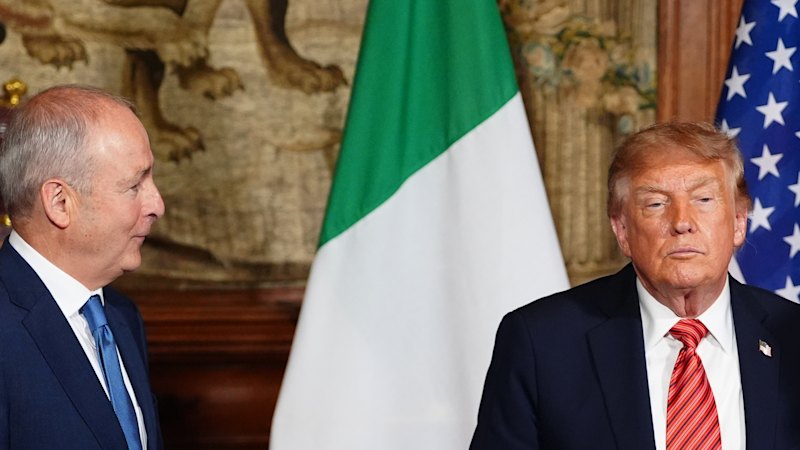
“I’d love to see it united,” said Trump in relation to the Republic of Ireland and Northern Ireland. He made the remarks on Saturday (Irish time) during a meeting with Irish Prime Minister Micheál Martin in Dublin, before a trip to his golf course in the west of Ireland.
The issue of a border poll, as the vote on unification is known, is contentious in both the UK and Ireland, which act as co-guarantors of the 1990s peace accord that largely ended sectarian violence between British unionists and Irish nationalists in Northern Ireland.
While support for Irish unification is growing in Northern Ireland, recent polling suggests there is still no clear majority in favour. In the Republic of Ireland, unification is an aspirational goal of many but its government has stressed the need to prioritise cooperation between north and south.
Advertisement
Burnham’s position on a border poll in Northern Ireland remains as he stated in recent comments in parliament and during a visit to the region, a spokesperson for his office said. “The Prime Minister is committed to upholding the Good Friday Agreement which sets out the threshold for consent for a border poll,” said the spokesperson.
Martin said recently that there had been an overreaction to Burnham’s remarks. “It’s no different to what any previous British Prime Minister has said in recent times,” he said.
The US played a major role in the brokering of the Good Friday Agreement, the landmark treaty that brought an end to decades of violence in Northern Ireland, known as the Troubles.
“I don’t want to cause any problems, but I will tell you, I’d love to see it unified. I have friends on both sides,” said Trump. “It would be a great feather in everybody’s cap if that happened.”
Advertisement
Trump’s comments drew criticism from unionist politicians in Northern Ireland. Gavin Robinson, leader of the Democratic Unionist Party, said in a social media post that the region’s constitutional future “will be decided by the people of Northern Ireland, not by commentary in London, Dublin or Washington”.
Later in a speech at an event convened by the US embassy in Ireland, Trump appeared to acknowledge the controversy his comments might cause. It came from reporters who ask questions designed to provoke grand-slam home runs, he said. “That’s one of those questions where, no matter what you say, no matter how well you say it, there’s no good answer,” Trump said. “We’ll read about it tomorrow.”
Bloomberg
Get a note directly from our foreign correspondents on what’s making headlines around the world. Sign up for our weekly What in the World newsletter.
You have reached your maximum number of saved items.
Remove items from your saved list to add more.
More:
AdvertisementAdvertisement