
Advertisement
Hoodies with cameras hidden in the drawstrings, glasses secretly taking photographs, hidden earpieces receiving information – wearable technology has opened a new front in universities’ war on the global criminal syndicates that seek to profit from cheating students and undermine exams.
Largely based in mainland China, contract cheating syndicates are deploying increasingly sophisticated technology from the $157 billion wearables industry, leaving students vulnerable to blackmail and universities scrambling to ensure their qualifications remain valuable.
The syndicates charge between $2000 and $5000 a subject, have local strongholds across Sydney and are turning to increasingly brazen tactics to funnel students into their schemes.
In the lead-up to exams, students collect gear – a “cheating jacket” that features parts of old mobile phones sewn into its lining, smart glasses, a button camera or a camera hidden in the drawstring of a hoodie – from the Sydney base and covertly take the equipment into the exam.
Advertisement
These devices are used to photograph and send the exam paper to the local base and passed on to a contract cheater. These may be in Australia or offshore, typically in Nigeria or India (both home to underemployed, highly qualified English speakers). They send the answer to the Sydney headquarters and that is relayed to the student via a hidden earpiece, some so small they need to be removed from the ear with magnets.
During the winter exam period at the University of Sydney, first-year courses across economics, chemistry, business and computing were all affected by cheating. The University of NSW also had a cheating incident inside an exam lab earlier this year that involved wearables, and the University of Melbourne has had similar incidents.
Universities across the globe are grappling with this. Numerous Chinese provinces now physically inspect glasses, while in Japan, a proposal to block the internet at exam venues was rejected because of the cost of installing giant Faraday cages. Spanish authorities are considering Bluetooth blockers, while doctors in Russia have reported students needing medical attention to remove tiny earpieces that got stuck.
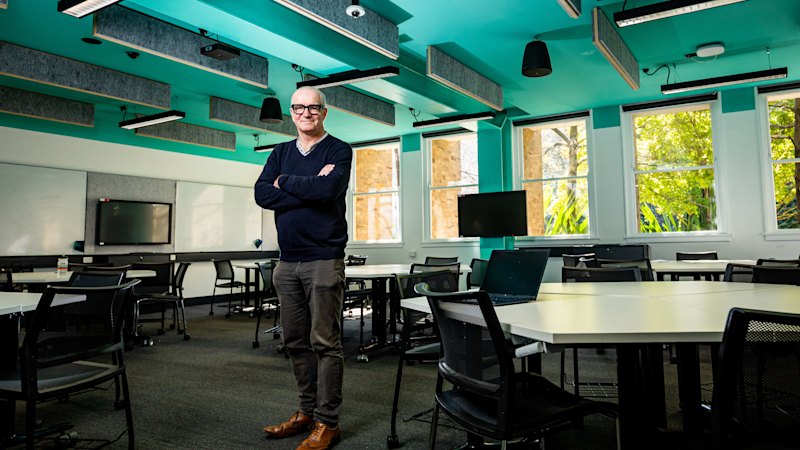
University of Sydney pro-vice chancellor for educational innovation Adam Bridgeman said this method of cheating had been detected in the winter exam period. There was “very strong evidence” of cheating using wearables in about 20 cases across 11 exams, which were sat by 10,500 students.
Advertisement
Research from the University of Western Australia from 2022 found that about 10 per cent of students engage in contract cheating.
International students, who can be under immense financial or social pressure and can experience language difficulties, tend to be overrepresented in those numbers.
Students are approached at the start of semester – either via social media or on campus.
“In our recent welcome week, we had to have a squad coming through to make sure all our stall-holders were legitimate,” Bridgeman said.
Advertisement
Often, cheating syndicates set up “very professional-looking” stalls outside university grounds that promote tuition services or help with visas.
“We’re seeing QR codes – the student scans it, and they’re in the system. Some students will be knowing what they’re getting into, but some would have just exposed themselves to their name being held by these criminals.”
Tensions over cheating were further fuelled when the syndicates uploaded photographs of an exam to Chinese social media sites RedNote and Dougin in real time.
The uploads initially puzzled onlookers, who were confused about the benefit of sharing an exam in real time. Bridgeman explained: “The sharing is mostly about advertising, it’s saying this is what you can get for $4000.”
Advertisement
Bridgeman’s team uses both people and AI agents to scour the internet, including the dark web, for evidence of cheating. It has also uncovered a number of fakes.
“We compare them with the actual exam paper. Some are fakes, with all the hallmarks of having somebody say ‘Write an Econ 1001 exam’. What comes up is an AI-generated, poorly constructed paper purely for the purposes of showing off or advertising,” he said.
A University of NSW spokesperson said it expected students to comply with rules around wearables and complete assessments honestly, while University of Melbourne deputy vice chancellor for education Professor Gregor Kennedy said it closely monitored all exams and investigated all reports of suspected cheating.
The syndicates have also been known to threaten students with exposure if they fail to comply or pay.
Advertisement
“There is strong evidence of blackmail,” Bridgeman said. “Students are told, ‘Take that camera into the exam or we will inform the embassy or the police’.”
Students are told to say they have been blackmailed if they are caught, Bridgeman said.
“We have photos from offices of these companies where we see our letters from our integrity office, where we’d have to drop the case, boasting about their reach,” he said.
The Tertiary Education Quality and Standards Agency, the university regulator, said it was aware of reports of wearables being deployed by contract cheating syndicates.
“Staff, students or members of the public can … report advertisements, solicitations and offers of access to assessment materials.”
Advertisement
If caught, students can be suspended or expelled, though the University of Sydney did not mete out any of these punishments after the last set of exams (the University of Melbourne and UNSW did not respond to questions about how many students were caught).
When the next set of exams roll around, the University of Sydney is looking at technical changes, renewed exam design and increased supervision.
UNSW said it continuously monitored exams, calling wearable cheating “detectable” and “when found, a range of penalties apply, up to and including exclusion from the university”.
In Melbourne, staff were looking to increase secured assessments such as oral exams, Kennedy said.
Advertisement
The question of what to do is an existential one for universities. As well as devaluing the degree and undermining honest students, assurance of learning – students being able to do what their qualification says they can do – is a condition of registration for Australian universities.
“We take it incredibly seriously,” Bridgeman said.
Start the day with a summary of the day’s most important and interesting stories, analysis and insights. Sign up for our Morning Edition newsletter.
You have reached your maximum number of saved items.
Remove items from your saved list to add more.
More:
Sally Rawsthorne is The Sydney Morning Herald’s higher education reporter.Connect via X or email.AdvertisementAdvertisement