
Advertisement
She wrote Australia’s best-selling political biography, won glittering prizes, had a novel made into film and was portrayed in a television soap opera, but her most public role was playing the woman who waited for the man she loved.
Blanche d’Alpuget’s not-so-clandestine affair with Bob Hawke was conducted just before private lives of the great and good – such as Prince Charles and Princess Diana, and Camilla Parker Bowles, and Bill Clinton and Monica Lewinski – erupted into tabloid, magazine and reality television entertainment.
She was the mistress Hawke dumped for his wife, Hazel, and the prime ministership. He feared his philandering would cost Labor 3 per cent of the vote. But the affair was problematic for d’Alpuget too: a leading feminist who built a career on talent and a knack for attracting attention, she could not be seen to be undermining an older woman who personified loyalty and modesty and was genuinely liked and admired across Australia.
So for three decades d’Alpuget remained in the shadows until, one day, her prince did come. She had other relationships, was busy with motherhood, but mainly she wrote.
Advertisement
Her admiring Hawke biography won the 1981 NSW Premier’s Award for non-fiction; Turtle Beach won the 1982 The Age Novel of the Year. She collected an inaugural Commonwealth Award for Literature in 1987. Two years later, Turtle Beach flopped as a film. Greta Scacchi played the d’Alpuget role.
In later years, d’Alpuget borrowed leaves from Colleen McCullough and Hilary Mantel and began penning historical novels. They were set in Plantagenet England.
She died on Wednesday aged 82.
Josephine Blanche d’Alpuget was born in Sydney in 1944, the only child of Josephine Curgenven and Lou d’Alpuget, news editor of the then Packer-owned afternoon tabloid newspaper The Sun, who as a yachting writer sailed Sydney to Hobart races and chronicled Frank Packer’s America’s Cup campaigns. Her grandfather, Lou d’Alpuget, was a famed rugby league player who scored Eastern Suburbs’ first goal in the code’s 1908 inaugural season and was a founding member of the Bondi Surf Club. D’Alpuget was named in honour of her great-aunt Blanche d’Alpuget, a pioneering women’s journalist.
Advertisement
D’Alpuget grew up in Potts Point. She attended SCEGGS Darlinghurst and began a science degree at the University of Sydney before fighting with her father over a relationship with an older man and leaving home. The vein of journalism that ran through her family ensured a cadetship, although it was Rupert Murdoch’s Daily Mirror she joined, an afternoon rival to her father’s newspaper.
Contemporaries recalled how closely she resembled another Mirror cadet journalist, Anna Torv, who went on to become Murdoch’s second wife. D’Alpuget also met her first husband, Tony Pratt, at the Mirror.
She was a notorious blithe spirit who impishly skewered the demure Torv with shocking stories. The highpoint of her writing at the time seems to have been the Beatles’ first press conference at Mascot in June 1964, when she chaperoned teenage girls who’d won a Mirror competition to attend Paul McCartney’s birthday party.
Advertisement
In 1965, d’Alpuget married Pratt, who’d joined the Department of Foreign Affairs. The following year – with Indonesia still a charnel house as the Sukarno government continued to slaughter communists, ethnic Chinese and unbelievers – the couple moved to Jakarta. She worked in the Australian embassy news and information bureau.
They were regarded as the “golden couple” of the diplomatic corps, but after four years, he left to perfect his craft, and she went alone to Malaysia. In 1972, they settled in Canberra for the birth of their son, Louis. She was involved in the fledgling Women’s Electoral Lobby, but the marriage started to unravel and the typewriter beckoned.
D’Alpuget’s South-East Asian years provided centrepieces for early writing. Her fiction was laced around a journalist’s appreciation of the big news story – the 1965 Indonesian coup (Monkeys in the Dark) and Vietnamese fleeing to Malaysian refugee camps (Turtle Beach) – but it was her earlier work, a biography of Sir Richard Kirby – the man who oversaw court decisions giving equal pay to Aboriginal stockmen (1966) and equal pay to women (1969) – that established her credentials.
D’Alpuget had met Sir Richard in Jakarta when he was president of the Commonwealth Conciliation and Arbitration Commission. Her 1977 biography, Mediator: A biography of Sir Richard Kirby, was the first time that Australians were made aware of the danger he faced while prosecuting Japanese war crimes and resolving differences between the Netherlands and its former East Indies colonies as they struggled towards independence.
Advertisement
D’Alpuget had encountered Hawke in Jakarta in 1970 when he was the newly installed president of the ACTU, having spent the previous two decades arguing cases before the commission. Naturally, she sought him out in 1976 while researching her Kirby book. Hawke was cementing his reputation as the great conciliator, flying around Australia settling industrial disputes that flared after prime minister Malcolm Fraser’s hard-line industrial relations stand and the union movement’s de facto leadership of Labor following Gough Whitlam’s rout at the recent federal election.
Hawke was living a sort of rock’n’roll lead-singer lifestyle engaging in relationships and casual affairs with women across the country, including with d’Alpuget.
Their affair became more exclusive, and he proposed in 1978. The relationship was an open secret among Labor cognoscenti, worried what exposure would do to a man with leadership aspirations: Hawke had been Australian father of the year in 1971, and his wife, Hazel, had personified the dutiful wife in the years that he built his national profile.
Advertisement
In 1979, Hawke chose career over d’Alpuget. He stopped drinking, too. But they never really let go.
The non-couple started collaborating a year later on her admiring Robert J. Hawke: A biography, a 1982 book that had the felicitous coincidence of being published as her former lover firmed as favourite for prime minister.
Then, as Hawke roared into an eight-year stint as prime minister, d’Alpuget took a walk in his shoes. Hawke had been a strong advocate of Israel since meeting Golda Meir in 1971. “I’m an Israeli. If I were to have my life again, I would want to be born a Jew,” he told d’Alpuget for the biography. She went to Israel.
The result, in 1986, was Winter in Jerusalem. Her book told of an Australian screenwriter who returned to the land of her birth during the first Lebanon war and fell in love. It sold little, but it is not a stretch to see it as a love letter to Hawke.
Advertisement
Pratt and d’Alpuget divorced, and she moved to Sydney. She raised her son, and busied herself on the ACT Arts Advisory Council, the Copyright Agency Ltd, the Australian Film Commission and chairing the Australian Society of Authors. She also wrote two more books, including White Eye, a crime novel around animal liberation. Then one afternoon, in November 1988, the phone rang …
As they rebooted their affair, Hawke’s prime ministership was starting to peter out. D’Alpuget stayed in the background, taking the time to write an essay, Lust, in 1992, in which she revealed a nameless judge who lived next door to her family home had started molesting her when she was 12. The essay received wide media coverage.
The following year, d’Alpuget was in a light plane that crashed off the Whitsundays. She got out a window and swam to a nearby yacht, and when she rang a friend to tell Hawke she was unharmed, he received such a shock that he resolved to marry her.
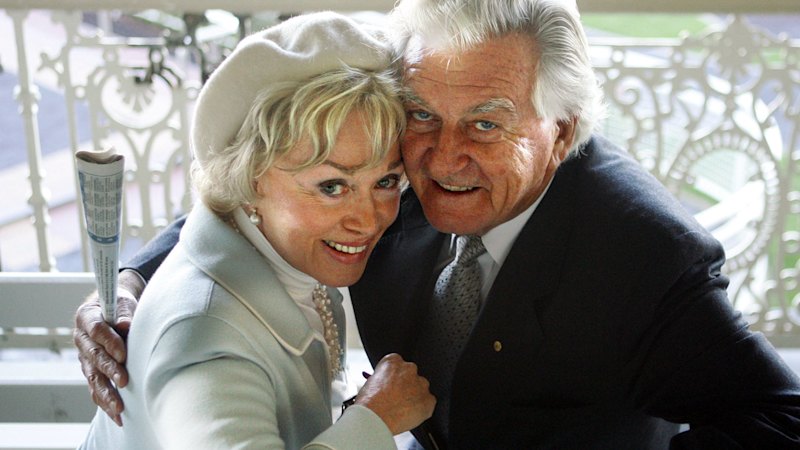
The Hawkes announced their separation in 1994. Eight months later, Hawke, then aged 66, married d’Alpuget. Their wedding press conference, in matching terry towelling dressing gowns at Double Bay’s Ritz-Carlton Hotel, was an early version of post-coital reality television.
They jauntily starred as Australia’s most high-profile cuddly couple (in fact, Network Ten turned the marriage into prime-time soap with a television film, Hawke, in 2010 – Asher Keddie portrayed d’Alpuget) and travelled constantly as Hawke embraced the spoils of retirement. They unfailingly stumped up for Labor at each election.
Advertisement
In 2008, five years after Hazel Hawke revealed she was suffering from Alzheimer’s disease, d’Alpuget penned another essay, On Longing, obliquely nodding to a nameless Hawke as her muse and the tension between love and writing.
“Hawke and Hazel had enjoyed young love,” she wrote in an update for On Longing. “He and I enjoyed mature love.”
Hazel Hawke died in 2013. Hawke died in 2019.
Advertisement
In March 2020, d’Alpuget started chemotherapy after discovering a lump on her breast.
She spoke about her breast cancer, the mastectomy and subsequent breast reconstruction in the book Fridays with Blanche, written by Derek Rielly and taken from regular Friday lunches between the pair in her Sydney apartment.
The book, which followed Riley’s previous work Wednesday’s with Bob, delved into all aspects of d’Alpuget’s life including motherhood, her career as a writer, her love affairs and her intense dive into spiritualism, which culminated in training as a priest with the Independent Church of Australia.
The book, d’Alpuget said, was a compromise. Her agent wanted her to write her autobiography but she “didn’t want to go into all that stuff”.
Advertisement
“Some of my childhood was quite traumatic, and I didn’t want to be raking that up again,” she told this masthead over lunch last year. “And to write, you have to be passionate about wanting to do it because it takes so much of your energy.”
Her son, Louis, and stepchildren Sue Pieters-Hawke, Rosslyn Dillon and Stephen Hawke survive her.
Start the day with a summary of the day’s most important and interesting stories, analysis and insights. Sign up for our Morning Edition newsletter.
You have reached your maximum number of saved items.
Remove items from your saved list to add more.
More:
Damien Murphy is a senior writer for The Sydney Morning Herald.Connect via email.AdvertisementAdvertisement