
Advertisement
Forget stadiums. The urban planner who helped popularise the worldwide Ciclovia movement says Brisbane’s most powerful Olympic legacy could begin by simply closing streets to cars and letting people take over.
Gil Penalosa, founder of non-profit organisation 8 80 Cities and a leading advocate for creating people-focused urban spaces, will be a keynote speaker at the Transport Professionals Association national conference, which started in Brisbane on Tuesday.
As Bogota’s parks and recreation commissioner in the 1990s, Penalosa championed and expanded Ciclovia, which closed the city’s streets to traffic between 7am and 2pm every Sunday, giving pedestrians and cyclists free rein.
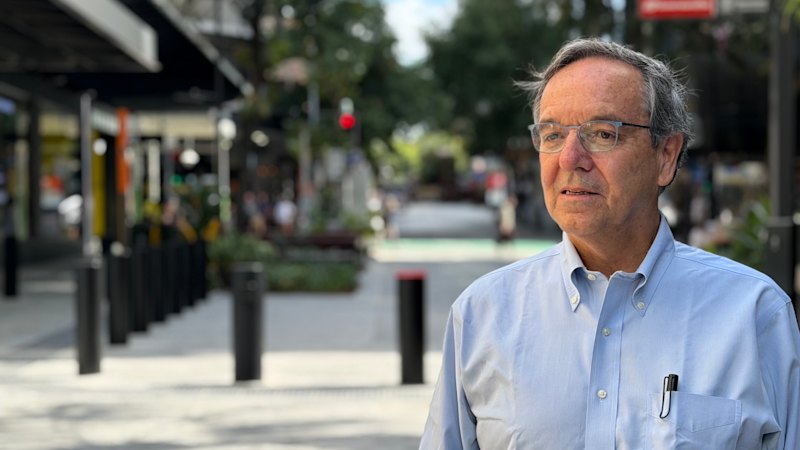
Speaking on Albert Street, which was recently converted to a pedestrian boulevard in the Brisbane CBD, Penalosa said the movement was as much about social integration as recreation.
Advertisement
Reading a biography of Frederick Law Olmsted – the American landscape architect who designed Central Park in an attempt to bring New Yorkers together – inspired Penalosa’s passion.
“One-hundred-and-seventy years ago in New York, he said everybody hates everybody – the locals and the immigrants, the blacks and the whites, the rich and the poor – and they don’t meet each other as equals,” he said.
“They don’t live in the same buildings. Their kids don’t go to the same schools. They don’t even go to the same restaurants.
“I realised, wow, that’s the same thing with the cities everywhere. Every city could have this connection of people, even without having Central Park, by using the streets.
Advertisement
“That’s why I was obsessed with it – connecting the wealthiest neighbourhood and the poorest neighbourhoods every Sunday.”
Ciclovia has spread around the globe to varying degrees, though it has had most success in South America.
“It’s good for integration. It’s good for health, for physical, mental, social health. It’s good for the environment. It’s good for economic development,” Penalosa said.
On that latter point, Penalosa recalled examples from Guadalajara, Mexico, where restaurants began opening along Ciclovia routes, and California, where even a furniture store was able to cash in on the phenomenon.
Advertisement
“In San Francisco, I saw a sign said ‘free restrooms’ in a furniture store, and I thought that was crazy – everybody normally says ‘no restrooms’ [for non-customers],” he said.
“So I asked the manager what was going on and he said, ‘When people buy, we always ask them how they got to know about us’ and people were saying it was because of the Sunday bikeways.
“They come in here for the restroom, which is in the back of the store, and they walk past all the furniture.”
Penalosa said Ciclovia was a low-risk, high-reward first step for Brisbane to embrace a more pedestrian-friendly city in time for the 2032 Olympic and Paralympic Games.
Advertisement
“The big legacy of LA [1984] is, ‘We didn’t lose money’,” Penalosa said.
“Who cares? Well, you did nothing to improve the city. It would have been better if you had lost money and done something about it.”
Brisbane should instead look to 1992 Olympic host Barcelona for inspiration, Penalosa said, as an example of how a major sporting event can reshape a city for generations.
“Barcelona hosted the Olympics and split the history of Barcelona in two,” he said.
Advertisement
“Barcelona was a mediocre city, and afterwards became a spectacular city that today is still one of the nicest cities in the world for everything: for walking, for cycling, for playing, for trees, for parks, for public spaces.”
More recently, Paris Mayor Anne Hidalgo used the lead-up to the 2024 Olympics to rapidly expand the city’s protected cycling network, adding 400 kilometres in the lead-up to the Games.
“Five years before the Olympics, [she said] everyone in Paris is going to have a protected bike lane within one kilometre, and within five years, she had it,” Penalosa said.
“She started building and building and building an amazing network of protected bike lanes because that was her goal.
Advertisement
“Now, if you go and ask anyone in Paris who won a gold medal or not, people don’t remember. But people do remember the bikes were thanks to the Olympics.”
Penalosa likened city-building to completing a jigsaw puzzle, with every project contributing towards a shared goal.
“You need shared vision and action,” he said.
“If you have vision and no action, you become frustrated. If you have action but no vision, then you end up doing a Frankenstein.
Advertisement
“But if you have shared vision and action, you can transform Brisbane into a more equitable, sustainable and playful city where everyone can live healthier and happier.”
Penalosa, who had scheduled meetings with local council and government officials during his visit, said it was up to Brisbane to decide what it wanted to become.
“I’m here to shake people into thinking about it,” he said.
Start the day with a summary of the day’s most important and interesting stories, analysis and insights. Sign up for our Morning Edition newsletter.
You have reached your maximum number of saved items.
Remove items from your saved list to add more.
More:
Cameron Atfield is a journalist at Brisbane Times.Connect via Facebook or email.AdvertisementAdvertisement