
Advertisement
You have reached your maximum number of saved items.
Remove items from your saved list to add more.
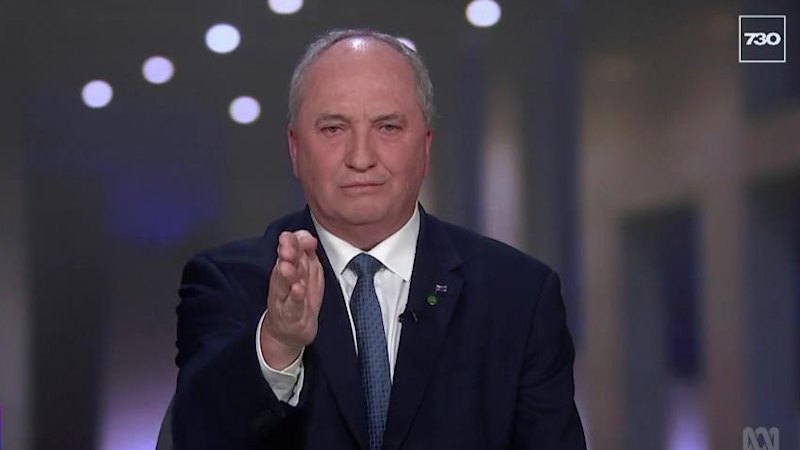
Barnaby Joyce says he is One Nation’s Treasury spokesman, “not Jesus Christ”, when asked to explain the consequences of his party’s superannuation policy on 7.30 (“Joyce says he’s ‘not Jesus Christ’ when pushed on controversial superannuation policy”, September 8). Nobody was asking for a miracle. Sarah Ferguson was asking for something more mundane: had One Nation actually done its homework before announcing the policy? Asked whether the inflationary impact had been modelled, Joyce ducked and deflected. Asked what raiding super might cost a 30-year-old at retirement, he dismissed it with “how long is a piece of string?” Confronted with estimates of substantial losses, he had no figures of his own. This isn’t serious policy, it’s making it up as you go along. Australians can already access super in cases of severe financial hardship and on compassionate grounds, including in some circumstances to prevent losing their home. One Nation’s answer is to throw the gate open much wider, apparently without knowing what it will cost. “It’s your money” is a great line until someone asks what the policy will actually cost. And what a cost of living policy: we won’t fix the problem – just raid your retirement savings and fix it yourself. No, Barnaby, you don’t need to be Jesus Christ to explain your own economic policy, but being your party’s Treasury spokesman surely requires knowing what the hell you’re talking about. Denise McHugh, Tamworth
Pauline Hanson’s latest brain-wave is that people should be able to raid their superannuation to pay the bills (“Super raid will impoverish millions in retirement”, September 8). “It’s your money,” she says. Well, it isn’t really. The government compels employers to put it aside for you, then gives you significant tax concessions to grow this money. So you could say it belongs to your employer and to the tax office. It only becomes yours in retirement. How hard is that to understand, Pauline? Cheryl Murdoch, Annandale
Once again, watching Barnaby Joyce on Monday’s 7.30 report was painful viewing. Why he would repeatedly expose himself to Sarah Ferguson’s probing questions is beyond me. He always comes off second best, though I was pleased to hear him proclaim he was not Jesus Christ. What a relief. Denis Suttling, Newport Beach
Joyce’s endorsement of One Nation’s latest thought bubble on superannuation certainly highlights the discrepancy between an accountant and an economist. Bob Cameron, Coffs Harbour
I don’t think even Jesus Christ could explain Joyce’s superannuation policy. Neil Quinn, Vincentia
Advertisement
Dogs share joy
The picture of man’s best friend frolicking on the beach at Mona Vale should surely unleash feelings of joy rather than anger (“Anger unleashed as council reviews beach trial”, September 8). As a local resident and regular beach walker, I agree that the council’s decision to allow canine companions to share a limited section of beach has had benefits beyond the dogs and their owners. If you do not have a dog, it is most heart-warming to make passing acquaintance with a friendly pooch – it brings a smile to your face and an extra spring to your step. I have never encountered aggressive dog behaviour on the beach and really hope the Northern Beaches councillors show some empathy when voting on the decision to extend the off-leash dog trial. Joy Nason, Mona Vale
Australia has stricter laws about animals in public places than most European countries, citing health reasons (“Pet-friendly Europe leaves us scaredy-cats way behind”, September 8). Being used to this, I was astonished when I first went to Germany to see a large Alsatian sitting in the window of a laundrette. The amazement continued that evening while dining at an upmarket restaurant, where we saw customers feeding sugar cubes to the resident dog as it freely circled the tables. One of the greatest pleasures of travel is the opportunity to witness these idiosyncratic cultural practices and to realise that our own entrenched customs can be modified to embrace the best of the world’s wonderfully diverse traditions. Sometimes by striving for perfection, we deprive ourselves of the richer and often unseen benefits. Elizabeth Maher, Gordon
If I were a dog, I’d wish to be born in Chile, where canine companions seem to be afforded the same consideration and respect as humans. Town squares up and down the country are the favoured meeting places for independent pooches of all shapes and sizes, off-leash and going about their day. They’re impeccably behaved, well bred, well fed and well groomed, all with tags on their collars. They casually mingle with people, who don’t get uptight, shout at them or chase them away, even when dining al fresco. Many villages around the country lack even the most basic amenities, but almost all have a resident vet. Pets are clearly an important priority. One hot day, I walked into a small airport up north, and there, on the carpet just inside the automatic doors, lay a gathering of contented doggies enjoying the air conditioning without a worry in the world. No one battered an eyelid. Certainly, no one shooed them outside into the heat. How nice. I came away with the impression that Chileans and their pets have a unique and trusting relationship, unlike anything I’ve seen before. It was most refreshing. Gideon Withers, Engadine
In response to Jo Pybus’ column praising Europe’s dog-friendly transport policies, we had a different experience of travelling with dogs on a recent trip. On both a ferry in Greece and a train in Germany, we saw dogs forced to sit under their owners’ seats for hours, every squirm or whimper greeted with a stern admonishment. No opportunity to walk, drink or toilet. It was distressing to witness. So yes, those dogs might have been trained to travel, but it did not look like fun for them at all. Jane Coburn, Bellambi
Affordable for some
The NSW government media release says that plans for 9400 new homes in the Woollahra area will include 3 per cent affordable housing contribution, with up to 15 per cent applied to certain sites in perpetuity (“First look at high-rise plans to add 10,000 homes to eastern suburbs”, September 8). While what this means exactly is unclear, including what mechanism will be applied to determine “affordability”, it is apparent that the so-called affordable housing component will be relatively insignificant. Three per cent of 9400 is 282, and even 15 per cent of the total number (which isn’t proposed) is only 1410. In addition, NSW Treasury has recent advice that profits on each new apartment in Woollahra will be at least $1.2 million, which gives a good indication of what the asking price and market rent will be, and how affordable (or not) they will actually be for low- and middle-income earners. That all sits somewhat uneasily with NSW Housing Minister Rose Jackson’s assurance that “we’re doing this for our young people and for our essential workers, who have felt the dream of living and working in the greatest city in the world slipping through their fingers”. Ross Duncan, Potts Point
Advertisement
To justify this proposed overdevelopment of Edgecliff and Woollahra, Premier Chris Minns says that “we can’t keep pushing all of Sydney’s development to the west”. But the west has no physical barriers to impede development, while in the shrinking east there are two very real ones: the harbour on one side and the ocean on the other. But politicians are canny and know that it’s really all about the announcement, not the delivery. However, in the unlikely event that this urban blight does go ahead, I hope the developers are made to contribute to a mandatory fund before a sod is turned, to cover costs when the inevitable defects are found, or when the developers or the builders shut down, skip town, change names or cry bankruptcy, leaving half-built, rusting hulks where once stood communities and neighbourhoods. Patrick McGrath, Potts Point
Stuck in storage
Along with many other people, I was under the impression the purpose of the new Powerhouse Museum at Parramatta was to house all the artefacts that have been stored away for years. Now it seems they will keep gathering dust in storage to make way for the many exciting, new exhibitions planned when the museum opens. The purpose-built Powerhouse building in Ultimo has been stripped, waiting for the hoo-ha to quieten down so they can quietly sell it off. What happened to the exhibits there? That’s anyone’s guess – perhaps more ongoing storage. The $915 million cost for Parramatta is starting to make sense. Judith Rostron, Killarney Heights
Tighten transparency
All hard-line groups and movements must surely know that social media “algorithms” make their work easier (“Hardline free-speech campaigners demand Coalition block Labor’s latest social media plan”, September 8). The platforms help them push out hardline messages, stories, news (true or false) to enthusiastic consumers who can’t get enough of it. It’s cheap and hugely efficient. Bad news and outrage travels fast and wide. The walls of the various echo chambers have hardened, impervious to alternate views or facts. It is no coincidence that One Nation is strongly resisting any efforts to introduce more controls and greater care by social media platforms. The outrage and grievance machine has worked brilliantly for its cause. It’s time to demand greater transparency and accountability from these social media behemoths. Cathryn Callaghan, Croydon
Advertisement
When I was a clerk in the public service, I was astonished at how people would mindlessly use precedents without any thought or nuance. It’s the same with artificial intelligence. The old saying that “a precedent is a good slave but a poor master” still applies to AI. Pasquale Vartuli, Pennant Hills
Energy sapping
Queensland Premier David Crisafulli is not as “energy-agnostic” as he thinks (“It is ideology, not economics”, September 8). As Smart Energy Council chief executive David McElrea points out, Crisafulli’s energy policy goes against Queensland’s much-admired shift towards solar and batteries for households and businesses, and will cool investment in renewables. It now appears that the needs of data centre developers have trumped the much-admired work in the state towards clean energy. The “market”, that is data centre developers, will opt for the easy coal and gas option. Will the other “market”, that is ordinary consumers, be protected from the resulting higher costs? Reliability Watch monitors breakdowns at fossil fuel-powered stations across the National Energy Market. For the 12 months to November 2025, Queensland coal stations were offline for 86 days. That is an average of 23 per cent unavailable capacity. As conditions get hotter, expect more breakdowns. Whose needs will take precedence when supply is down? Fiona Colin, Malvern East (Vic)
Help with HECS
Apart from AUKUS and the GST carve-up, I can add another item to Carl Boyd’s list of Scott Morrison disasters that the PM has not fixed (Letters, September 8): the Job-ready Graduates Package for humanities, arts and law students, which amounts to a HECS debt of about $55,000 for a three-year degree. The Labor government has had four years to assess the inequity of the package and to restore student debt to more reasonable levels. If Albanese wants to win over young people, here’s his chance. Helen Russell, Leichardt
Trump oblivious
Stephen Bartholomeusz says “Canada’s Mark Carney has risked an escalation in trade hostilities with the US by following through with his foreshadowed retaliatory tariffs on US imports” (“Fighting the bully: Canada throws a punch back at Trump”, September 8). But Mark Carney is a clever man with a degree in economics from Harvard. He has been the governor of the Bank of England and the Bank of Canada. The US has been Canada’s largest trading partner and Carney, anticipating Donald Trump’s actions, set about establishing new trade relations with global democracies – 20 at the last count. So as Trump sabotages the US-Canada trade relationship, Canada will end up better off while the US economy will suffer. Trump has no understanding about the consequences of his actions. Terrence Dunn, Washington (US)
Advertisement
I despair at the state of our world, where so-called “leaders” such as Trump encourage their mega-billionaire buddies and despots to do as they wish, and those who could and should stand against them cower in fear of retribution (Letters, September 8). I am put in mind of W B Yeats’ famous poem The Second Coming, written in the aftermath of World War I. It describes a civilisation falling apart, where “anarchy is loosed upon the world” and where “the best lack all conviction, while the worst are full of passionate intensity”. It foretells not of a saviour arising, but a “rough beast” coming to take its place as the leader of the free world. Sound familiar? Nick Andrews, Bellevue Hill
Dodging directors
I thought I had some understanding of governance and corporate law, having passed my Australian Institute of Company Directors exams some years ago, yet I still fail to see why directors of large companies such as Bathla never appear to suffer any form of criminal prosecution in spite of effectively destroying the lives and aspirations of so many ordinary, law-abiding citizens (“The Sydney council and ratepayers on the hook after Bathla’s collapse”, September 8). Katriona Herborn, Blackheath
Selective flag burning
Angus Taylor wants people jailed for burning the Australian flag. But what if I only burnt the Union Jack in the canton as a protest against the British and left the rest intact? Seeing as that’s a flag of a foreign country, would I still be guilty of an offence? Just asking for a friend. Robert Antill, Lake Conjola
Advertisement
Driverless tractor
Annalise Magill believes AI will never have a seat in the tractor (“Students head for country as AI bites”, September 7) but correspondent Graham Lum questions her optimism (Letters, September 8). Unfortunately, it seems he’s right – just look at the YouTube clip of John Deere’s Autonomous 8R Tractor, available in the USA now. Paul Keys, Clouds Creek
Bed bugbears
While I am at one with Genevieve Milton on taking proper care of those who served this country in uniform, I am not sure we can solve the problem of separate beds (Letters, September 8). Indeed, my English mother once told me that it was only poor people who shared a bed, not the upper classes and wealthy, and indeed the late Queen and Duke certainly had separate suites on HMY Britannia. My wife, impressed by the aforementioned example, has now deserted me because, apparently, I am conducting a war of my own during the night. Peter Thornton, Killara
- To submit a letter to the Sydney Morning Herald, email [email protected]. Click here for tips on how to submit letters.
- The Opinion newsletter is a weekly wrap of views that will challenge, champion and inform. Sign up here.