
Advertisement
You have reached your maximum number of saved items.
Remove items from your saved list to add more.
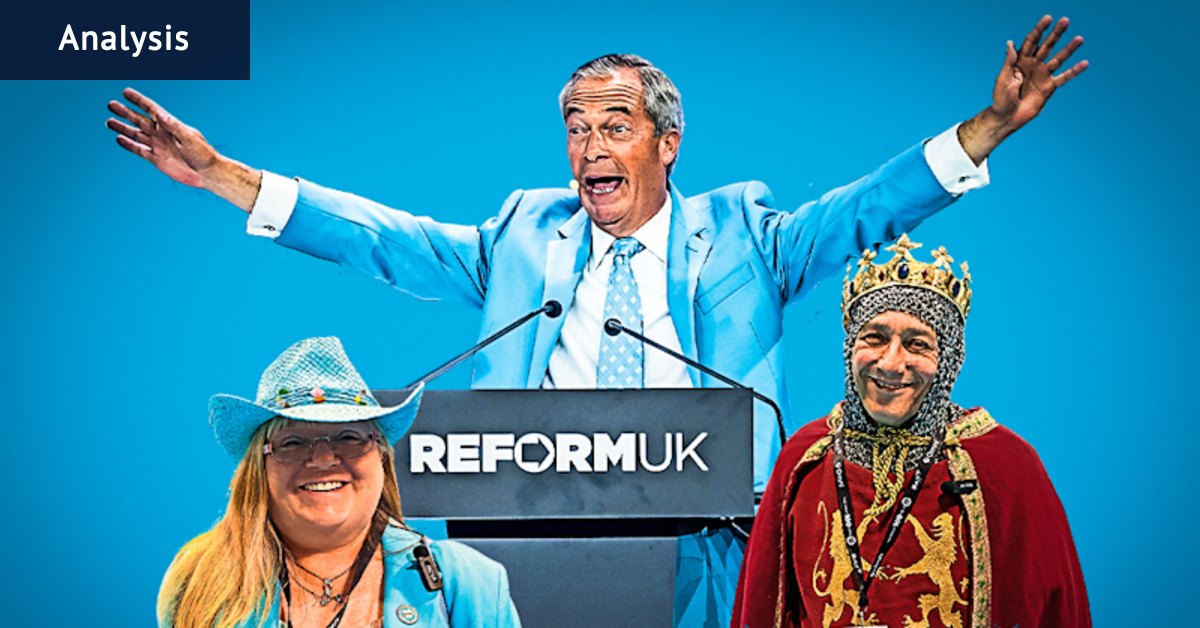
Birmingham: A feudal king is striding through the crowd as thousands of Reform UK members gather to hear their leader, Nigel Farage, remind them that they are on a mission to save Britain. The king is dressed in faux chain mail, a crown and a red cloak embroidered with lions – a reminder of the country’s glorious past. And he is an instant hit with the Reform faithful.
Chris Luck has come to the annual Reform conference dressed as Richard the Lionheart, famous for defending English territory and waging crusades against Muslim enemies. Luck, 62, enjoys medieval re-enactments when he is not working in the distribution business from his home in Bracknell, west of London. His reason for wearing this outfit today, he says, is to remind Britain what makes it great.
“The main problem with this country is immigration,” he tells me. “That’s the thing that needs to get sorted out. And once they get that sorted out, that’s going to affect everything else that’s wrong with the country, because all the money is being wasted on them.”
By them, he means migrants. He wants a complete stop to unauthorised arrivals. He believes the government has set up an “invitation machine” by offering too many welfare and housing incentives for asylum seekers who come by boat across the English Channel. And he blames Labour and the Conservative Party: “They’re all traitors.”
There is plenty of passion for the Reform movement here in this vast conference hall on the edge of Birmingham, where party members are spending two or three days to see the leaders they admire. Some are enjoying some political cosplay by dressing up, especially in the party’s trademark light blue, but most look like the people you see on an average English high street. Whatever they are wearing, they share Luck’s concern about migration.
From a distance, it is easy to dismiss Reform as an extreme movement that wants to overturn British politics with radical change. Up close, however, the members are ordinary people with everyday concerns. And that is exactly why the party remains so significant even when Farage is tainted by scandals over donations from wealthy crypto investors and the sudden resignation of two aides caught on camera talking about taking money from foreign donors.
Advertisement
Farage is under pressure in the parliament and the media, but that’s not the only pressure that counts. A much more powerful force, over time, is the palpable frustration among ordinary people about the state of their communities. As society changes, tension grows. And people will demand to be heard.
Susan Morrell, a small business owner, was a member of the Liberal Democrats, the UK’s middle-of the-road party, for 32 years. She served on the local council in her town of Coalville, in the English Midlands, and supported Labour at times, but she has joined Reform because she worries about the degradation of government services. She believes migration is a key problem.
“It’s overwhelming the country and we’ve got to be realistic about it,” she says.
Morrell is the daughter of a migrant who came to England from Austria in the 1950s. She is not against migration, but she is worried about the scale of the influx in recent times when she sees the change in the nearby city of Leicester.
“I’ve always been kind of in the centre of politics, but I’ve moved a little bit more to the centre right,” she says. “I’ve seen how Leicester has changed over the last 10 years. There are an awful lot of people that just hang around, and they’ve obviously not got anything particular to do, and they’ve not come in on work visas. They’ve not gone the proper route.”
When Morrell’s father required medical help last month, she struggled to get what he needed. He was sent home without a care package, she says, even though he had broken his sternum and ribs. When she broke her foot in June, she says, she was sent home from the medical walk-in centre and had to drive herself in pain.
Advertisement
“I’m thinking, well, this is just not right. You don’t know it until you experience it, what’s happening on the front line. And it’s not that the staff are awful people, it’s just that they’re overwhelmed.
“I think that’s what’s really, really done it. It’s the sheer numbers for me.”
In Britain, as in Australia, hospitals and aged-care homes depend heavily on workers from overseas. Of the 1.5 million workers in the National Health Service, around 325,000 were born overseas, according to the House of Commons Library. That represents about one in five health workers. (The biggest source countries are India, the Philippines, Nigeria, Ireland and Poland).
Loading
The challenge for Britain, and the source of frustration for Reform members, is that life does not seem to be improving as a result of migration. Whether the complaints are about healthcare, or drug addicts on the high street, or rubbish in the alleyways or slow progress on building new roads, there is an overwhelming sense of decline in living standards.
One of the most effective refrains from Farage captures this sense of gloom. “Nothing works any more in this country,” he says. Another refrain tells voters he is their only hope. “Britain is broken: only Reform can fix it.”
Vicky Shaw, a nurse, is loud and proud at the Reform conference in Birmingham. She arrives in a light blue jacket, with a matching cowboy hat in the party colours, and she has good reason to be confident about the party’s future. She was elected as a councillor on the Crewe Town Council in May, when Reform confirmed its rise by defeating Labour and the Conservatives in many neighbourhoods.
Advertisement
Shaw says health services are under severe stress and migration has not helped, even though it has brought in some workers.
“The way it’s working at the moment, there’s too many managerial roles and not enough nurses,” she says. In her view, government money is being wasted in other areas when health needs more support, and she believes the passage of asylum seekers across the English Channel has to end.
“I think we should stop the boats,” she says. “I think that any government that allows it to happen has blood on their hands for every death in the channel. They could easily stop the boats – get the army, get the navy to stop them.”
The boat arrivals make headlines every time dozens of migrants make it on to an inflatable dinghy from the beaches of France and Belgium, but the numbers vary. There were no arrivals in the week to September 4. In the final week of August, however, 616 migrants arrived on 10 boats. The rolling tally at the Migration Observatory at the University of Oxford shows the annual rate has fallen to about 32,000. This is down from last year but is about three times the inflow seen in 2021.
The argument in Britain mirrors the years of dispute in Australia about whether asylum seekers are motivated by “push” factors from their home countries or the “pull” factors about living in London or other cities. One thing that grates on voters is that asylum seekers are often housed during processing in hotels in residential neighbourhoods, giving them a quality of accommodation beyond the budgets of most people.
Steve Trevelyan, a former soldier who lives in St Austell in Cornwall, thinks the asylum seekers are responding to a signal sent out by the British government.
Advertisement
“I can’t blame them. Our governments give them an incentive to come over – housing, money, mobile phones, they put them up in five-star hotels. But you’ve got veterans on the streets who don’t get that,” he says.
What is the solution? “Don’t offer these incentives. People will go to wherever they get handouts. If there are genuine cases where there are asylum or persecution, possibly [let them in]. But we do know the majority are coming over for the economic benefits.”
Labour and the Conservatives have been wary of shutting down assistance for asylum seekers, given decades of support for refugees under British law. The new prime minister, Andy Burnham, would face a backlash from his Labour party room if he attempted to remove benefits, but there is a live debate in Britain about whether the current law makes it too hard for border authorities to remove migrants. One factor is that migrants contesting their removal can rely on the European Convention on Human Rights, an international treaty the UK supports.
This has totemic importance for Reform, which describes the ECHR as a sign of weak national government. Farage vows to remove the UK from the treaty and make sure judges have to order more asylum seekers out of the country. On the conference floor in Birmingham, Reform members name the ECHR as a key issue.
But it is not the only issue. Trevelyan names “woke” politics from progressive causes, free speech and welfare as some of his concerns. We speak after he has just signed a condolence book to express grief at the death of Ann Widdecombe, the former Conservative and Reform politician who was killed in her home in July. Widdecombe made enemies with her traditional social values, especially when she argued against activists for trans rights. A man has been charged with her murder.
Farage is scrambling to control the political damage from the donation scandal hanging over him and his party. On Friday morning, hours before he addressed the party conference in Birmingham, he removed the two aides caught on camera talking about funding from overseas donors, which is banned under donations law. He says the aides were suspended for “loose pub talk” but insists he and the party have done nothing wrong.
Advertisement
Farage played down the scandal during an address to the party conference that was punctuated by stage effects such as smoke machines and strobe lighting. The party faithful seemed to love him all the more when he blamed the media scrutiny on a plot by “the establishment” to bring him down. When protesters yelled out during his address, Reform members hurled abuse at them and cheered their leader.
Billy Horder, a hospitality worker and party member, brushes off the concerns about donations. “It does not reflect badly on Nigel Reform or Reform,” he tells me. “You will get a couple of bad eggs, no matter where you are from politically.”
The most important goal, says Horder, is to work for Reform to take power and sweep away the “uniparty” of Labour and the Conservatives.
In a quiet part of the conference, before the thundering music begins for the major speeches, stand some party members from villages near Bristol. One of them, William, tells me he was a police officer for 30 years and joined Reform because of the decline he saw in his community.
“I live in a country now where my children will be poorer than the adults, and that is terrible,” he says. “Over the years, children have always been wealthier and had better lives than the previous generation, but that has changed for the worse. And that’s an absolute disgrace.
“Governments of all hues have done that to us. It’s time for a change.”
Reform could easily lose ground in the opinion polls over the donations scandal. Built on the towering personality of one man, the party might even crumble if Farage cannot find his way through these challenges. He can be so sensitive about scrutiny that he seems unready for real power in Number 10 Downing Street.
Labour is recovering support under Burnham and the Conservatives are trying to do the same under their leader, Kemi Badenoch. The questions over Farage might shift voters towards Badenoch, who is talking tough on borders and welfare spending.
Even so, the underlying conditions that drive people to Reform will not change overnight. Many believe him when he declares that nothing works in Britain any more. When they vote, they will vote for change.
Get a note directly from our foreign correspondents on what’s making headlines around the world. Sign up for our weekly What in the World newsletter.