
Advertisement
You have reached your maximum number of saved items.
Remove items from your saved list to add more.
Twenty minutes into a One Nation press conference on a sunny Friday, the angular eyebrows of Senator Pauline Hanson begin to furrow, trying – like most attendees – to discern what her party’s new leader in NSW and candidate for Cessnock is saying in fluent Japanese.
The event – held at the industrial headquarters of mining equipment supplier Drill Doctor on the outskirts of Singleton, an hour north-west of Newcastle – has been arranged so One Nation could announce the identities of its ambitious campaign for next year’s state election. Despite having no MPs sitting in Macquarie Street, the party talks of taking power.
As Sean Bell, Hanson’s former adviser turned NSW senator, exclaims during a fundraiser at the Toronto Hotel that August evening: “I don’t think there’s ever been an opportunity like this.”
Even Hanson’s admonishment of Cessnock candidate Mike Newman’s foreign interlude – “Excuse me. I think everyone else would like to know what you’re saying” – is swiftly brushed past, with the 53-year-old calmly explaining he will complete answering the Japanese journalist’s question in her native language before translating for the crowd.
The vignette is a microcosm of the strange new era of Australian politics. It’s one in which Newman – a cosmopolitan, bilingual investment banker with a Japanese wife, and a preacher of foreign investment – has joined One Nation, a nationalist populist party of the battler whose leader just months earlier rejected multiculturalism in favour of a “monoculture”.
It marks another attempt by Hanson’s outfit to evolve from a closed tent mainly composed of insiders and loyalists to one recruiting the talent that it hopes will solidify its status as the nation’s leading conservative party.
Advertisement
Eight years after Hanson enlisted political maverick Mark Latham to be the party’s leader in NSW, One Nation hopes the Newman experiment can succeed where that marriage ended in acrimony.
Less than 28 hours after announcing its first NSW candidates, One Nation easily claimed victory in a byelection in the West Australian state seat of Secret Harbour. Hanson is on the march. And the Hunter will be fertile ground for the party’s populist message in NSW.
The Hunter is coal-mining country. It was once a Labor heartland. The eponymously named, blue-collar federal electorate has voted Labor since the electorate was established in the early 20th century. Cessnock, the state seat that sits within the Hunter’s boundaries, has been in the party’s column since 1927 aside from an aberrant result in 1988.
That sense of security was shattered in May 2019, when in his first crack at federal parliament, coal miner Stuart Bonds snatched 22 per cent of the primary vote in the Hunter. Joel Fitzgibbon, the veteran Labor frontbencher first elected in 1996, was left with a 3 per cent margin.
Advertisement
Bonds, who will now run at the top of the party’s upper house ticket in NSW, says despite living and working in the electorate, he was initially encouraged to run for the neighbouring seat of Lyne in 2019 because the prospect of winning the Hunter was considered fanciful.
“You will never flip the Hunter in a million years,” Bonds says he was told by One Nation. “No one else could see this uprising happening, but I could see it, literally, at the coal face.”
Ten people showed up for his first branch meeting in Singleton in 2018, Bonds remembers with a laugh. Since then, support for One Nation in the Hunter has fluctuated. Bonds’ primary vote of 16 per cent in the 2025 election was nearly 6 per cent lower than 2019.
Yet, as proven by the South Australian state election in March and the Secret Harbour byelection, people are turning out to vote for One Nation in 2026. Polling by Resolve in August shows more than one in four NSW respondents would vote for the party if an election were held today.
But even those unprecedented polling figures understate how well the party is doing in regional seats. Where Bonds once tapped disaffected Labor voters looking to send the party a message, today One Nation has become the brand of choice in the Hunter.
Advertisement
“I’ve no doubt that [Hanson’s] support in the Hunter Valley is very, very strong,” Fitzgibbon says in an interview from his Cessnock home. “The question is: can the juggernaut continue to grow right until March of next year?”
“They want to send the most powerful message that they can – that they’re as angry as hell, and they’re not going to take it any more.”
If anyone wanted to witness the popularity of Hanson in the Hunter, all they needed to do was visit the Singleton Golf Club on a Friday in late August.
“She is the most in-demand person in Australia right now,” the host tells a crowd who have taken the Friday off to see Hanson, who is headlining a fundraiser for the Singleton charity shop’s cancer appeal. The 320-seat event, costing $125 a ticket, was sold out two weeks in advance.
There was so much demand, Bonds claims organisers could have sold double the number of tickets.
Advertisement
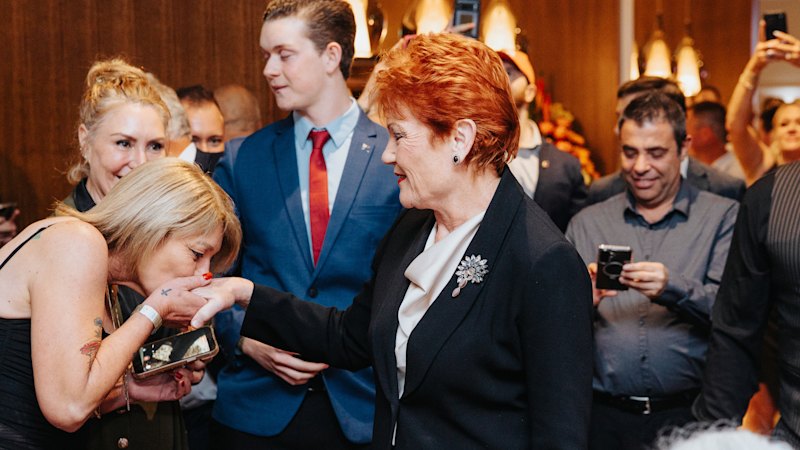
It takes the Queensland senator – who walks in with Bonds and his Finnish tattooist wife, Sini – half an hour just to make it into the clubhouse after being swamped by patrons looking for selfies or simply to hold her hand and offer words of support. A heavily tattooed man with a flannelette shirt and handlebar moustache reminiscent of Mark “Chopper” Read sheepishly asks his friend whether he thinks Hanson will take a photo with him.
“You can stay at my place,” a woman tells Hanson when asked if she’ll be visiting the Hunter again.
If Hanson’s popularity is undeniable, so is the sense that Anthony Albanese is on the nose.
The second and third prize of the charity auction are two “Fire the Liar” packages – name-checking One Nation’s campaign against Albanese – each containing a party shirt and cap signed by Hanson and the opportunity for the winner to have their photo taken with her.
Advertisement
The first heavily contested auction sells for $2200 and the second for $2500.
Moments earlier, One Nation recruit Barnaby Joyce – who, after taking up an offer to sell off the opening item, delighted the crowd with his convincing impression of an auctioneer – had extracted just $2700 for a four-person overnight stay at a golf resort.
Over a sandwich in Kurri Kurri, Clayton Barr, the 15-year member for Cessnock who will run against Newman, laments the difficulty of cutting through to voters in 2026. “Right now is as hard as it has ever been,” he says.
The 55-year-old Labor MP concedes the outcome of next year’s election is currently a “coin toss” – a remarkable confession given his 23.4 per cent margin is the 10th largest in NSW.
A recent private poll for the state seat of Cessnock conducted in early August and provided to the Herald shows a scarcely believable transformation in the electorate. Labor’s first preference vote has plunged to 24 per cent, half of One Nation’s 50 per cent. If replicated on polling day, that primary vote would translate to a two-party-preferred vote of 67-33 per cent.
Barr says in his four previous elections, voters could explain why they were angry with Labor or the Coalition. But the grievances he hears when door-knocking these days are either steeped in misinformation or conflating federal issues such as migration or taxation, which he can’t change.
“People can’t articulate to me what they want the government to do tomorrow, and they can’t articulate to me why they hate the government today,” Barr says.
Three factors can explain the rise of One Nation, he believes: the weakness of the Coalition brand, the spread of Sky News onto free-to-air channels, and the sense of fear and economic uncertainty generated by the rapid adoption of renewables and AI.
But why some of the biggest beneficiaries of the nation’s politico-economic system harbour such white-hot anger towards that same system is a paradox Barr can’t explain.
“Most of my mates work in coal mines. They have good jobs, beautiful wives, their kids have gotten a good start in life. They have no debt, a couple of cars in the shed, caravans and take yearly overseas holidays – and they’re going to vote for One Nation,” he says. “If you’re saying that politicians are all shit, how has the system not worked for you?”
David Layzell – the Nationals’ member for Upper Hunter, a marginal electorate covering 22,959 square kilometres, which neighbours Cessnock to the north – has similarly experienced voters’ deep disillusionment with the two-party political system.
In an interview from his parliamentary office, the 51-year-old says a narrative that the major parties are puppets with “people controlling us” has taken root in part of the community.
In the last couple of months, Layzell has experienced surging support for One Nation, particularly in unexpected constituencies, saying he has begun being regularly approached by women in their 30s and 40s wanting to talk to him about One Nation.
“‘Dave, we like you, but why don’t you join One Nation?’ Yeah, I’ve had that a lot,” he says.
In a self-deprecating speech during a One Nation fundraiser, Bell tells the story of his rise from a shift manager at Video Ezy to party apparatchik to senator for NSW. It is the backbone of Hanson’s political model, rewarding and promoting insiders for their unwavering loyalty.
But that model has its limitations, and capitalising on the party’s popularity requires speaking to new constituencies and recruiting outsiders, like Newman. It will be another test of whether new voices can survive inside the Hanson hierarchy.
During his lengthy, discursive acceptance speech – which Joyce, hardly known for his brevity, later quipped, was the longest since Abraham Lincoln – Newman outlined a libertarian agenda of a smaller, lower taxing government modelled on Florida and Texas.
While One Nation has clearly given Newman agency to assert himself, his use of that freedom sometimes felt odd and driven by his own idiosyncrasies. At one point, he criticised the Minns government for not thinking about second- and third-order economic derivatives.
His elusiveness about where he lives has also provided Labor with a line of attack. The most Newman will say about his residence is that it is 10 minutes from the border of the Cessnock electorate in the “Lake Macquarie area”. The arrangement was a “necessary evil” because his growing family couldn’t find suitable accommodation in the electorate.
“Do you want to live in a sort of hovel with lots of noisy trucks and trains driving by because that’s all you can find?” he asks during an expansive interview with the Herald. “Or do you want to live in a place that is far more satisfactory?”
Barr has already leapt on this ambiguity, accusing his opponent of living in Sydney – a charge Newman rejects as patently untrue.
Second, while offering a full-throated endorsement of One Nation’s pro-mining, anti-renewables stance, Newman is more muted on migration. He dismisses a question about the topic as a “federal issue” before saying it has been “done to death”.
Pressed on whether he believed migration numbers were too high, he argued One Nation had made its position “pretty clear” and he was solely focused on state issues before adding those entering the country should possess skills that were in short supply.
“I’m a migrant,” he said. “My wife’s a migrant. I mean, you know, there’s a million ways to skin the cat. It’s not really something that I can give you … what you’re looking for.”
Bonds displays little of his new colleague’s reticence. He wants more migrant workers moving into the regions, and says student visas should bear the brunt of any cuts, claiming the ability for those studying to bring families over is a scam. “I don’t even think my wife should be able to bring her family over,” he says.
How does a mainstream party respond if voters simply want to torch the status quo? Where parties once would have committed millions to build bypasses and hospitals and upgrade roads to win over wavering constituencies, voters’ anger with the system is an abstract problem with no obvious solution.
“Most One Nation voters, in my view, aren’t so attracted to One Nation or its policies that they’re attracted to delivering a verdict on politics as it is,” Fitzgibbon says. “In other words, they just want to burn the house down.”
Layzell says he will avoid criticising One Nation, describing Labor as his “main opponent”. Barr will change his communications strategy to try to change voters’ perspective. His fortnightly column in the local newspaper and social media will become more philosophical, encouraging people to consider whether “things are that bad for you just right now”.
Barr notes the line for Oz Harvest Food handouts outside his electorate office has grown from a handful of people to around 50 these days. “For those people, the system really isn’t working,” he says. “For other people who are driving nice new cars and living in nice homes and carrying nice new phones, you know the system isn’t fantastic for you, but it hasn’t completely failed you.”
In past elections, Fitzgibbon says, a local candidate or MP might only be worth 2 per cent of the overall vote, influential in a tight contest, but broadly overshadowed by the parties they represented.
“That’s changed a little,” he says, arguing parties have had to become more discerning about who they choose in seats, finding people who present as “fair dinkum” and “talk the language of their local community”.
It’s why he believes his hand-picked successor, Dan Repacholi, more than two metres tall, five-time Olympic sports shooter, former coal-miner, will be re-elected despite the turn against Labor in the region.
Ultimately, party politics will need to change, Fitzgibbon argues.
With communities increasingly diverse, he believes Labor’s parliamentary discipline – what he describes as the strictest in the world – should be loosened to allow MPs better represent their communities by crossing the floor.
“Gone are the days when you can successfully expect your candidate in Singleton to be saying the same thing as your candidate in Surry Hills,” he says. “They are very, very different electorates.”
Cut through the noise of federal politics with news, views and expert analysis. Subscribers can sign up to our weekly Inside Politics newsletter.