
Advertisement
Venice: Ink, the story of Rupert Murdoch’s rise to power in Fleet Street, provided a fiery start for this year’s Venice Film Festival.
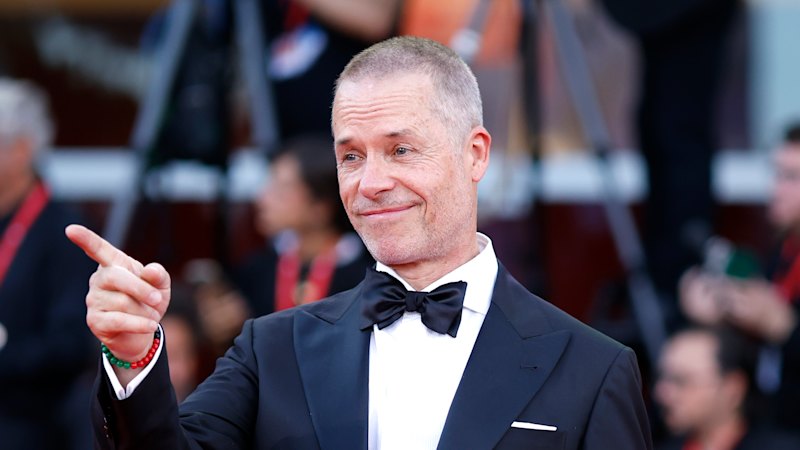
Guy Pearce plays Murdoch as he buys the ailing The Sun newspaper in 1969 and sets about making it the biggest-selling newspaper in Britain, recruiting working-class journalists who were overlooked for promotion by an establishment that had also initially dismissed Murdoch – as he says in the film – as a colonial savage.
“This is business first,” he tells his newly appointed editor, northern lad Larry Lamb, as they offer huge sums to the best of The Mirror’s staff. “But it’s revenge second.”
Danny Boyle’s vigorous account of the tabloid world, where the clatter of the old roller presses is exciting, but sleazy scoops are the biggest thrill of all, was not an obvious fit to open the world’s most glamorous film festival.
Advertisement
On the first day before the opening gala, the main street has been teeming with women in frothy pink evening dresses, while film fans have camped next to the red carpet with umbrellas and snacks, waiting for the stars to start arriving.
Unlike many festival opening night films, Ink commanded serious critical attention, largely favourable. “An irresistibly hooky tale of sex, murder and other very bad behaviour, shot and cut with maximum flash and dazzle,” said Variety in a same-night review. “A snazzy screen adaptation, shot through with kinetic energy,” said Hollywood Reporter.
For Boyle, the history recalled in Ink is immediately relevant to today’s audience. “I lived through the era of The Sun,” he said at a conference after the morning’s press screenings. “It was an ignition point for where we ended up, with a chain link between that moment and now that is clearly discernible. One of the things on that chain is Brexit, which was deeply influenced by this pursuit of entertainment, trivia and good times.”
Advertisement
James Graham wrote the screenplay based on his own play, which was a hit on the West End in 2017. Boyle saw it on the stage, where it struck him that it was all about Murdoch; he wanted to weight it differently, questioning the who, why and where of the editor who ditched the newspaper he had grown up reading – the working-class, Labour-loyalist Mirror – for Murdoch’s upstart rag.
Graham’s film version thus focuses on Larry Lamb, played by Jack O’Connell. “We’re all from the north of Britain, not London anyway,” says Boyle, looking around at his cast and producers. He was born in Radcliffe, just outside Manchester. “We all have an attitude – or I do – that you have to be tough, that they underrate you. It’s what’s called the chip, and Rupert had that as well in a different way. So in a way you could identify with them at the beginning as rebels – and it stopped us ‘monsterising’ Rupert.”
He also wanted an Australian to play Rupert Murdoch; Bertie Carvel, who played him on the stage, plays the older Mirror group chairman Hugh Cudlipp in the film. “I wanted Guy and I had to fight for him,” he says. Financiers, he says, wanted Hollywood stars. “‘Why can’t Leonardo DiCaprio play an Australian?’ That goes on. And I wrote to Guy a few times saying ‘please hang on, it will happen’ – and it did.”
The key to playing Murdoch at the outset of his international career, says Pearce, was to set aside what he had done since then. “Friends said ‘what’s it like playing the most awful person in the world?’ It was interesting to see their demonisation of him; they had really painted a picture of him, and he is no doubt responsible for that. But it was really important to park that.”
Advertisement
Watching interviews with Murdoch from that time, Pearce saw a different person. “It was interesting see the shy, slightly awkward character he was – ambitious, but not really wanting the spotlight. That told me so much about that personality I was playing. Every now and then while filming, I’d see some article and a picture of the 90-year-old Murdoch and it was hard for me even to connect the two: what I was doing with who he seems to be today.”
Ink darkens, however, as The Sun’s pursuit of stories at any price starts to wreck lives. Ink is one of several films at the festival revolving around journalism, such as Lance Oppenheim’s Primetime, which stars one-time Twilight heartthrob Robert Pattinson as Chris Hansen, host of the reality show Dateline: To Catch a Predator.
The Venice festival is seen as the opening salvo of the Hollywood awards season, but this edition has strikingly few star vehicles. Among the most hotly awaited titles are Martin McDonagh’s Wild Horse Nine, with John Malkovich and Sam Rockwell as a pair of CIA agents, and Father Joe, in which Al Pacino plays a priest who takes on the mob.
Ink will be released in Australian cinemas on January 7.
Want more film stories?
- Fetching performances: Hollywood’s best canine stars
- In case it was ever in doubt, Jacob Elordi is a ‘dog person’
- ‘Be yourself but look like everyone else’: Imelda Staunton on younger people’s dilemma
- Must-see movies, interviews and all the latest from the world of film delivered to your inbox. Sign up for our Screening Room newsletter.
You have reached your maximum number of saved items.
Remove items from your saved list to add more.
More:
Stephanie Bunbury is a film and culture writer for The Age and The Sydney Morning Herald.AdvertisementAdvertisement