
Advertisement
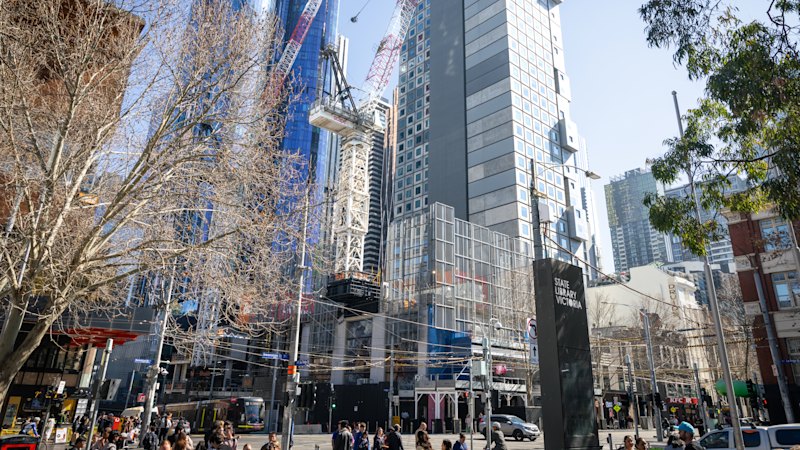
A 57-storey high-rise tower that will transform one of Melbourne’s major intersections and overshadow the State Library broke ground this week, having received state government approval without public consultation.
The high-rise is being built on top of the new State Library station and will reach 185.4 metres. The developer, Scape Student Accommodation, says it will be the tallest student accommodation building in the world.
Scape received permission for the tower in 2017, bypassing Melbourne City Council because the project is part of the Metro Tunnel planning framework and was approved directly by then-planning minister Richard Wynne. As a result, there was no public notice period or community consultation, but the Office of the Victorian Government Architect and the council worked with the developer on the design and technical requirements.
The site, called the State Library Exchange, will transform the north-west corner of Swanston and La Trobe streets, with a glass podium and a textured facade that Scape co-founder and chair Craig Carracher likened to “Rubik’s cubes”.
Advertisement
The top 46 storeys of the building will accommodate about 1420 students, while the first nine levels will be leased to RMIT as teaching and commercial spaces.
The development has three towers of varying heights designed to avoid extending the current overshadowing of the State Library forecourt by surrounding buildings. Plans show it will contribute a minor shadow of its own to the forecourt at particular times of the year, but the new tower’s shadow is mostly within those cast by existing buildings.
Scape had originally planned to have the building completed two years after it received approval for it in 2017 but faced delays as part of the Metro Tunnel Project. Above-ground construction on the building started on Monday.
“We identified this site in 2015,” said Carracher. “It’s been the subject of the Metro rail program for the past 10 years. It has gone through all sorts of mechanisation during that 10 years.”
Advertisement
He said the building would surpass the current tallest student accommodation tower in the world – also a Scape building in Melbourne – located at Franklin Street and about 170 metres high.
Other Scape sites such as at 50 La Trobe Street offer student accommodation from 16 square metres for a studio to 25 square metres for a two-person apartment.
Melbourne City Council referred questions about the approval process to the state government.
“We’re approving homes where people want them – close to jobs, transport, universities and services,” a state government spokesperson said.
Advertisement
Norman Day, an architect involved in university campus design, said he was surprised there had been no community input into the building and believed more could be done to make the intersection more useable for pedestrians.
“It’s a huge building in a very delicate part of the city in an important intersection,” he said. “A city is designed for its people, and so it seems to me a lost opportunity to get the best value for people.”
The tower is costing Scape and its partners more than $500 million to build, while RMIT will spend $190 million over 15 years to lease part of the building.
RMIT vice chancellor Alec Cameron said the university was expanding its teaching spaces to reflect the changing needs of students.
“Large lecture theatres were built for a different model when students would have a passive participation in the classroom along with 100 of their peers,” Cameron said.
Advertisement
“[This] is much more a flat-floor accommodation size, more interactive and more flexible. I think the latest thinking in tertiary education really is more interactive sessions, which means smaller groups. It means more flexible teaching. It means more group work.”
The student accommodation will be available for any student, not just those studying at RMIT. Cameron said the convenience of the tram and train network made other campuses accessible from the site.
Working on the site are former RMIT students Liv Kaur, Andy Kelly – both graduate project co-ordinators – and Chris Mirgiannis, a project engineer, who have started their careers metres from where they studied
The number of international students in Australia has been declining, and federal Labor is under pressure from the Coalition and One Nation to cut numbers further.
Advertisement
Despite the changing outlook, Carracher said there were about 80,000 student accommodation rooms in Australia, which he said was far fewer than needed.
“We probably need at least another 100,000 to meet the demand that’s currently high,” he said.
“The good news is these students are not going into housing in Carlton, they’re not going into housing along the suburbs on the train lines. They’re coming into purpose-built student accommodation, which means they are not contributing to the housing shortfall.”
Start the day with a summary of the day’s most important and interesting stories, analysis and insights. Sign up for our Morning Edition newsletter.
You have reached your maximum number of saved items.
Remove items from your saved list to add more.
More:
- Development
- For subscribers
- Immigration
- City life
- Property development
- University
- Planning
- International students
Jackson Graham is an education reporter at The Age. He was previously an explainer reporter.Connect via email.AdvertisementAdvertisement