
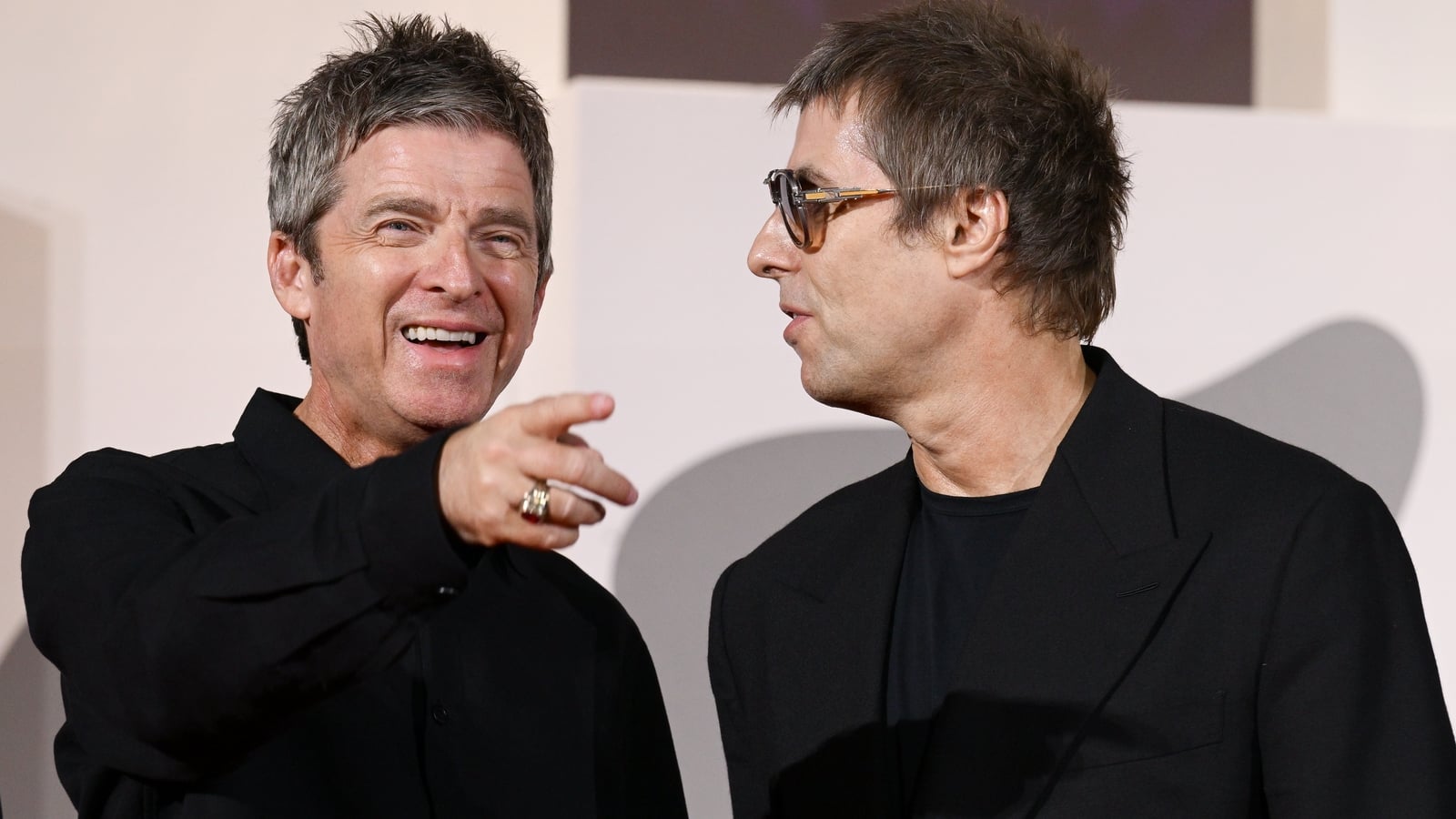
The directors of the new documentary Oasis: Don’t Look Back in Anger have said that they set out to make a ‘feelgood film’ that didn’t dwell on the past but aimed to capture the estranged band’s bid to restore their legacy.
Filmed on IMAX, the film charts the band’s reunion, 16 years after their famous split, and follows them across the world on a comeback tour that many people thought would never happen.
It’s a concert movie and a road movie but mostly it is a story about forgiveness and redemption as the famously feuding Liam and Noel Gallagher slowly learn to live with each other again – at least on stage.
Written by Peaky Blinders creator Steven Knight, Oasis: Don’t Look Back in Anger was directed by Dylan Southern and Will Lovelace, whose previous work includes Meet Me in the Bathroom, a chronicle of New York’s resurgent early 2000s indie music scene.
In vast contrast to Mat Whitecross’s 2016 Oasis film Supersonic, anyone looking for fisticuffs and bust-ups in Don’t Look Back in Anger will be disappointed.
Read our four-star review of Oasis: Don’t Look Back in Anger
“Well, I hope they won’t be disappointed because the film is a feelgood movie,” says Lovelace, who also made the Blur documentary No Distance Left to Run. “That stuff about bust-ups exists in the past and what we did with this film was reveal Liam and Noel’s relationship coming back together.”
“Liam in particular treated this like an athlete training for the Olympics. He was so committed to getting it right. He was literally leaving as soon as the shows finished, in bed early, not smoking, not drinking because this mattered so much to him, it mattered to them all.”
Southern adds, “Going into it, we speculated about the same things as everyone else – are they going to get on, are they going to make it through the rehearsals, will they make it through the whole tour . . . ?”
“But as soon as we got to rehearsals, there was no ‘come to Jesus’ moment where they sat down and apologised to each other and talked through their feelings, that was never going to happen. There was tension in the rehearsals – you see it in the film.
“The first day Liam turns up, he puts his bag down and says ‘right, let’s do this…'”. They rattle through the two-hour set and during the outro to Champagne Supernova, he picks his bag up and leaves and we were like, ‘Wow, what happened?'”
It went on like that for the full six weeks of the rehearsals, Southern says.
“It was the same every single day and even by the end of rehearsals, there was still a tension and we didn’t quite know where they were in their relationship and I think the beautiful thing about this film and this story is you really see them reconcile on stage and through the music because of the love and the energy they’re getting off the fans.
“As it progressed it became a story about forgiveness and the power of music and reconciliation. We were prepared for anything but I don’t think we were prepared for how emotional it was.”
The directors shot thousands of hours of footage at 12 gigs of the world tour, including the band’s two-night stand in Croke Park last July, across three continents before editing it down to a tight two-hour documentary.
Liam and Noel had no editorial control over the final product.
“We showed them the film when it was finished,” said Lovelace. “We had a few conversations about the sound of songs and the mix of songs but in terms of the story, they watched it when it was done.”
The film dedicates a lot of time to those Croke Park shows and we hear Noel admitting that he and Bonehead were crying their eyes out as The Auld Triangle by Luke Kelly boomed out across Croker and 80,000 people joined in before Oasis took to the stage.
“There’s a moment in the film when we’re following the band to the stage at Croke Park and you can really feel what it means to them,” says Lovelace. “Noel has his fist in the air and then the crowd take over the song. It was an amazing moment and such a special part of the film.”
Southern adds, “Personally, the Croke Park shows are some of the best shows on the tour. The Irish crowds just bring a different kind of energy and the most amazing thing was seeing all the people who’d gathered outside the stadium giving it just as much as everyone inside the stadium. It was such an incredible atmosphere that day.”
However, there is precious little in the film of the Gallagher brothers post-gigs, mainly because their wild days are long over and they both knew that taking on a world tour in their fifties was a serious business.
“Liam in particular treated this like an athlete training for the Olympics,” says Lovelace. “He was so committed to getting it right. He was literally leaving as soon as the show finished, in bed early, not smoking, not drinking because this mattered so much to him, it mattered to them all.
“One of the things that surprised us so much in rehearsals was that they were so focused. The eyes of the world were on them and they didn’t want to just turn up and do the shows and take the money. They wanted to restore the legacy of Oasis and put the best version of the band on stage.
“Honestly, it was as you see it on screen. I think there was an after show in Dublin but by the time we heard about it, it was too late.”
At the start of the film Noel still has his misgivings and is extremely nervous in the build-up to the band’s first show in 16 years, which took place in Principality Stadium in Cardiff.
We see him pacing the backstage area lost in his thoughts, while Liam wonders what all the fuss is about.
It is only when he steps on stage and is blown away by the crowd’s reaction that everything crystallises for the older Gallagher.
“You can definitely feel that,” says Southern. “I think everyone was nervous, maybe not Liam, but the rest of us were nervous. Noel talks about it in the film and it shocked him – that feeling, being on stage and the energy of all of those people.
“In the film, Cardiff was definitely a pivotal point because in the minutes before Oasis go on stage, you don’t know how this is going to play out – nobody did.”
And will they be making a film about next year’s Oasis tour?
“We’re not the people to ask about that,” smiles Lovelace.
Southern adds with a grin, “If it happens and they ask us . . . “
Oasis: Don’t Look Back in Anger is in cinemas and streaming on Disney+ and Hulu now.