
Updated / Monday, 7 Sep 2026
16:13
Alan Corr
Multimedia Journalist
Reviewer score
15A
Director
Will Lovelace, Dylan Southern
Starring
Noel Gallagher, Liam Gallagher, Andy Bell, Paul Arthurs, Gem Archer
Don’t Look Back in Anger, the new film about the Oasis reunion hits real emotional high notes as it tells the story of their miraculous comeback tour. As Noel says, “It turns out that the Oasis thing never went away . . . “
Ten years ago, director Mat Whitecross gave us Supersonic, a terrific rock doc about the rise of Oasis from Burnage dreamers to Britrock royalty in the space of just three meteoric years.
Tinged with regret, sadness and not a little anger from then estranged brothers Noel and Liam Gallagher, it was a great film about ambition and rock ‘n’ roll excess and success that really got into the pain and glory of being in a massive band.
Supersonic ended in 1996 on a considerable high with two headline gigs at Knebworth, but there was still a lot of the Oasis story to be told, not least their ignoble split backstage in Paris in 2009 in a final sibling meltdown involving a plum thrown in anger and Liam wielding one of Noel’s favourite guitars like Excalibur. By 2016, both brothers had moved on to successful solo careers and the chances of a reunion looked very remote indeed, but here we are a decade later with a new Oasis film that chronicles what happened next and their miraculous comeback tour.
To tell the biggest music story of the past five years, writer Steven Knight and co-directors Dylan Southern and Will Lovelace’s (Shut Up and Play the Hits, Meet Me in the Bathroom) go all out with an epic rock ‘n’ roll road movie that spans 12 concerts over three continents. Given that this is Oasis, everything is on a huge scale, but at its heart, Don’t Look Back in Anger is a very human story about forgiveness and redemption. As much as anything else, it is a life-affirming paean to the power of music itself and its mysterious ability to bring people together and heal, for both creators and fans alike.
But there is a lot missing here. Shot in IMAX, it looks fantastic and is technically superb, but the whole film is so orchestrated and slick that it has the over-polished sheen of corporate spin. It has none of the punky raggedness of Whitecross’s film, but that is to be expected. Anyone who witnessed this once most volatile of bands in action over two nights in Croke Park last year will know that we are now looking at the New Oasis; a tightly-drilled unit with dollar signs in their eyes. Anyone expecting bust-ups, tantrums and fisticuffs from this film will come away disappointed.
Just as miraculous as the actual reunion, Noel did not walk out and Liam turned up for every single gig and this film didn’t turn into Made of Stone, Shane Meadows’ overly hopeful documentary about the ill-fated Stone Roses reunion back in 2011.
However, that 2009 split is covered with characteristic Gallagher frankness. “He’s making out as if I’ve stabbed one of his cats,” a genuinely perplexed Liam says early on. “Leave it out, mate; we had a little argument.” The more saturnine Noel gloomily remarks, “I was born with one fatal flaw in my character. I cannot forgive people.”
Noel admits that he and Bonehead were in floods of tears as The Auld Triangle by Luke Kelly boomed out across Croker and 80,000 people joined in before Oasis took to the stage
Older and now considerably richer, the elder Gallagher is guarded and wary and not quite convinced why he is here other than the crates of money. As he says early on in Don’t Look Back in Anger, “this band would put you in a nuthouse”.
Still, watching their snowball-in-hell reunion unfold is fascinating. It begins in an anonymous warehouse in southwest London where the reformed Oasis will rehearse for six weeks solid. Noel, who catches the Tube every morning, is all business; Liam, who arrives every morning in a large black people carrier with tinted windows, doesn’t turn up for the first day.
When he finally walks in, he slings his bag on the ground, gives out about the drumkit, and gets straight down to it with barely a nod at the brother he hasn’t spoken to since 2009. It is quite a moment, but from there, the thaw begins and the songs slowly start bringing this band of brothers back together.
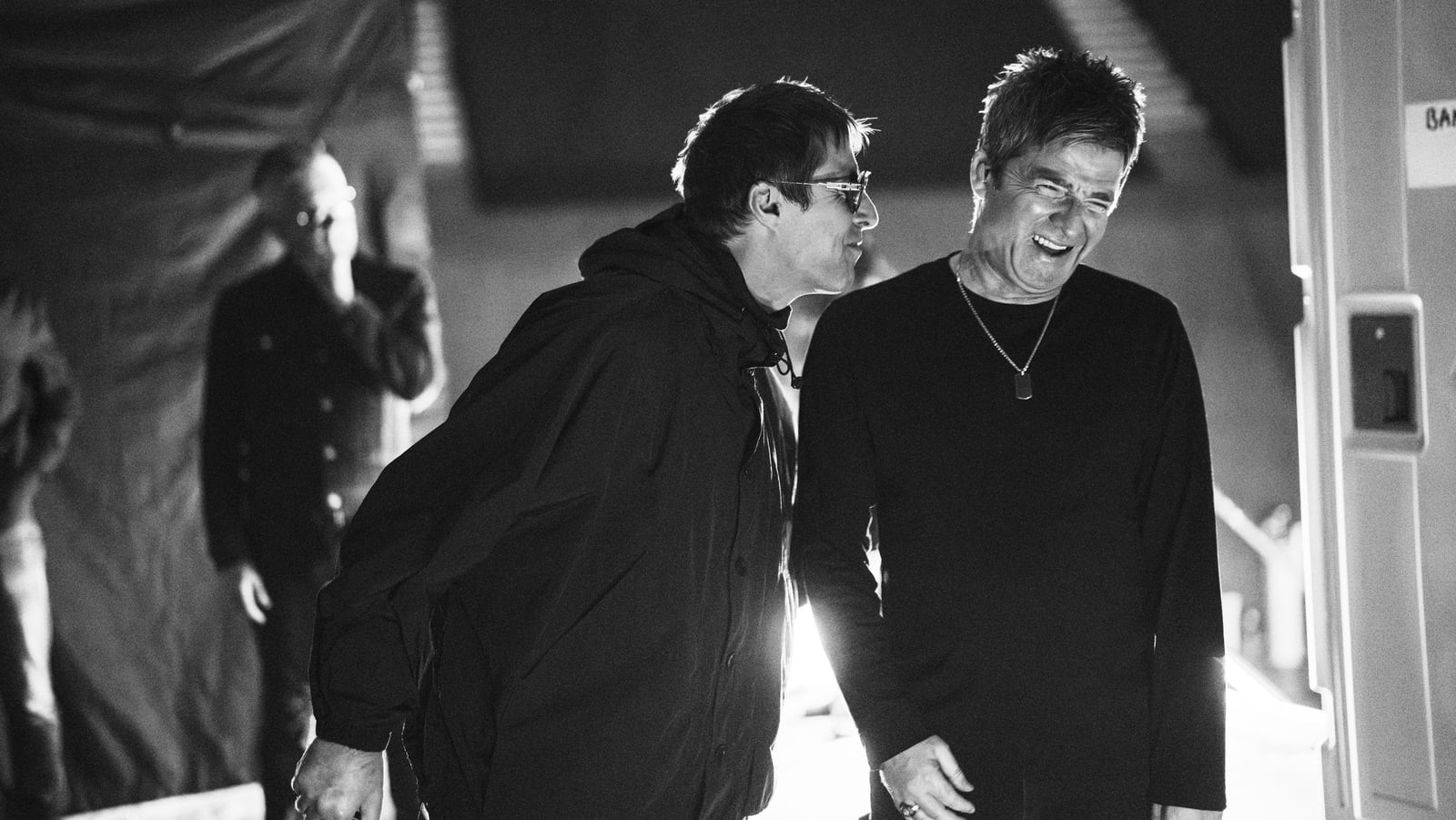
Before the first gig of the tour in Cardiff – the band’s first show in 16 years – Noel is visibly nervous, pacing the vastness of the backstage area and keeping very much to himself. However, the moment they walk on stage is electrifying and we get a close-up look at perhaps the most iconic moment of the whole Oasis reunion story – Liam grabbing Noel’s hand so that they can make their return with fists aloft in a show of unity. A clearly taken aback Noel looks dazed. “I didn’t know where I was for the first forty minutes,” he says. Liam takes it all in his simian stride and just looks like he’s back where he belongs. “You’ve got to put your f**king big boy pants on and go for it,” he says.
For a band who often gave better interviews than actual music, rock’s modern day glimmer twins have lost none of their talents as brilliant rock ‘n’ roll raconteurs
Liam does a very good job at being unimpressed and nonchalant, although in another example of the gnomic wisdom he is renowned for, he observes, “You don’t get to not give a f**k if you don’t actually give a f**k. I look like I don’t give a f**k because I do give a f**k.” Which is all rather reminiscent of Dolly Parton’s line about having to spend a lot of money to look that cheap.
The mass euphoria that sweeps through those audiences over the next five months is something to behold. There are lingering shots of grown men in Fred Perry shirts and women in bucket hats openly weeping and lingering shots of teenagers who weren’t alive when the band split bawling their eyes out.
But after the adrenalin burst of the first forty minutes, the rehearsals and that first show, the film has nowhere to go. There is no longer any conflict or jeopardy here. So the directors tell the fans’ stories rather than following concert film cliché, although there is plenty of that. We hear from the Brazilian fan who called the stray dog she adopted Bonehead; a very wise young Japanese fan who says, “When you fall down. Oasis fall down with you and then they pull you up again”; and an Argentinean fan, who has adapted Wonderwall and turned it into an anthem for his beloved San Lorenzo. In Manchester, we meet a survivor of the 2017 arena terrorist attack as she travels to Wembley to see the band for the first time and witness Don’t Look Back In Anger, the song that became a unifying force for her hometown after the atrocity.
Gem Archer, a refugee from Britrock also-rans Heavy Stereo who joined Oasis Mk 2 in 1998 and the ever-poised and cool Andy Bell of excellent 90s shoegaze act Ride are given the Bill Wyman/Mick Taylor treatment and all but ignored. Bonehead, however, is given lots of love from Noel, who says the guitarist and frequent Dublin visitor is the man responsible for Oasis’ impenetrable wall of sound. “He is the sound of Oasis. When he left in 1998, we spent the next 11 years chasing that sound,” before we cut to the band’s first performance of Bring it on Down in nearly thirty years.
Some Might Say is singled out by Noel as “the most Irish song of all time”. He adds, “The Irish can fight, laugh, smoke and drink all at the same time and they are the only race in the world who can do that.” Later he admits that he and Bonehead were in floods of tears as The Auld Triangle by Luke Kelly boomed out across Croker and 80,000 people joined in before Oasis took to the stage.
And for a band who often gave better interviews than actual music, rock’s modern-day glimmer twins have lost none of their talents as brilliant rock ‘n’ roll raconteurs. Noel, looking mature and prosperous, and Liam, looking like a Cro-Magnon fixer for some shady enterprise, now spar with each other with a lovely mutual respect in new sit-down interviews.
Much more should have been done with those Noel and Liam interviews, but this is joyous stuff, a moment of humanity and sheer good fun in a polarised world. Watching these warring brothers work it out is a genuine tonic. And just think, we’re going to get to do it all over again next year . . .
As Philip Larkin once said of another Northern English band, “When you get to the top, there is nowhere to go but down, but the Beatles could not get down. There they remain, unreachable, frozen, fabulous.” That may be the only Beatles/Oasis comparison ever worth making.