
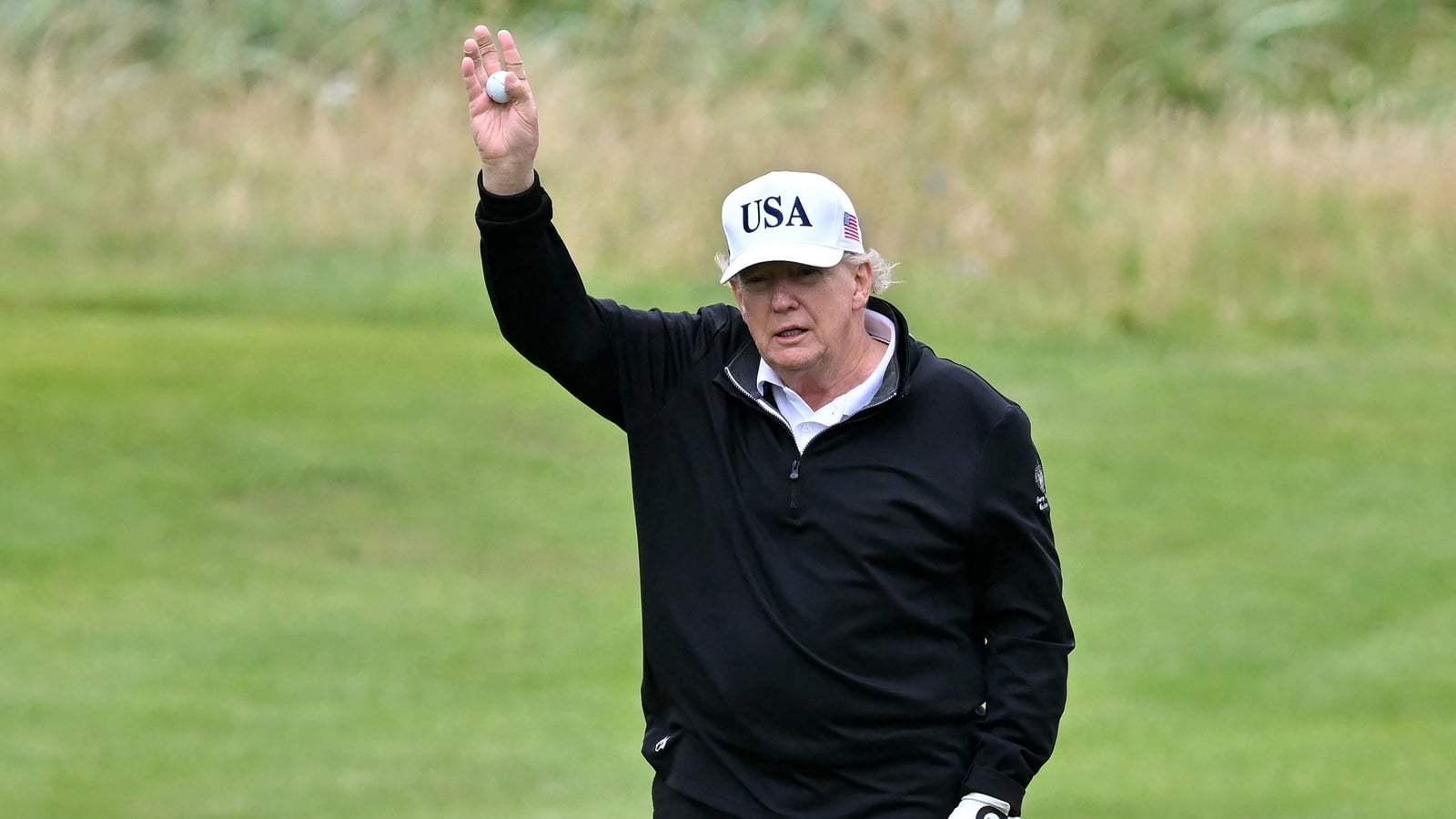
Unlike US presidents who came before him, Donald Trump’s visit to Ireland this week is about the fairways rather than searching for roots.
While it is unlikely he’ll pose with a pint of the black stuff in an ancestral home like Barack Obama or Ronald Reagan, or name a family pet after a village in Ireland (Richard Nixon had an Irish setter called King Timahoe), Mr Trump will be welcomed by hundreds of locals and tens of thousands of golf fans at the Amgen Irish Open at the Trump International Golf Links & Hotel in Doonbeg.
Much of his weekend will be spent at the event in West Clare, where it is expected he will present the trophy to the Irish Open winner on Sunday.
But just because the avid golfer has limited of political engagements, with the trip being personal rather than an official state visit, doesn’t mean it will be a quiet or unassuming affair.
After teasing the visit for months, President Trump is first expected to land in Dublin on Saturday morning aboard his new Air Force One, the aircraft given to him by Qatar, and will be greeted by Tánaiste Simon Harris.
Phoenix Park is set to become something of a political fortress, with a high-security operation in place by the end of the week, as Mr Trump starts his weekend with a visit to Deerfield Residence, the official residence of the US Ambassador to Ireland.
US Ambassador Edward Walsh, certainly a driving force behind this trip, will host the president with a function at the 250-year-old estate.
From there, President Trump will travel to see the Ambassador’s closest neighbour, President Connolly, at Áras an Uachtaráin before meeting the Taoiseach at Farmleigh House.
While Phoenix Park will play host to the political fanfare, Mr Trump will be kept away from demonstrations a few kilometers away, where tens of thousands are expected to march through the capital’s streets protesting President Trump’s visit.
The “No Welcome For Trump” demonstration, a broad coalition of groups from across a range of political parties, rights’ groups and anti-war organisations, is set to protest a range of issues including Mr Trump’s war in the Middle East and women’s rights.
Organisers also said they want to also show solidarity with Americans, with the extensive coverage this visit is likely to receive back in the United States.
One of those who demonstrated against Mr Trump’s visit to Ireland in 2019 will be meeting him at Áras an Uachtaráin, the house that inspired the White House.
President of Ireland, Catherine Connolly was well-known a vocal opponent of war and the US’s use of Shannon Airport during her time as a TD, and during last year’s campaign trial, she was highly critical of President Trump.
“We have a president, Trump, who is volatile, unpredictable, acting like a bully, bringing in tariffs when it suits him” she told RTÉ’s This Week, but said she would meet him if the situation arose.
Well, the situation has arisen.
Mr Trump is due to make a “courtesy call” to President Connolly on Saturday morning, in what is likely to be one of the most politically significant moments of her presidency and this trip.
What does now-President Connolly do now when the person she criticised during the campaign is standing in front of her as US President?
President Connolly’s comments, so far, haven’t been as openly or directly critical of Donald Trump since she took up her role as head of state.
There was, however, some indirect push back in separate statements in March as joint US/Israeli strikes continued.
“The normalisation of war can never be accepted. Now, more than ever, we must renew our commitment to peace and diplomacy in line with the principles of international law as set out in the United Nations charter” she said during her first St Patrick’s Day message.
On International Women’s Day, President Connolly said: “What we have witnessed in recent days in the Middle East, and beyond, are not political disputes. They are deliberate assaults on international law, the international laws that have underpinned global peace for 80 years. We must name them as such, without euphemism and without equivocation.”
While the meeting of the two presidents is expected to be brief, there will be ample opportunity to chat.
It is unclear how or where talks will take place in the Áras, but what is clear is that most of the engagement will happen behind closed doors and this is President Connolly’s first test.
Some of those who voted for her will expect her to raise the issues that defined and shaped her political career: her opposition to war, her criticism of US foreign policy and her concerns over Ireland’s neutrality.
Others will expect the president to put diplomacy first, mindful of the depth of the economic relationship between Ireland and the United States.
What happens in private between two leaders can sometimes remain a mystery, until one publishes a memoir, or a press statement may reveal some of the issues discussed as body language is picked apart.
But this is Donald Trump.
Whatever is said behind the closed doors of Áras an Uachtaráin may not stay there for long. He has also shown a willingness to speak publicly and at length about private meetings, disagreements and the people he meets.
And there will be ample opportunities for Mr Trump to speak to the media during his stay, with press conferences and multiple “chopper talk” scenarios in Dublin and Doonbeg. Don’t forget, his Truth Social platform is also at his fingertips.
This isn’t Taoiseach Micheál Martin’s first rodeo, evident by his “be grand” response to reporters this week when asked if he was concerned about the meeting.
“President Connolly is the official head of state of Ireland and that’s appropriate and proper that the president would meet with President Trump and be grand,” he said.
And while it all may be “grand”, there could be some serious business on the agenda.
Mr Trump has long targeted Ireland’s pharmaceutical sector and regulation of US tech companies. Ireland is also seen an important interlocutor for Washington, particularly now that Dublin holds the rotating presidency of the Council of the European Union.
It is a quick swing from geopolitics to golf on Saturday, but what happens in Phoenix Park may matter long after the final putt in the Banner.