
A jury has recommended an urgent review of legislation regarding the retention of adult mental health patients following the death of a man hours after he was discharged from a HSE mental health unit.
The jury at the inquest into the death of a 37-year-old Michael Hanley from Strandhill Road in Sligo returned a narrative verdict, having found that he died from multiple injuries as a result of having been struck by a train near Ballsodare on 27 September 2024.
The legal representative for the Hanley family sought a narrative verdict while the legal representative for the HSE sought a verdict of death by suicide.
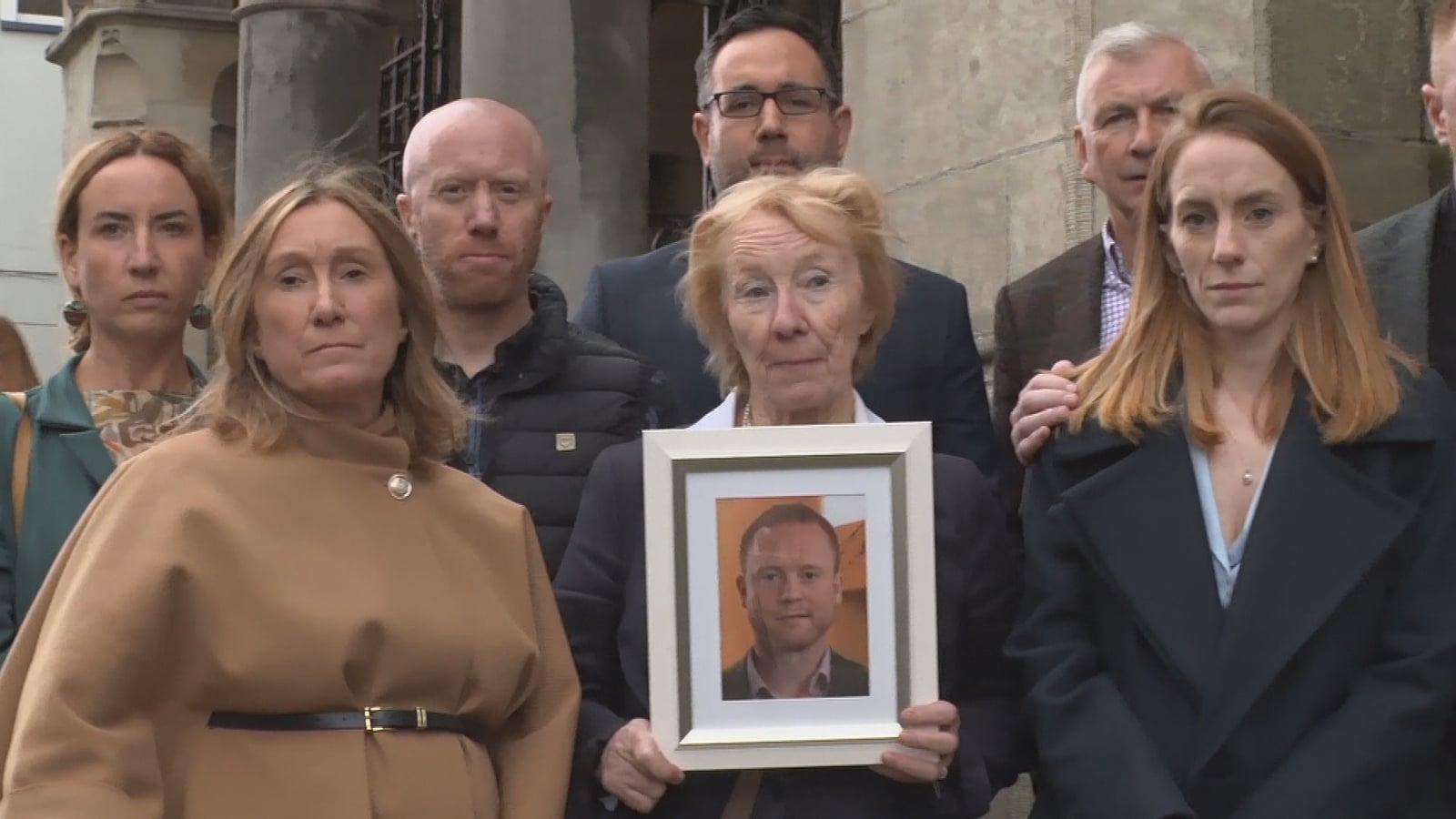
In a statement on behalf of the Hanley family, following the inquest, Michael Hanley’s sister, Mary Hanley, said they continue to feel failed by what happened to their brother.
She said Mr Hanley was a much-loved son, brother, brother-in-law and a cherished uncle, who was exceptionally bright and gentle in nature.
“Our family continues to be devastated by his death. The outcome of the inquest today goes some way to helping us understand the decision-making process at the Acute Mental Health Unit in Sligo, where Michael was a patient until a few hours before his death.
‘Michael was failed’
“But, as a family, we continue to feel failed. Michael was failed. We tried everything we could to share crucial information about Michael with the unit, to inform their assessment, but to no avail. We were screaming from the rooftops, but nobody listened.
“We will continue to do whatever we can to make sure that no other family finds themselves in the position that we did. We will continue, in Michael’s memory,” she said.
Mr Hanley had been a patient at the Adult Mental Health Unit – Sligo University Hospital for a week before he was discharged on 27 September 2024.
The inquest heard that Mr Hanley’s family made 17 attempts to provide relevant information to the unit during admission to inform their assessment.
It heard that Mr Hanley sought, when he was admitted, that there would be no contact with the family, a matter raised by clinicians, the inquest heard.
The inquest heard that Mr Hanley was diagnosed with Encephalitis in 2005, which resulted in an acquired brain injury, and that he also suffered from epilepsy and alcohol problems.
Consultant in General Adult Psychiatry Dr Eimear McGuire told the inquest that Mr Hanley was brought by gardaí to the SUH Mental Health Unit, due to concerns his family had, which included threats of self-harm on 18 September, 2024.
She said he returned home from London due to loss of his job 18 months ago, impacted by alcohol problems, and that he had outlined plans to return to employment.
Dr McGuire said she found him to be tense and articulate, with no psychotic symptoms.
She told the inquest heard of challenges in Mr Hanley’s life and that he had to engage with a local substance abuse counsellor in the locality, following his discharge.
He was discharged and readmitted on 20 September 2024. The court heard that he showed anger and made threats while intoxicated and was placed at a high level of observation in the facility in light of his suicidal thoughts.
Mr Hanley was noted to be at high risk due to the fact he did not disclose previous suicidal thoughts, and the inquest heard of a protection order that had been sought.
Dr McGuire spoke to Mr Hanley’s mother on the phone on 26 September 2024 and again the following day.
It was agreed that he could be discharged to her home on the following day, 27 September 2024 and Dr McGuire agreed to meet with Mr Hanley’s mother and brother at 12.30pm on day of his discharge.
Several hours later, she received a call from nursing staff, informing her of his tragic death.
Hanley was diagnosed with Encephalitis
The inquest heard that the family provided information about Mr Hanley’s behaviour to aid the unit in his treatment.
The inquest heard that Encephalitis, which he was diagnosed with in 2005, had caused brain injury and the brain injury may become more marked.
Dr McGuire said she was of the opinion, that Mr Hanley had alcohol misuse disorder and that he was not dependent on alcohol.
She said he did not show signs of delirium tremems in hospital.
She alluded that she tried to help him with the issues that she identified, including disharmony in his life, and added that she did not believe that he had a mental illness.
The inquest heard that clinicians cannot involuntarily admit someone because of alcohol misuse or a personality disorder.
Dr McGuire said that Mr Hanley agreed not to consume alcohol on his discharge and that she had significant collateral in the form of the documents that the Hanley family disclosed, which she said were examined in detail.
Dr McGuire said Mr Hanley sought, when he was admitted, that there would be no contact with the family.
She said she questioned him about this frequently.
A lengthy discussion took place about Mr Hanley, his mental state, health, behaviour and family concerns.
The inquest heard of discussions about the provisions of the adult mental health legislation, provisions for detention, personality disorder as well as the difference between alcohol dependence and alcohol misuse.
Mr Hanley died as a result of multiple injuries as a result of having being struck by a train on 27 September 2024.
The inquest accepted that the events were out of control of the train driver and at the time of Mr Hanley’s death, his blood alcohol level was 176 mg per 100ml of blood.
Coroner Fergal Kelly, extended his sympathies to the Hanley family, as did all the agencies present.
Mr Kelly said it is always important to remember the deceased, not just in their last moments.
He said Mr Hanley, who had difficulties, was an intelligent, positive and caring man, during his 37 years.
Mary Hanley told the inquest that her brother, Michael had a keen interest in economics, finance and public affairs and that was a talented sportsman in his younger years.
‘He was adored by all of us’
She said Summer 2005 changed his life irrevocably, when he contracted a virus that developed an acquired brain injury.
He was admitted to St Patrick’s Hospital in Dublin.
Despite his illness, Mr Hanley graduated with a degree in economics and finance from Queen’s University Belfast and a master’s in econometrics from Bristol University.
He had worked at the Institute of Chartered Surveyors in the UK.
The inquest heard that Covid lockdowns had a negative effect on him and his family believe that, during this time, he developed a problem with alcohol.
“Michael always masked difficulties very well… we believe he used alcohol as a coping strategy…we continue to be devastated,” Mary Hanley told the inquest.
“He was adored by all of us… especially his nieces and nephews… we believe that his death was not a foregone conclusion. We tried everything we could to support him,” she said.
She said her family will remember their brother as a kind, gentle, bright brother and son, and she extended their deepest gratitude to first responders.