
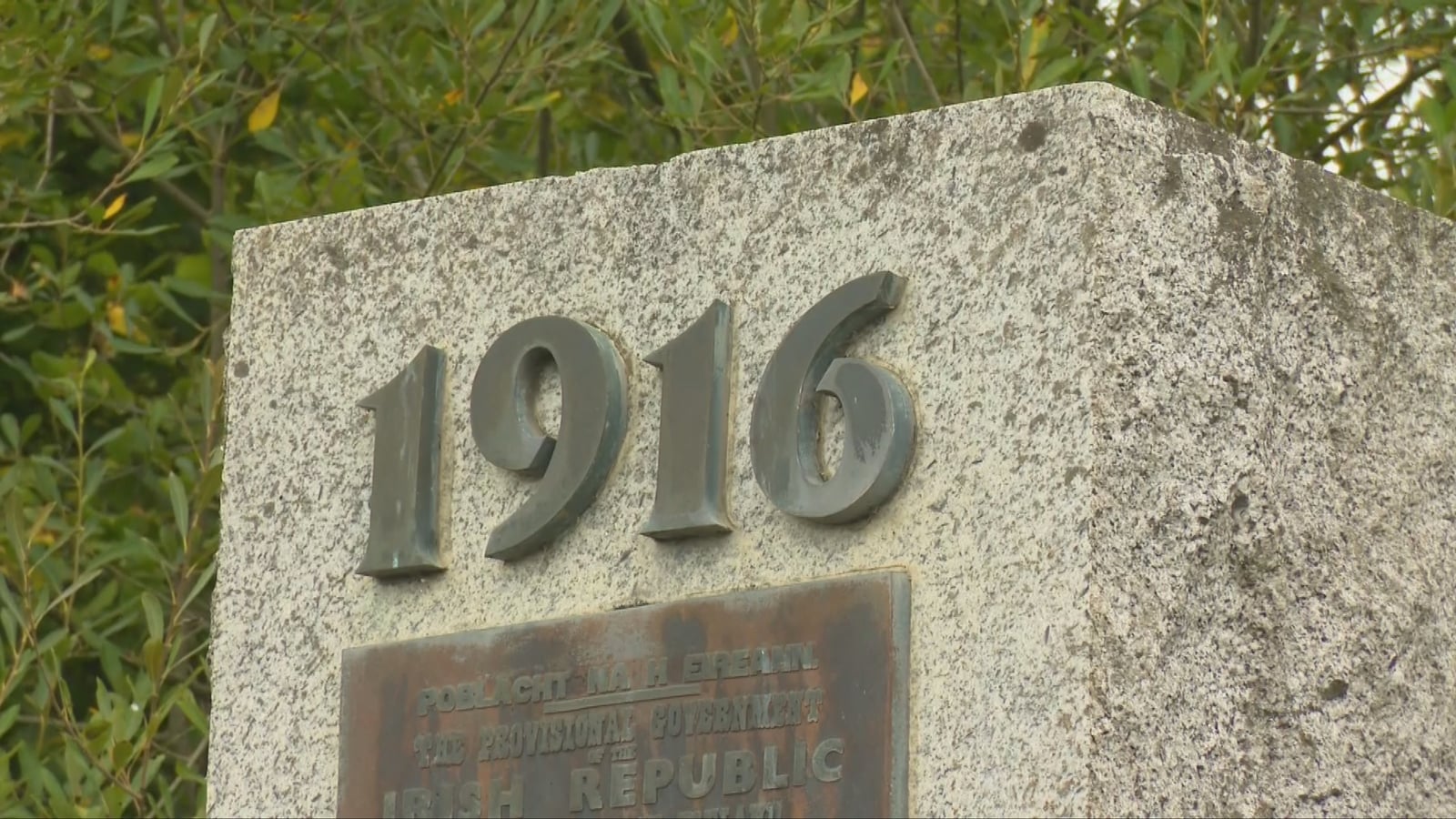
On Easter Sunday night, 23 April 1916, a group of Laois volunteers acting under the direct orders of Pádraig Pearse participated in the demolition of a section of the Portlaoise railway line and breaking communication lines.
Their goal was to prevent British military reinforcements from reaching Dublin via Waterford after the 1916 Rising had started.
Train tracks were ripped up, a train was derailed; telegraph wires were cut, and, significantly, what is claimed to have been the first shot of the Rising was fired.
However, many of these men never received recognition, in the form of a 1916 medal.
Now, 110 years later, their descendants are calling for what they feel is a historical injustice to be corrected.
Campaigners also feel that volunteers outside the capital did not receive the same recognition as their counterparts in Dublin.
The Government decided in January 1941 that two medals should be struck in respect of service during the 1916-21 period, one for service during Easter week 1916, and the second for subsequent service up to the truce of 11 July 1921.
The current system is tied to an old pensions scheme wound up in the late 1950s.
However, campaigners have stressed that this is no longer an issue of money but of fairness.
‘They should be recognised’, says historian
Historian and author, Dr Cormac Moore has done extensive research on the efforts of the Laois volunteers.
He said the operation at Colt Wood in Portlaoise was “quite a successful operation.”
“They cut off a lot of communication; they were able to derail the tracks as well.
“The next day, a train came here and actually was derailed. Eight men, including five RIC [members], had to jump off the train to prevent injury,” he said.
While the operation to derail the tracks was ongoing, a railway clerk came out from Portlaoise with a lantern to investigate.
Dr Moore said: “He was told to stop, and three shots were fired at him by PJ Ramsbottom (leader of the operation).
“They actually were the first official shots of the 1916 Easter Rising.”
Dr Moore feels the volunteers “did everything that was asked of them and they should be recognised”.
The Fleming family has kept Pearse’s direct order for over a century, and it is now believed to be the only one still in existence.
Decades of research of the events that Easter week in Co Laois was spearheaded by Jim Fleming from the Swan.
His cousin Pat Fleming also became involved in the campaign on behalf of his grandfather Patrick, who picked up Pearse’s order.
He believes there was “no consistency in how the medals were awarded”.
“Half of them got medals and the other half didn’t even get recognised for 1916. And I think there’s some injustice there”.
“At this stage the pension doesn’t matter,” he said.
Mr Fleming also highlights the plight of the women involved who were “written out of history”.
The families have previously made applications for their ancestors to be awarded a posthumous medal, but the bar is high.
In the Dáil last December, Minister for Defence Helen McEntee explained why.
“In certain exceptional situations, a medal can be posthumously awarded if no medal was previously issued,” she said.
“However, in order not to diminish the intrinsic value of such medals, this is only done in exceptional cases and only where there is incontrovertible verified evidence available that the criteria for the award of a medal have been met.
“The process by which applications and petitions or appeals under the Military Service Pensions Acts were investigated and verified was wound up in 1958 and … there are now no surviving members of the old IRA or related organisations who could verify membership.”
However, while it is difficult to satisfy the requirements, it is not impossible.
New figures from the Department of Defence show that last year, 14 applications for medals were received, of which six were awarded.
So far this year, eight applications have been received and two have been awarded.
‘Just a handful of weapons’
The campaign for recognition stretches across the Atlantic.
Owen Kirby in Washington DC has taken over his family’s century-long quest for recognition.
Mr Kirby’s grandfather Michael Gray joined the IRB as a young man and became one of the Laois volunteers.
“On Easter weekend, they received notice, an order from Pearse, telling them the rising was on, and they had to go and do whatever they could do at the time”, said Mr Kirby.
“They had very little equipment, really, just a handful of weapons.
“They were under direct orders, and they they followed through on the orders to the best of their abilities and their capabilities.”
Mr Kirby said “things got messy” and the group split during the Civil War.
‘Brother against brother’
“You had brother against brother. You had comrade against comrade, and things just got a little tricky in terms of recognition,” he said.
Mr Gray said that despite witness statements verifying his grandfather’s efforts, he was never recognised for 1916.
“I think it’s time that we open the files back up and give a proper look. The full story of 1916 is not complete yet, until these issues are resolved, until we recognise all the men and women who rose up for what we have today – the Republic,” he said.
Mr Kirby said his had father started looking for justice for Michael Gray in the 1980s, before he picked up the task.
However, the family “repeatedly hit stone walls” and heard “various excuses”.
When Mr Gray’s mother died earlier in May, he decided to “give this one last try”.
“She is not going to live to see this resolved. But there are six living children of Michael Gray, who grew up knowing of his disappointment over not being recognised.”
Mr Kirby feels the “issue of pensions” needs to be forgotten.
“This is one of the reasons why back in the day, my grandfather didn’t receive the medal and why the others didn’t, because in the 1940s and 50s, when they were looking at these files, the state was not in good financial health.
“To give someone four years’ service for seven days of rising was probably a lot for the Government to swallow,” he said.
Mr Kirby believes the story of the Laois volunteers is a “Pandora’s box”.
“It’s probably not just these men in Laois. We know there are other claimants as well, other descendants who are out there looking for similar recogognition.
“It’s just telling the full story, telling the whole story of 1960, and recognising all those who served,” he said.
The descendants of the 1916 Laois have vowed to continue their efforts.
“Better late than never,” Mr Kirby said. “But this isn’t just the story of the Gray family, it’s the story of Laois, it’s the story of Ireland. It’s something for everyone to share.”