
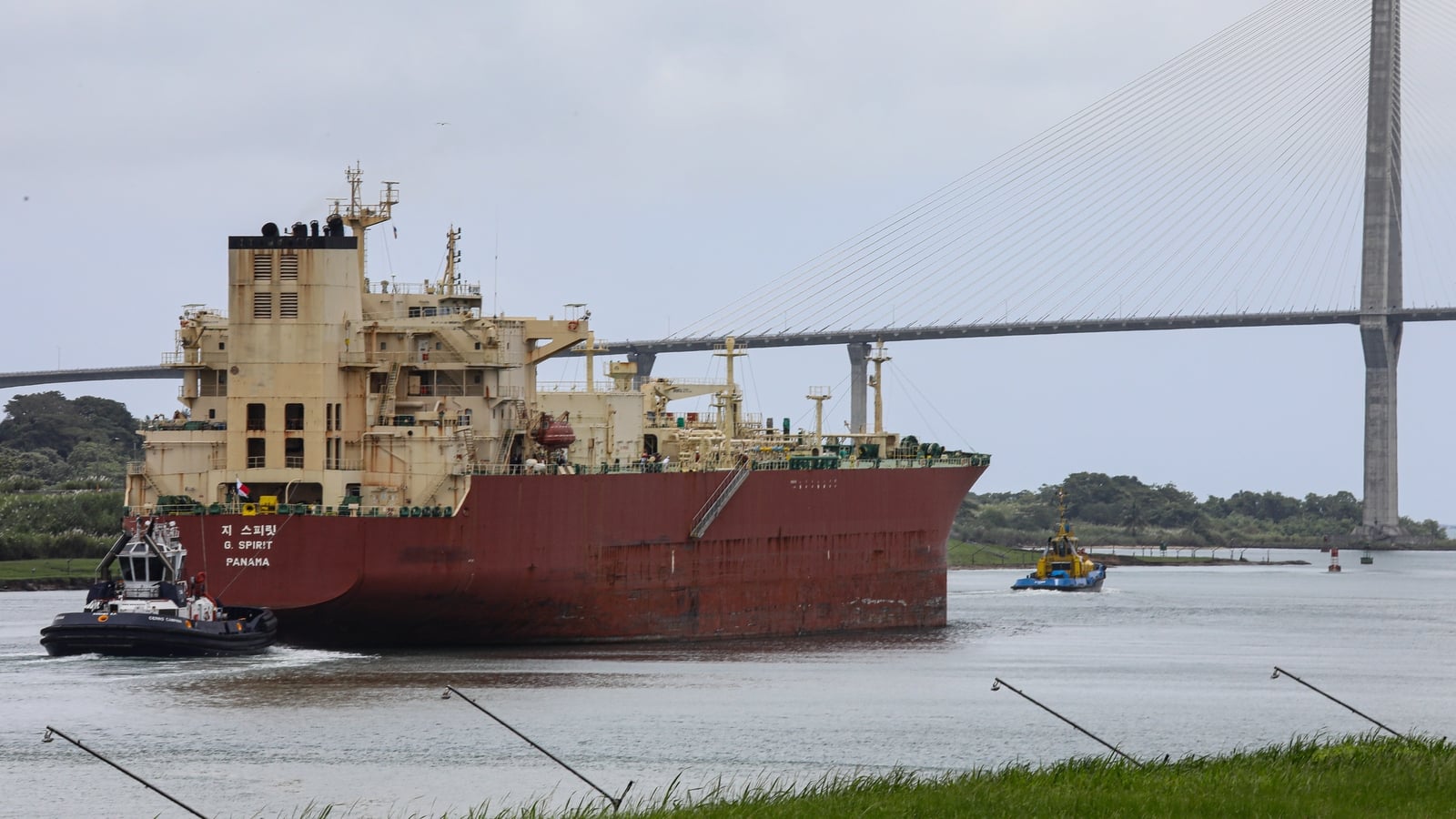
The Panama Canal has begun to reduce the number of ships passing through due to a drought caused by the El Niño weather phenomenon.
The Panama Canal Authority said low water levels in the two artificial lakes that feed the canal forced it to act.
The number of vessels allowed through the waterway connecting the Atlantic and Pacific oceans will be progressively lowered from 36 per day to 32 by mid-September.
Panama has declared a nationwide emergency over El Niño, a weather pattern developing over the Pacific Ocean that is triggering worldwide changes in winds, atmospheric pressure and rainfall and pushing up global temperatures.
This year’s El Niño is expected to be the strongest since comparable records began four decades ago.
It has not yet reached its peak, but Central America is already in the throes of a severe drought, prompting Honduras and El Salvador to also declare emergencies.
The Panama Canal handles 5% of global maritime trade and around 40% of US container traffic.
It has already implemented other water conservation measures, such as lowering the maximum draft – the vessel’s depth in the water – for the largest ships.
In 2023, El Niño forced the canal authority to reduce the number of daily crossings to 22 vessels.
On Thursay, the World Meteorological Organization (WMO) said a potentially exceptional El Niño warming event is now firmly established in the tropical Pacific and is expected to strengthen significantly into a “very strong” El Niño over the coming months.
The event is expected to continue intensifying through the autumn and peak towards the end of 2026, although its climatic effects are expected to continue well into 2027.
The WMO stresses that El Niño itself is a naturally occurring climate phenomenon and is not caused by human-induced climate change.
However, this El Niño is occurring against the background of an already much warmer planet and unusually warm oceans.