
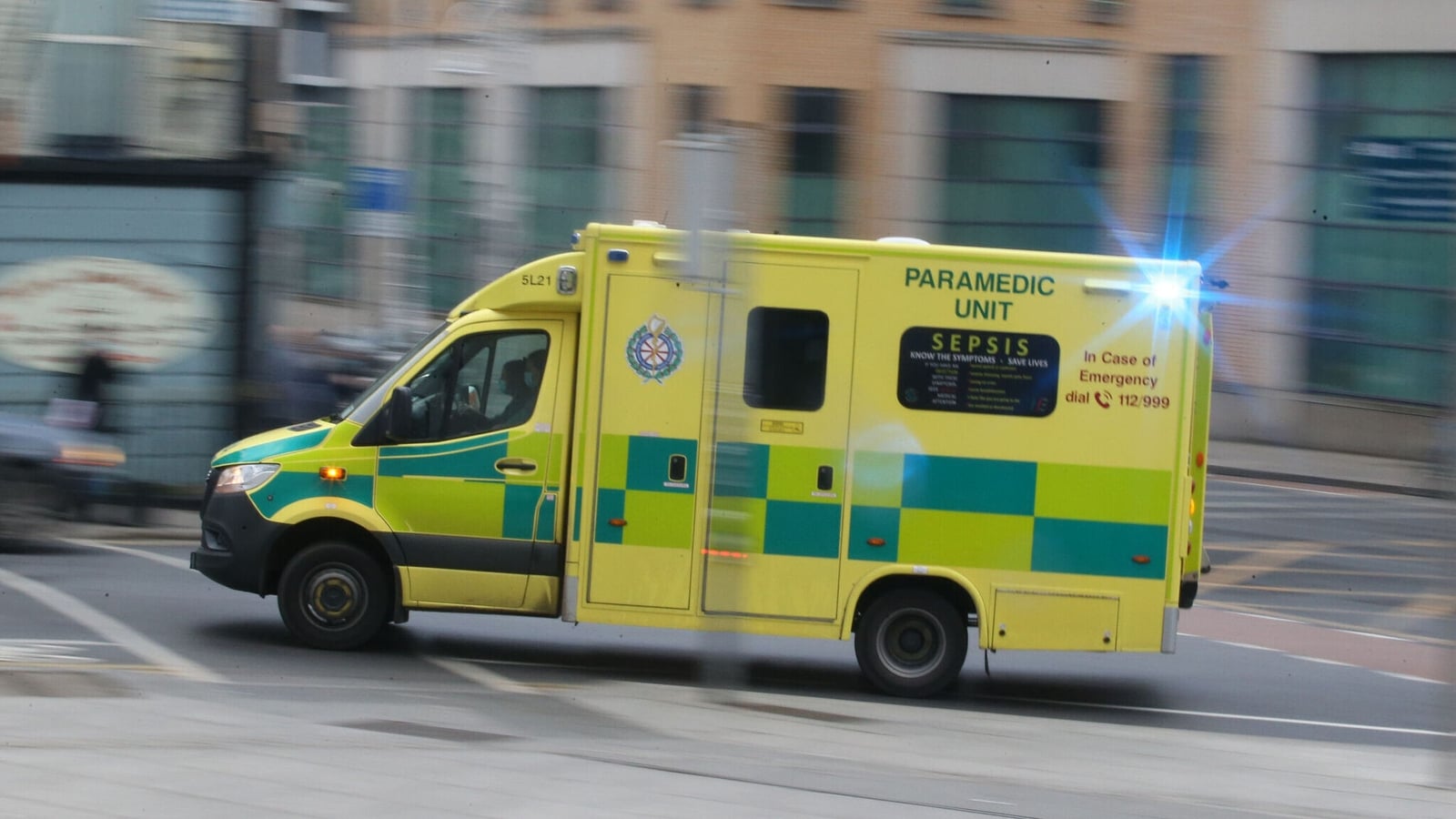
Ambulances took more than an hour to respond to over 20,000 emergency calls in the past five years, new figures show.
In some instances, patients were waiting around seven hours for an ambulance to arrive.
The figures from the National Ambulance Service (NAS) were obtained by RTÉ’s Drivetime through a Freedom of Information request and relate to ‘purple’ and ‘red’ calls, which are the highest priority.
Purple is the most serious and means there is a cardiac or respiratory arrest. Red relates to other life-threatening illnesses or injuries.
The NAS aims to reach 75% of purple calls within 19 minutes and 45% of red calls within the same timeframe.
But these figures reveal there were 20,244 occasions for the years 2021-2025 in which it took more than an hour for an ambulance to arrive.
Forty-six of these were for purple calls, the highest level of emergency.
For 129 calls, it took more than four hours for an ambulance response, while on two occasions it was around seven hours.
The NAS said the figures should be interpreted with some caution, as the status of a call could change throughout the incident.
A call may initially be recorded as lower priority and then upgraded if the patient’s condition worsens.
Stephen McGuinness, who is a shop steward for the trade union SIPTU and a paramedic working in the east of the country, said he and his colleagues are under constant pressure.
He said: “It’s very frustrating and you do end up arriving into someone’s house or their workplace or a football pitch to be met with angry faces.
“They don’t understand that we were in a hospital where up the wards due to lack of beds, the ED (emergency department) can’t move people up the wards or due to lack of staff, they can’t move people out of the hospital. So there’s a backlog in the A&E.
“So if I’m sent to a house or a football pitch, when I’ve just cleared a hospital after being stuck there for maybe an hour and then it’s an hour and a half to get to the football pitch and the call’s been in for a previous hour – so three and a half hour response time, yes, of course I’m going to be met with hostility or anger, but it’s not my fault.
“Now, it’d be hard to establish whose fault it is, but it all comes back to resources.”
In October 2025, NAS director Robert Morton told an Oireachtas health committee that the service needs “more of everything, everywhere” with rural areas among the worst affected.
SIPTU organiser for the ambulance sector John McCamley said the workforce needs to be doubled.
He said: “We would put the blame on any delays on the fact that there isn’t adequate resources in the ambulance service.
“You do have the stacking up of ambulances of EDs, which is an ongoing problem. But I think the main acute problem there is there just isn’t enough ambulances within the country to deal with the demand that’s there presently.
“I know there has been good developments in getting extra staff in particular areas, but I think overall, we in SIPTU and our members would argue that there needs to be a whole wave of additional staff, both for EMTs and paramedics and advanced paramedics, and the need to make it attractive for people to want to work there.
“And that is very, very difficult where people, where our members are working beyond their hours, sometimes, for five, six, seven hours over their finishing time because they’ve been dispatched across the country because there isn’t a resource in a particular part of the country or that resource is tied up somewhere else or in an ED.
Sinn Féin‘s Spokesperson on Health David Cullinane said it is “indefensible” that on some occasions patients were waiting more than five hours for an ambulance.
He said: “The HSE themselves and the government carried out a number of capacity reviews within the National Ambulance Service and we dealt with this several times at the Oireachtas health committee.
“I know that at least 2,000 additional paramedics are needed over the next number of years.
“In fact, they should have been in place by now. So, the HSE and the Government are way behind the recruitment targets and if they don’t have sufficient numbers of paramedics, they depend on overtime and goodwill from the existing paramedics and that leads to a lot of burnout and a lot of frustrations.
“There’s lots of areas in healthcare where on the one hand we need more efficiencies. But where we need to invest to ensure that patient safety is paramount, then that needs to be done.
“So that’s the responsibility of the Minister for Health (Jennifer Carroll MacNeill). We cannot penny pinch when it comes to saving people’s lives and patient safety.”
In a statement, the HSE said: “The HSE National Ambulance Service (NAS) is currently undergoing a significant programme of transformation to enhance service delivery, optimise resources, and expand its role in providing alternative and community-based care.
“The NAS continues to face sustained and growing demand, responding to approximately 450,000 emergency calls in 2025. NAS activity from January to June 2026 increased by 5.3% compared with the same period last year. Since 2023, demand has increased by 23%.
“Working closely with acute hospital partners, the NAS has introduced measures to improve hospital turnaround times and ensure patients receive timely, high-quality care.”