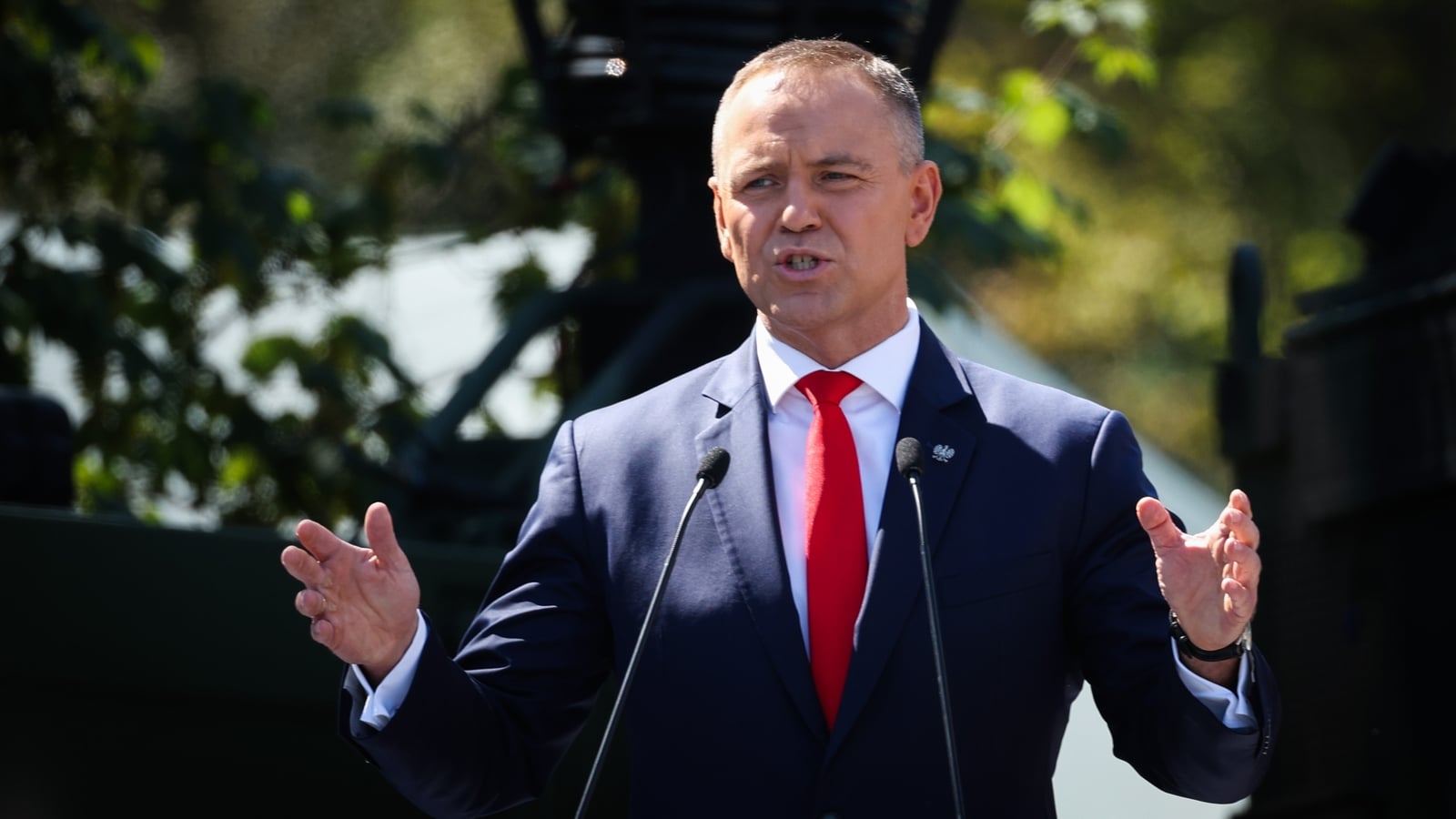
Poland’s President Karol Nawrocki has called on Germany to settle the issue of World War II reparations at a ceremony marking 87 years since Nazi Germany invaded Poland.
The attacks on 1 September 1939 marked the start of World War II. Two days later, on 3 September, Britain and France declared war on Nazi Germany.
“I appeal to the German Chancellor, to the German nation, let’s settle the issue of reparations and reparations with historical justice in mind, but also with the future in mind,” said Mr Nawrocki at the pre-dawn ceremony in Westerplatte, a peninsula at the northern edge of Gdańsk.
Mr Nawrocki, a nationalist historian, said a “true, firm alliance” towards Poland “requires that our allies from Berlin and our neighbours pay us compensation”.
Poland, he said, would transfer any sums to the Polish armed forces and the Polish arms industry “so that we do not have to take Western loans, so that we get what we deserve”.
Poland’s previous nationalist government, which governed from 2015 to 2023, demanded that Germany pay €1.3 trillion in reparations to the Polish state for the destruction caused by Nazi Germany to Poland during almost six years of brutal occupation.
The current government of Prime Minister Donald Tusk has not pursued that sum but has not abandoned the pursuit of some level of reparations from Berlin.
In 2024, Polish foreign minister Radoslaw Sikorski called on Germany to “think in a creative way about finding a form of compensation for these war losses, or of redress”.
Successive German governments have considered the matter closed, based on Poland’s renunciation in 1953 for any further claims of war reparations.
But Poland disputes this point, arguing that the renunciation was made by Polish communist authorities at the time.
Speaking at this morning’s ceremony at Westerplatte, Mr Tusk spoke of the need for unity among Western allies and said that “evil is once again lingering behind our border”, in a clear reference to Russia’s invasion Ukraine.
“The coming months, this autumn and this winter ahead of us, may prove crucial not only for the independence of Ukraine, but also for the security of Poland and the entire free world,” said Mr Tusk, adding that NATO “cannot be an alliance on paper”.
Polish leaders gather each year on 1 September for a commemorative ceremony at the Westerplatte, a peninsula that was defended by Polish soldiers and attacked by German forces at 4.45am that day.
The isolated Polish soldiers defending the Westerplatte put up fierce resistance for seven days before surrendering.
Mr Tusk also attended a commemorative ceremony in Wieluń in central Poland, the first Polish town to be bombed by the Luftwaffe at 4.40am on 1 September 1939.
Of the town’s 16,000 inhabitants, it is estimated that more than 1,000 were killed.
The Soviet Union invaded Poland from the east on 17 September 1939 as part of a secret pact with Nazi Germany to carve up Poland between them.
On 27 September, Poland surrendered and its government went into exile.
Germany’s invasion marked the start of almost six years of brutal occupation of Poland.
More than six million Polish citizens – about 20% of the country’s pre-war population – were killed during the war.
That death toll included three million Polish Jews who were murdered by the Nazis in extermination camps.