
Advertisement
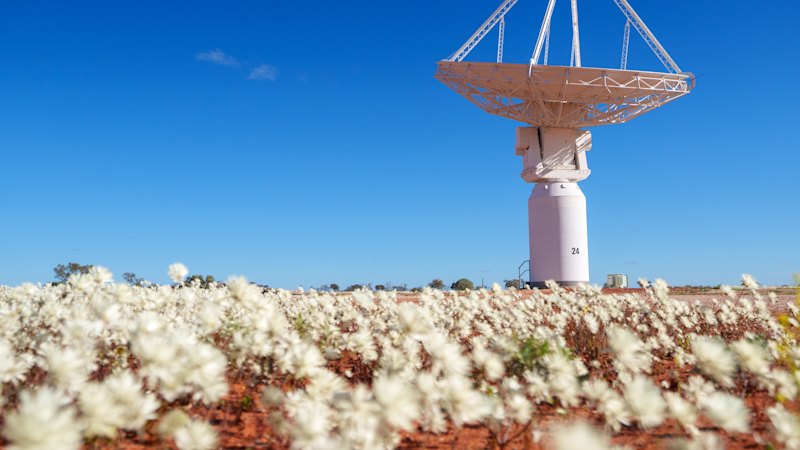
Western Australia’s Mid West has recorded the best wildflower season in almost two decades, with early winter rains contributing to ideal conditions for seeds that had been lying dormant for years to finally sprout.
In the Shire of Murchison, more than 800 kilometres north of Perth, flowers blanketed the region across August and into September.
At the CSIRO’s Radio-astronomy Observatory, the variety has impressed long-time Murchison local Andrew Whitmarsh – also the CSIRO’s land manager for the observatory site.
The flowers this year have bloomed right up against the radio telescopes that peer into the far reaches of space.
Advertisement
The season also began early this season, triggered by generous downpours starting with Cyclone Mitchell back in February.
Whitmarsh said the soil’s “seed bank” had come alive, with the early season rains allowing many seeds that were dormant for years through drier conditions to germinate.
“Different species like different conditions, but this year has been a free-for-all with so many varieties blooming at the same time,” he said.
“I don’t think I’ve seen a display this good since 2008.”
The CSIRO’s observatory land management team work closely with WA biodiversity experts to monitor and document the species at the observatory.
Advertisement
Over the last decade, the observatory’s presence has necessitated a change in land use for the site, from pastoral lease to radio astronomy only, which included adapting water management and land care activities.
“We take samples and help monitor populations, gathering information to support biodiversity work in Western Australia,” Whitmarsh said.
“We’ve helped trace new populations of protected wildflowers, resulting in one already being reduced from a priority 1 to a priority 3 protected species last year.”
That species is the Calandrinia Mirabilis, listed as priority 1 until 2025, when the flower’s classification was dropped after additional populations were documented at the observatory site.
Advertisement
At the beginning of the 2026 season, Bush Heritage senior ecologist Michelle Hall said this year’s wildflowers were putting on a “spectacular show”.
“There aren’t many places in the world where you can see this kind of thing,” she said.
“The Mid West is particularly known for these amazing carpets of flowers. It’s an extreme arid environment that occasionally gets cyclones coming through. That’s what caused this big display.”
As the wildflower season comes towards its end across the Mid West, the CSIRO team already has their eyes on the future.
Advertisement
“We plan to increase our water flow management activity across the site, minimising the movement of water where it wouldn’t naturally go through reducing road-side windrows and constructing pond banks,” Whitmarsh said.
While he said he doesn’t expect to see another wildflower season like this one again next year, it is likely there will be growing displays as the land changes with its new use.
“We’re seeing extra plant variety and growth in the areas where the soil has been disturbed near the telescopes, as well as slow-growing tree species like Mulgas growing and surviving in new spaces across the site,” he said.
You have reached your maximum number of saved items.
Remove items from your saved list to add more.
More:
Holly Thompson is a journalist with WAtoday, specialising in education and the environment.Connect via X or email.AdvertisementAdvertisement