
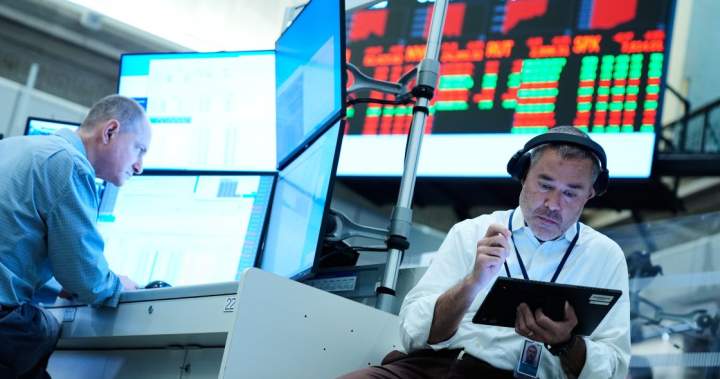
The U.S. stock market is slipping Tuesday as oil prices and the bond market crank up the pressure on Wall Street.
The S&P 500 fell 0.4 per cent. The Dow Jones Industrial Average was down 506 points, or one per cent, as of 10:30 a.m. Eastern time, and the Nasdaq composite was 0.6 per cent lower.
They felt pressure as the yield on the 10-year Treasury, which is the centerpiece of the U.S. bond market, climbed to 5.01 per cent from 4.97 per cent late Monday. It’s been jumping to its highest level in years, and Monday was the first time it breached the five per cent level since 2023.
Higher yields mean everyone from the U.S. government to households to businesses must pay more in interest to borrow money, which slows the overall economy. They also make people less willing to pay high prices for stocks because they can earn more from sitting in bonds, which are considered safer investments.
Story continues below advertisement
“The result is a market that must work harder to generate earnings growth just as investors become less willing to pay premium valuations for that growth,” according to Darrell Cronk, president of Wells Fargo Investment Institute.
4:01
Global bond yields surge
The last time the 10-year yield was consistently above five per cent was around the turn of the millennium, and it’s been a long march back since bottoming out below 0.50 per cent in 2020. It’s picked up speed since February, after the war with Iran sent oil prices much higher.
Get weekly money news
Get expert insights, Q&A on markets, housing, inflation, and personal finance information delivered to you every Saturday.
By providing your email address, you have read and agree to Global News’ Terms and Conditions and Privacy Policy.
That raised worries about high inflation potentially lasting for years, which are layering on top of longstanding concerns about the U.S. government’s massive debt level and other issues.
Oil prices rose further Tuesday following several sharp swings in the morning. The price for a barrel of Brent crude, the international standard, climbed 1.7 per cent to US$107.49 after flipping between $105.10 and $108.43 earlier in the day.
Story continues below advertisement
It remains well above its $72 level from early July and from before the war with Iran began in February, as doubt continues about whether the United States and Iran can reach an agreement that would allow oil tankers to freely exit the Persian Gulf through the Strait of Hormuz.
Inflation remains high enough that the widespread expectation is that the Federal Reserve will announce on Wednesday that it will hike the federal funds rate for the first time in three years.
Traders are still betting on a slight chance that the Federal Reserve could hold off on hiking interest rates, though. If it does, the market could swing because investors may see it as a sign that the Fed is less committed to getting inflation lower.
Fed officials will also release forecasts for where they see interest rates heading in upcoming years, providing another opportunity to inject uncertainty into the market.
2:08
Iran war stokes inflation, ‘oil poverty.’ How long until prices calm down?
- Donald Trump Jr.’s wedding funded in part by Russian oligarch, couple says
- Amazon ‘pauses operations’ with cargo airline after fatal Miami plane crash
- Person of interest arrested after 4 killed in Louisiana stabbings
- Sydney Sweeney faces backlash from athletes over nude sports betting ad
-
‘I find Canada to be the worst country to deal with,’ Trump tells reporters
-
Trump downplays AI warnings as concerns grow
-
U.S.-Canada trade war makes cross-border shipping tougher
-
Trump suggests Canada-U.S. trade deal could happen ‘fairly soon’
On Wall Street, stocks of companies that depend on customers having enough spare cash to spend on their products fell to some of the sharpest losses.
Story continues below advertisement
Chipotle Mexican Group dropped 4.8 per cent. Darden Restaurants, the company behind Olive Garden and Longhorn Steakhouse, sank 3.6 per cent.
Dollar Tree, whose customers may have less financial cushion than others to keep spending, lost 3.9 per cent
Dave & Buster’s Entertainment tumbled 15.3 per cent after reporting weaker results for the latest quarter than analysts expected.
Elsewhere on Wall Street, artificial-intelligence stocks held a bit steadier following their worldwide slide the day before, after leaders of the AI industry called for a slowdown in development to address safety issues for humanity.
Nvidia rose 0.8 per cent, a day after its 3.4 per cent drop was the heaviest weight on the S&P 500 index. Advanced Micro Devices climbed three per cent.
Such stocks led the U.S. market to records for years, but they’ve come under pressure recently on worries that their prices shot too high in the frenzy around AI.
Some companies hoping to power the AI revolution also recovered some of their own sharp losses from Monday. GE Vernova gained 1.5 per cent to recoup some of its 8.6 per cent drop.
In stock markets abroad, indexes fell across much of Europe and Asia. But for several, the drops were not as sharp as Monday’s caused by the slide for AI stocks.
Story continues below advertisement
The Toronto Stock Exchange was down about 0.75 per cent as of publication.
South Korea’s Kospi index, for example, fell 0.9 per cent following Monday’s 3.3 per cent drop.
– with a file from Global News’ Ariel Rabinovitch