
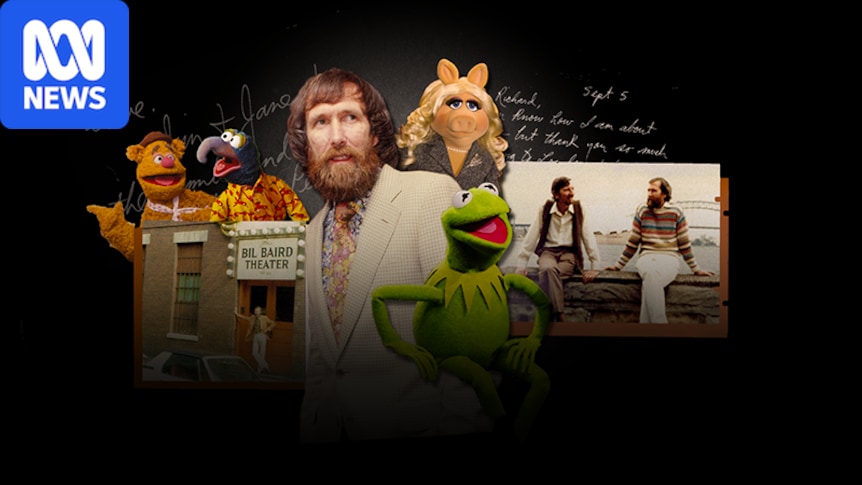
It’s been 50 years since The Muppet Show hit TV screens around the world. For one Australian puppeteer, it was the adventure of a lifetime.
February’s edition of what to watch on TV, our monthly wrap of new shows, didn’t reach that many people.
Which was a surprise because it was sold off the 50th anniversary special of The Muppet Show, a one-off nostalgia-fest helmed by stars Seth Rogen and Sabrina Carpenter.
But someone must have been reading, because the next day a message appeared in my inbox.
“Velvet has recently posted something about a new Muppet Show to celebrate 50 years. I have attached a letter … which Velvet might have fun seeing.”
Attached was a scan of a meticulously kept letter dated March 8, 1976.
“Dear Richard,
So, how the hell are you?
We’re embarking on a rather interesting project. We’re doing a series of 24 half-hour television shows which will be syndicated in the US and around the world.
The show is called The Muppet Show.”
It was a letter from Muppets creator Jim Henson.
The person he was asking on his new-fangled program was Richard Bradshaw OAM; he would become the only Australian puppeteer to ever appear on The Muppet Show.
Puppets for an ‘adult’ audience
Before The Muppet Show, Sesame Street had been on the air for almost seven years introducing a whole generation to Jim Henson’s creativity.
But Henson, even at 40 years old and with decades of experience behind him, was struggling to bring his creations back to an adult audience.
Loading…
The original “Muppets” had been appearing on television and in advertisements for years.
Kermit the Frog, made out of Henson’s mother’s old coat, a pair of blue jeans and some ping-pong balls, made his first appearance in the mid-1960s.
Before Sesame Street, their creations had been “strictly adult entertainment”, according to Michael Frith, Henson’s former art and creative director.
“What they were doing was blowing each other up and biting each other’s heads off, and things like that,” he said in a Studio 360 documentary series.
“Very non-kid stuff.“
From Clovelly to New York City
Bradshaw’s journey to The Muppet Show is as unexpected as the Muppet’s explosion into the mainstream.
Loading…
Born in Sydney in 1938, it was never his intention to become a professional puppeteer.
“I actually did mathematics and geology at the university and then I taught for a while,” Bradshaw tells ABC News
“Puppets go back to 1952 and I joined a little puppet theatre in Clovelly in Sydney. But it wasn’t until I was teaching and I was living in a boarding school in Sydney that I thought, ‘Oh, I might like to do some puppets again’.”
Bradshaw dabbled in standard hand puppets and marionettes but found them too “messy”, so he turned to a lesser-known artistry — shadow puppets.
Not the finger-formed bunnies you made on your bedroom walls as a kid, but intricate cut-outs which transform into full characters when held up to the light.
“Most puppetry is very messy but shadow puppets, you cut out of cardboard, you see.”
“So I thought, ‘Well, I’ll do shadow puppets’ and it took off from there. It just became an easy hobby.”
Under the guidance of Clovelly Puppet Theatre co-founder Edith Murray, Bradshaw was encouraged to take his performances further, to share them with more audiences.
“When I was teaching, I was invited by two sisters to build a show and tour around schools. I thought it’ll be a break for a couple of years and I’ll see a bit of Australia,” Bradshaw says.
Bradshaw further embedded his place in Australian arts culture with a tenure on Play School, dropping by intermittently to share his latest act, including the now iconic hippos on a wire routine.
In 1972, Bradshaw took the show to world-renowned festivals in France and the US where it “really took off”.
“I was surprised … I’d never had anything like a standing ovation until then. That was a great moment for me,” Bradshaw says.
Bradshaw’s standing ovations soon caught the eye of Jim and Jane Henson. Two years later Bradshaw found himself performing in Greenwich Village, New York City where he spotted Jim in the crowd once more.
Loading…
The two men shared correspondence over the next few years, with Henson coming to Bradshaw for advice on shadow puppetry for his television projects.
“I got back to Australia in early ’73. And in March, I got a letter, which began, ‘Dear Richard, how are you? It was a pleasure seeing you in France and a joy to see that a shadow show could be so good’,” Bradshaw laughs.
“Which stunned me. I didn’t expect that. He asked if I was going to be a New Yorker. I wasn’t. I was in need of money at the time and he didn’t offer to pay the fare.”
Drowned puppets
In 1974, Henson’s Muppets were on the up and up, thanks to long-running TV syndication and their features on Sesame Street, but the show that would take them into the stratosphere was still a few years off.
After reconnecting in New York, Henson and Bradshaw’s friendship strengthened; the Australian was invited to spend a weekend with the family which included Jim, Jane, Jim’s sister Heather, son Brian and legendary Sesame Street puppeteers Frank Oz and Caroll Spinney — the latter of whom originated Big Bird and Oscar the Grouch.
A summer party at Spinney’s Massachusetts home led Bradshaw to an astounding situation.
“Jane, Brian, Heather and I were in the car waiting to leave, outside my window, there was Jim, Carol and Frank Oz and they said goodbye to each other in the voices of Ernie, Big Bird, and Bert,” Bradshaw says.
“It was a magical moment.”
The ultra-talented crew rushed back to Jim’s house, only to be waylaid by an overheating engine. Bradshaw and Jim walked through a cemetery to find water only to be picked up by a police car.
“I thought ‘This is unbelievable. I’m riding in the back of a police car with Jim Henson’,” Bradshaw says.
“When we got home, Jim’s basement was flooded. He collected fake Muppet things that people made and sold illegally. They were all floating around in about 30 centimetres of water.
“Poor Jim and Frank had to get up very early, so I did my best. I had lots of sticky tape and I wound around the pipe and it eventually did stop.”
London steps in to save the Muppets
Bradshaw must have made a good impression, because two years after that flooded basement, Henson’s letter inviting Bradshaw onto The Muppet Show landed on his doorstep.
And this time Henson did offer to foot the bill to the tune of $US2,400 (around AU$16,000 in today’s money).
Bradshaw spent a week with Henson in London, while they bulk-filmed segments which would eventually become the first episodes of The Muppet Show.
“At the end of the show, just before we went home, Jim said, ‘We usually give our guest artists a little silver Kermit to hang around their neck. But I haven’t got one, so you can have this one’.
“And it was the one he was wearing on his neck,” Bradshaw says.
By the end of 1976, The Muppet Show had 14 million viewers tuning in, and a year later had been picked up by more than 100 countries.
“The Muppets employ puppetry … music, fast talk, and a guest human or two to get their laughs,” wrote one reviewer, published in The Guardian newspaper in 1977.
“Part of its charm could be that although the accents are all American and give the impression that the show is imported, in fact it was made specifically for British television.”
Loading…
Richard’s segment went to air in 1977 as part of the 22nd episode of The Muppet Show, with Broadway star Ethel Merman as the celebrity guest.
The show would run for 120 episodes over five seasons before the curtains closed — seemingly for good — in 1980.
By the end of its original run The Muppet Show had won four Emmy Awards, three BAFTAs, a Grammy, and many more accolades.
But that still wasn’t the last time The Muppet Show touched gold. In September last year – for the first time in nearly five decades – the 50th anniversary special saw The Muppet Show add four more Emmys to its already overflowing awards cabinet.
Beyond The Muppets
True to his reputation of being ever energetic, Henson didn’t stop after The Muppet Show, but moved on to bigger things.
They were “prolific”, according to Amanda Slack-Smith, curator of Make, Believe, Magic: The Worlds of The Jim Henson Company, a world-first exhibition at Queensland’s Gallery of Modern Art (GOMA).
“The thing with the company is they’re constantly rethinking, reworking ideas,” she told the ABC.
“They don’t work chronologically in thinking, they work in concepts and ideas and something that has been done, they may revisit and rework it.”
“Nothing’s put on the shelf.“
In 1982 they released The Dark Crystal, a dark fantasy film promoted as the first movie featuring no human beings at all.
That much proved a challenge, Henson told the New York Times.
“They can’t fight, can’t reach over and pick up props,” he said.
“We had to be like magicians in a whole series of tricks and illusions to fool the audience.“
In 1983 came Fraggle Rock, a musical comedy series made as part of a collaboration between Canada, the UK and the US.
Another cult classic was released in 1986, Labyrinth, starring David Bowie and Jennifer Connelly.
At the same time they were working on multiple television series through their special effects studio, Jim Henson’s Creature Shop.
By 1989 the company was in discussions with Disney for a potential merger valued at $US150 million ($207 million), equal to more than $US400 million ($553 million) today.
World of Puppetry
After his appearance on The Muppet Show, Bradshaw’s relationship with Henson remained strong.
“In 1978, Jim had heard that I was getting married. I hadn’t told him, but someone else had and he arranged to send this as a wedding present,” Bradshaw says, holding up an immaculate Muppets-themed tea set complete with Miss Piggy teapot.
When it came to Henson collecting the finest puppeteers in the world for his 1985 World of Puppetry series, Bradshaw’s name was on the list of just six artists.
Henson travelled to Australia to film Bradshaw’s episode at the Marionette Theatre, in partnership with the ABC.
It’s one of the moments in his incredibly storied career Bradshaw says he’s most proud of, not necessarily because of the prestige of the spot but because he got to stand beside some of his puppetry peers.
“They were and are such great artists. I didn’t think I could be up there,” he says.
When Henson died suddenly in 1990 from a short illness, the world mourned.
But Bradshaw remembers the time as Jim would have wanted — with an amusing anecdote.
“I was in Toronto and I went to the florist to send some flowers to St John the Divine Church in New York,” he said.
“The florist said that Monday is a public holiday. I was baffled, I said, “It’s a public holiday in Canada, but not in New York?
“She said, ‘They don’t celebrate the Queen’s birthday in America’.”
‘It feeds your soul’
In February 2027, GOMA will show a special screening of Bradshaw’s World of Puppetry episode as a part of their enormous exhibit.
The seven-month exhibition — which includes the real floor-to-ceiling set of Fraggle Rock, iconic muppets like Kermit and balcony commentators Statler and Waldorf as well as costumes from Labyrinth — has already attracted widespread attention.
“I went past the Creature Shop [in New York] … just to have a chat in general, because let’s be honest, it’s The Jim Henson Company,” Ms Slack-Smith said.
“I got to wander and pull open drawers, and then suddenly you find you’re five again, and it was amazing.”
The exhibit features hundreds of puppets, many of which have never left the United States before.
Much of what is on display is the only remnant of the production left, things “made to be used” and not preserved.
Other pieces were — prior to their over-sea journey to the museum — destined to be thrown away.
“I hope [seeing it all] opens up the joy of what you can do in your free time,” said Ms Slack-Smith.
“Not everybody has to be a puppeteer, but maybe you’re into textiles, costume-making, or theatre, behind-the-scenes.
“I think if you’re into those things, you are passionate and you’ll put in a lot of crazy hours … because it feeds your soul.”
Bradshaw says he reluctantly won’t be able to travel to the exhibition but that some younger puppeteers have contacted him to let him know they would attend in his stead.
He is humble when asked about what he is most proud of in his career, but shared this handwritten letter from Jim, congratulating him on his Muppet Show performance.
“Richard —
We finally edited your stuff in — it’s in the Ethel Merman show — so watch for it — I don’t know when it will air over there — I hope you like it with music.
Am finally back in New York — still busy. You certainly sound busy.
Have a good year — and please keep in touch.
We all send our love,
Jim + Jane + the family and all the Muppet People.”
- Share options
- Copy link
- X (formerly Twitter)