
Image source, Reuters
- Published24 minutes ago
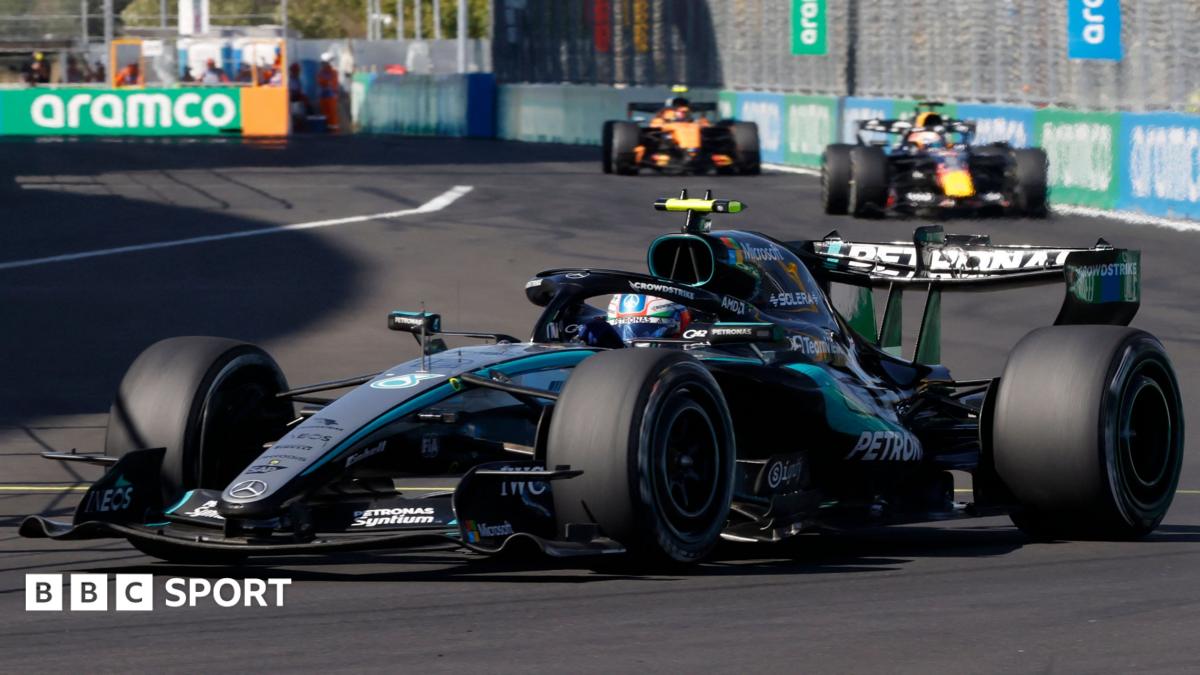
Mercedes’ Kimi Antonelli stretched his lead in the drivers’ standings with victory at the first Spanish Grand Prix held at the Madring.
Max Verstappen finished second in the Red Bull and McLaren’s Lando Norris completed the top three.
Norris, who was leading, lost out having passed the pit entry immediately before the virtual safety car was called.
BBC F1 correspondent Andrew Benson answers your latest questions.
-
Antonelli wins as Norris loses out under virtual safety car
- Published1 day ago
The new Madring circuit looks like one of the worst on the calendar for entertaining racing. Given that half the track is custom built (ie not having to conform to street layouts), how did they get it so wrong and will substantial changes be made ahead of next year? – Matt
It’s a good question. Even before the race weekend began, drivers were predicting that overtaking would be next to impossible at the new Madring, and they were proved right.
The track is effectively a start-from-scratch layout built partly as a new track and partly on existing roads around the Ifema exhibition centre near Madrid’s Barajas international airport.
It is, therefore, mystifying as to how they got it so wrong, as the problems could be foreseen by anyone with an understanding of F1. As Lando Norris put it witheringly after the race: “I don’t know how someone looks at this design and goes: ‘Mint.'”
There are some key issues.
The main one is the lack of a long straight leading into a big braking zone.
Another is, as the drivers pointed out, a lot of the corners have entries where drivers have to combine braking and turning, which makes overtaking extremely difficult, as well as walls that come back towards the track on corner exit.
And another is the ultra-long pit lane – the longest on the calendar.
The longer a pit lane, the more the time loss for a pit stop, so the less chance of having more than a one-stop race. And if tyre degradation is high, that means more tyre management, driving further under the limit, and less chance of accidents and therefore safety cars.
The good news is it is not hard to see how it could be fixed.
As Norris said: “There’s a lot of opportunity. They can make it into a track that’s good for racing, and I’m excited to come back here next year if they can make these changes because I think it’s a track that is good fun to drive and it can be a great race track.
“To me, it’s not a great race track. It’s great in qualifying.”
Norris suggested removing turns 18 and 19 and “making a straight line from 17 to 20, have a much wider entry like Austin Turn One or Turn 10 in Austin… big hairpin”.
That, he said, would “create much better opportunities for everyone and you’ll be able to enjoy the race”.
He also advocated what he called “some trickier changes”, such as changing the unpopular, clumsy chicane at Turn Five, and the section from there to Turn Seven.
While they’re at it, it would also be worth looking at the location and layout of the pits and paddock.
This was more fractured and over a much larger area than at any other track, which made working for F1 personnel difficult in a number of ways.
The many large exhibition halls on what is, frankly, a pretty unprepossessing site – it’s a bit like holding a grand prix at the NEC in Birmingham – clearly don’t make this the easiest task.
But finding a location for a pit lane that is not split in half by a building and making it somewhere the pits and paddock can be together and entirely outside would be another step in the right direction.
-
Madrid F1 circuit set for changes after criticism
- Published17 hours ago
-
‘It started as a joke, a fantasy’ – F1 hits football-obsessed Madrid
- Published5 days ago
-
Spanish GP Review: VSC or not to VSC
The virtual safety car (VSC) definitely throws jeopardy into races, but it does not do virtually what the safety car does. Would it not be more balanced to have a minimum of at least one full lap? Yes, this would dampen the jeopardy effect but what happened to Lando Norris feels like a chance card in Monopoly. – Kyle
Lando Norris’ bad luck with the virtual safety car at the Spanish Grand Prix has certainly focused attention on the ways this can disrupt races.
The VSC has always had issues – it freezes a race rather than resets it, which can be a bit boring compared to an actual safety car – but it has the benefit of minimising disruption when a track hazard can be cleared relatively quickly.
It has long been an opportunity for someone to benefit over a rival, because making a pit stop under a VSC takes significantly less time than under racing conditions.
But usually this has been in cases where one team has changed or deployed its strategy with the express intention of waiting for a safety car or VSC (such as Norris himself in his maiden victory in Miami in 2024), and benefiting over a rival who has run a more conventional strategy.
That sort of thing is considered fair game. What happened to Norris – a driver lost a race win because his specific track positioning at the time of a VSC meant he alone was unable to pit under it – is, to the best anyone could remember on Sunday, unique.
The media are not privy to conversations in drivers’ briefings, and Norris in particular gets a bit sniffy when information from those meetings leaks out because they are meant to be a safe space where the drivers and FIA can share opinions without it becoming a controversy.
But it emerged after the race that this issue, as Norris put it, “has been spoken about many, many times”.
Whether Norris’ misfortune leads to a change, such as ensuring that a VSC is deployed for at least one whole lap, remains to be seen.
There is no easy answer, because within F1 it’s recognised that safety cars are part of the competitive jigsaw, and can be used to a team’s advantage. And the latest rules have been arrived at after various previous iterations that worked in different ways, such as shutting the pit lane for specific periods.
McLaren team principal Andrea Stella said: “Offering a personal opinion, I’m puzzled myself as to what’s right.
“Is it correct to give enough duration such that everyone will have been subject to the same track conditions? So, for instance, the virtual safety car lasts at least one full lap.
“Or you just keep it in the hands of the Gods, and sometimes you are lucky, sometimes you are not. I’m not sure.”
There is process for these sorts of discussions – they go to a sporting advisory committee for analysis, before being reviewed by the F1 Commission of teams, commercial rights holder F1 and governing body the FIA.
That won’t happen quickly – unless it is decided by F1 and the FIA that it is a desirable outcome to change the rules. Right now, the momentum for that does not appear to be there.
What are the prospects for rookies coming into Formula 1 next year? Many drivers are re-signing long contracts with their teams. Are there likely to be any new recruits? – Mia
The most likely place for a new driver to come into F1 next season is Haas, where Esteban Ocon’s position looks shaky.
The two main candidates there are Italy’s reigning Formula 2 champion Leonardo Fornaroli, who is part of McLaren’s driver development programme, and Brazilian Rafael Camara, who is second in F2 this year and part of the Ferrari driver academy.
Both have tested for Haas and are said to have impressed the team.
Haas will want a quick driver who brings money, and it’s not clear who the favourite is. Ryo Hirakawa, Haas’ reserve driver and a long-time protege of Haas’ technical partner Toyota, is also in the picture, but considered a less likely candidate.
Elsewhere, there is talk of Red Bull considering moving F2 championship leader Nikola Tsolov, who is Bulgarian, into their Racing Bulls team.
To do so, they would have to drop either Liam Lawson or Arvid Lindblad. It’s hard to see how it would be Lindblad, after such an impressive rookie campaign.
But Lawson has also been doing a good job this year, so it’s not a given.
At Cadillac, they have Indycar race-winner Colton Herta as reserve. They have been planning for Herta to be in F1 before too long – the idea behind him moving to Europe and doing Formula 2 this year was so he could learn the ropes on this side of the Atlantic and be as prepared as possible for graduation to F1.
But Herta has had a very difficult F2 campaign this year – his best result is a fifth place and he is 19th in the championship – so moving him up to F1 for 2027 would be a massive risk.
Ugo Ugochukwu, who won the Formula 3 title in Madrid on Sunday, is another American said to be of interest to Cadillac.
He had been part of the McLaren driver development programme for several years until they parted ways at the end of last season.
But even if Ugochukwu’s Cadillac links become formalised, next year is probably too early for him to make F1.
He’s also extremely tall – well over six foot and much taller even than Ocon, Alex Albon and George Russell, the current tallest drivers – so getting him into an F1 car would not be easy.
The other teams are pretty much locked down, although it’s still unknown whether Fernando Alonso is going to continue in F1 next year.
-
How virtual safety car cost Norris win – and should F1 change rules?
- Published1 day ago
-
Antonelli impressive and one of Colapinto’s best weekends – driver ratings
- Published1 day ago