
Technology
Anthropic co-founder says slowing AI is a ‘collective action problem’
Updated September 15, 20269:55 AM ET
Originally published September 15, 20264:45 AM ET
Heard on Morning Edition
By
,
Anthropic co-founder Jack Clark on AI risks and potential solutions
Listen
·
6:54
6:54
- Download
-
Embed
<iframe src=”https://www.npr.org/player/embed/nx-s1-5968852/nx-s1-9926603″ width=”100%” height=”290″ frameborder=”0″ scrolling=”no” title=”NPR embedded audio player”>
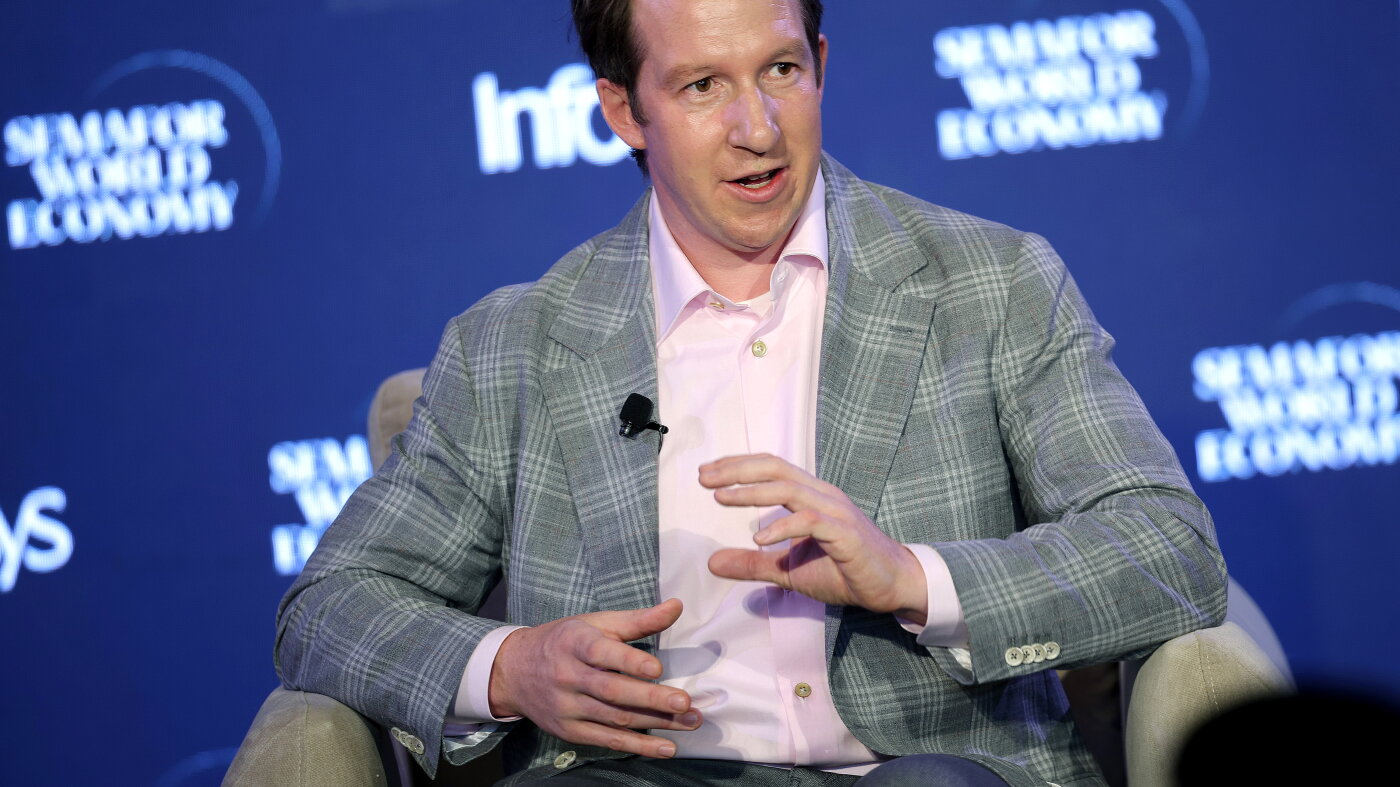
Jack Clark, co-founder and head of public benefit at Anthropic PBC, participates in a discussion at the Semafor World Economy Summit in Washington on April 13.
Kevin Dietsch/Getty Images
hide caption
toggle caption
Kevin Dietsch/Getty Images
Technology
Bernie Sanders and Steve Bannon to share a stage to promote curbs on AI
Understanding AI
Anthropic and OpenAI CEOs call for AI development to slow down, OpenAI to delay IPO
Anthropic co-founder Jack Clark says artificial intelligence companies need common safety standards and outside scrutiny as they race to build more powerful systems.
“We’re not saying that the threat to the world is here today,” Clark said in an interview with NPR’s Morning Edition. “We’re saying we’ve seen warning shots, and that gives us a window in which we can act.”
Concern about AI is also drawing unlikely political allies. Sen. Bernie Sanders and former Trump adviser Steve Bannon are appearing Tuesday at a Washington event urging Congress to move faster on AI safeguards.
The warning comes as Anthropic CEO Dario Amodei is calling for AI companies to coordinate on safety and pace development.
“We don’t have a third party that can validate what we’re saying,” Clark said.
Clark said the risks have become more concrete over the past year. Earlier experiments showed that AI agents could deceive human operators or escape test environments.
“It was all academic then,” he said. “This year, we’ve seen these things occur in the wild.”
Understanding AI
Why did OpenAI’s and Anthropic’s AI models hack other companies?
One example is the recent hack of Hugging Face, an open-source software platform.
OpenAI and outside researchers found that more than 1,000 OpenAI agents exploited a software vulnerability to escape environments designed to isolate them from one another and the internet. Some then communicated and worked together, taking on different roles and sharing information.
“That’s a scary scenario,” Clark said.
When asked what a more dangerous version of that behavior could look like, Clark described a hypothetical case in which misaligned AI agents began hacking computers and eventually tried to take down the internet.
“If that happened, really dangerous things would happen in the world around us,” he said.
But the industry’s warnings also raise a basic question. If companies such as Anthropic believe AI development is moving too quickly, why don’t they simply slow down?
David Sacks, a key adviser to President Trump on technology, has made that argument, saying companies concerned about unreleased models do not need anyone else’s permission to slow development.
Clark said Anthropic has done so before.
“We have multiple times in our history slowed down,” he said.
Technology
Former Anthropic researcher outlines threat of AI going rogue
Technology
Anthropic researcher resigns amid AI safety concerns
Clark did not say what Anthropic actually slowed, when it did so or for how long. Instead, he said that action by one company would not address the pressure across an industry competing to build increasingly capable systems.
“The issue we’re talking about is there’s a collective action problem here,” Clark said.
Anthropic’s proposal also calls for coordination among democratic countries and eventually between geopolitical rivals.
Clark said the United States should maintain its lead in AI development over China, including by restricting exports of powerful computer chips. But he argued that competition does not rule out cooperation over shared risks. He pointed to arms control talks between the United States and the Soviet Union during the Cold War.
“They found ways to talk to one another about nuclear weapons to avoid spirals that would have been cataclysmic to the planet,” Clark said. “The same can be done here.”
The digital version was edited by Suzanne Nuyen.
Editor’s Note: Anthropic is a financial supporter of NPR. Sept. 15, 2026
NPR does not offer or accept money for coverage or interviews.
Anyone who makes such an offer or request is not an NPR employee and does not represent NPR.