
Advertisement
From the outside the Red House is an unassuming, orange-bricked former Korean Christian church.
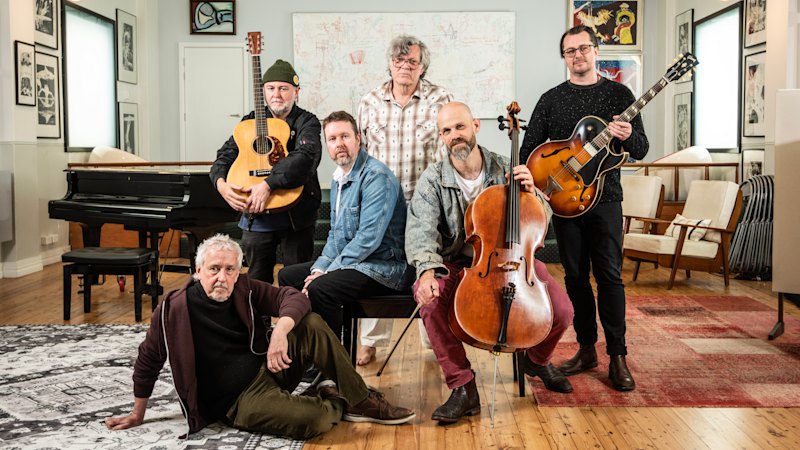
But take one step inside the structure in Sydney’s south-west suburb of Earlwood and you’ll be immersed in an art space fitted with soft Persian rugs, walls adorned with art – including numerous Arthur Boyd works – and a $30,000 black vintage Yamaha grand piano.
The former church, bought by Nick Shimmin and Matthew McGuigan in 2021, cost the pair more than $1 million to renovate and soundproof so they could host private, free and intimate gigs for a community of music fans. The space also includes a recording studio and, in the back half, McGuigan’s residence – where in a week he and his wife will welcome twins.
The gigs began in 2024 but now there’s a problem – Canterbury-Bankstown Council.
Advertisement
Following a neighbour’s “spurious” complaint about parking and noise in January, council officers visited Shimmin and McGuigan’s property. They decided the venue was an “entertainment facility” and could not operate under a residential development application.
The decision has sparked a bitter nine-month dispute between council and the property owners, who reject that categorisation because their space hosts free, unticketed, intimate, invitation-only events, with BYO-booze and voluntary donations going directly to the artists.
“It’s basically a house party,” Shimmin explains. “Except we are infinitely less noisy. We always stop by 9.30 pm … and we probably do maybe 15 [gigs] a year.”
Shimmin began hosting the intimate gigs in 2009 inside his Camperdown living room. During the pandemic he and McGuigan decided to find a space to expand. “Most of what we do has ended up being music … if people want to do book launches, we’ve had fundraisers, we’ve shown films,” Shimmin said.
Advertisement
In August, Canterbury-Bankstown Council sent Shimmin a letter explaining that an “entertainment facility means a theatre, cinema, music hall, concert hall, dance hall and the like”. It would operate under a DA that factors in “fire safety, hygiene, use, numbers of people attending, parking, noise, alcohol consumption, impacts on the surrounding built-up area”.
Council told the Herald that when staff met with Shimmin and clarified “why the premises could not be used as an entertainment facility” he was “reluctant to accept our explanation”.
“They have no approval to operate, yet continue to make a noise and unjustifiably attack council at every turn,” a spokesperson said.
Inside the structure each window is frosted and soundproofed. McGuigan, a sound engineer and record label owner, said the space’s electrical outlets jut out of the wall so they don’t create holes through which sound can escape. Shimmin noted the soundproofed studio doors cost $20,000 each.
Advertisement
“Surely councils understand now that there is this crisis with art spaces in Sydney, and if you have an opportunity to try and allow something like us to continue, you find a way to do it,” Shimmin said.
The building’s direct neighbours have sent letters supporting the Red House, as have many of the musicians and community members who have performed there or visited. But in the August letter the council said the support did “not alter council’s assessment of the land use characterisation issue”.
Chris Pidcock, a Sydney Symphony Orchestra cellist, said he had played about a dozen times in the space, which provided him opportunities to improvise experimentally before a crowd.
“[It’s] a space here where I can play music that I write and … wouldn’t fit that conservative programming at the Opera House,” Pidcock said. “Having this [space] motivates me not to just be a great contributor to the symphony; it motivates me to be a really holistic musician, work on my compositional ability. Work on my improvisation.”
Advertisement
So what happens if the Red House keeps throwing private events? “They’ll send a $3000 infringement notice,” Shimmin said. “But we have a strategy.”
“Ancillary events”, such as birthday or Christmas parties, are permitted in residential dwellings, he noted.
“When we met with [council] and said, ‘OK, so we can’t do these concerts but can we have a birthday party?’ They said yes, and I said, ‘OK, what if we celebrate my girlfriend’s birthday party next month?’ They said yes,” McGuigan says.
“But then we kept going … and there was just a certain number of birthday parties where they were like, ‘well, actually we’d have to step in here’.”
Advertisement
Shimmin said the space had also hosted international artists, and estimated that since they began in Camperdown he and McGuigan had put “more than $150,000 into the pockets of musicians from the donations”.
“I’m lucky because I’ve got resources … These are great people who should have space to play, and because art should happen in a city of 5 million people, and it’s just so hard. And I can make it a little bit less hard,” Shimmin says.
Guitarist Darren “DC” Cross, who has played in the space about five times and attended a dozen shows, said the Red House had fostered a community supportive of musicians.
“The music is always quiet. Sometimes I play a show not even with an amp. People just sit here in silence and they’re really just drawn into it,” Cross says.
“In Sydney this is a rarity … everyone’s just here for the music. And it’s just real special.”
Advertisement
Start the day with a summary of the day’s most important and interesting stories, analysis and insights. Sign up for our Morning Edition newsletter.
Read more arts and culture stories:
- A day in the life of one of Australia’s leading musicians
- James’ house burnt down in 2025. From its ashes rises Sydney’s newest surf and music festival
- ‘Ridiculed’: How Australia’s breaking community was left reeling after Paris
- Think there’s nothing on in Sydney? These Sydneysiders will change your mind
You have reached your maximum number of saved items.
Remove items from your saved list to add more.
More:
Kayla Olaya is a culture reporter at The Sydney Morning Herald.Connect via email.AdvertisementAdvertisement