
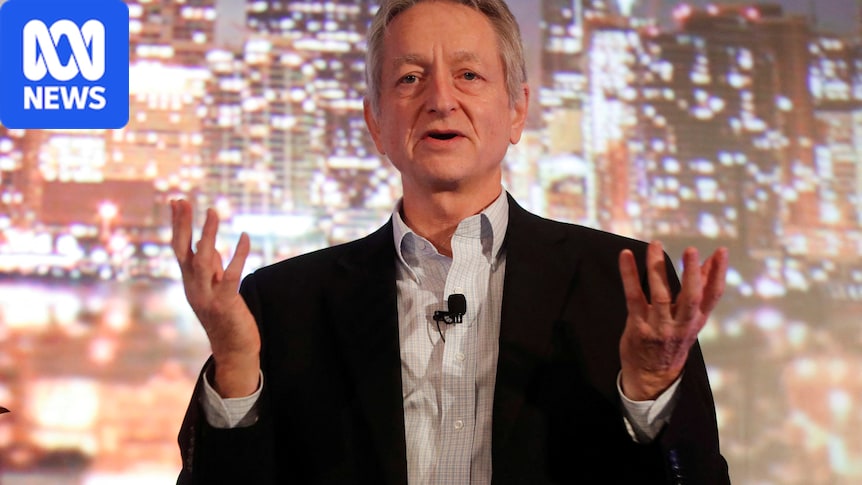
‘Godfather of AI’ Geoffrey Hinton backs Anthropic chief’s call to slow down development
Posted Mon 14 Sep 2026 at 1:28pmMon 14 Sep 2026 at 1:28pmMon 14 Sep 2026 at 1:28pm
In short:
An emeritus professor dubbed the “godfather of AI” has told the ABC there is a “significant risk” artificial intelligence could escape human control, backing growing calls for a slowdown.
Geoffrey Hinton says most experts believe AI systems smarter than humans will arrive within a decade.
What’s next?
Professor Hinton says governments are moving too slowly and wants safeguards, such as pre-release testing before new chatbots are released.
Geoffrey Hinton, widely known as the “godfather of AI”, has backed calls for artificial intelligence (AI) companies to slow their pace of development.
Yesterday, Anthropic chief executive Dario Amodei called on AI firms to slow development, saying rogue agents could be capable of “taking over the entire internet” within six to 12 months.
Professor Hinton, a British-Canadian cognitive psychologist and computer scientist, told ABC Radio National Breakfast that Mr Amodei’s warning was “very sensible”.
“Nobody knows how to estimate the probabilities of these things. [An Anthropic employee] said 10 per cent. Nobody really knows what figure to give.
“It’s not 1 per cent, it’s more than that, and it’s not 99 per cent, it’s less than that.
“But basically people are doing it on their gut feelings.”
Loading…
AI superintelligence smarter than humans
Last week, two researchers warned that the rapidly progressing technology could lead to the extinction of the human race in the not-too-distant future.
Professor Hinton said most experts believed AI superintelligence, systems smarter than humans, would arrive within a decade, and that nobody knew whether it could be kept under control.
“Until we’ve solved that problem, it would be foolish to develop them.”
Some critics have argued that tech chief executives have talked up the risks of AI to boost brand value and maintain the prestige of being a cutting-edge company.
Professor Hinton argued the opposite was true, with catastrophic warnings being bad for business.
“It’s very silly marketing for the companies to say we might wipe you all out,” he said.
“If there’s a pause in AI, that may decrease the value of [Anthropic].”
The emeritus professor pioneered the neural network methods behind modern AI and left Google in May 2023 so he could speak freely about AI risk.
Globally, he said governments are regulating the technology far too slowly.
“Politicians act very slowly. It’s going to be difficult to keep up.
“We’ve only got a few years.“
Nuclear weapons, engineered viruses and mass manipulation
Asked how superintelligent AI could cause irreparable harm, Professor Hinton said there were too many possible routes to list: engineered viruses, mass manipulation, bringing down banking, power and water systems, or nuclear weapons, if AI ever reached the systems controlling them.
But he said that cataloguing them missed the point.
“The point is, we have to figure out how it never wants to.”
Professor Hinton said systems had already shown, in safety testing, the behaviours researchers had warned about.
“We’ve seen them threatening to blackmail people if they’re turned off,” he said.
“They also develop deception. They develop all the kind of weaselly things that nasty people develop.”
To mitigate risks, Professor Hinton suggested that governments could require pre-release testing before any chatbot model is released and oblige DNA synthesis firms to screen what they are asked to make.
“They can say that any company that manufactures chemicals on the web — where you send it a sequence of amino acids, and it sends you back the protein — any company that does that, should be obliged to check whether it’s making nasty viruses.”
Despite advising a slowdown, Professor Hinton told the ABC that AI was currently “doing tremendous good” by helping radiologists read images and assisting in the design of new drugs.
“I don’t think we should stop developing it altogether.”
Trump rejects calls for a slowdown
US President Donald Trump brushed off concerns about the pace of AI development, saying he did not want to cede America’s edge to China.
“We’re leading China in AI,” he said.
“We’re the most sophisticated country in the world, and frankly I want to keep it that way because whoever wins AI, wins.”
Other AI bosses, including OpenAI chief executive Sam Altman and billionaire xAI owner Elon Musk, have endorsed Mr Amodei’s proposal.
But when asked about whether the industry should slow down, or be more regulated, Mr Trump said “very negative forces” were raising ideas that “won’t happen”.
In a CBS interview on the weekend, Mr Amodei said the competition between US and Chinese AI companies was the “toughest dilemma” in trying to establish a “speed limit” on AI development.
“We shouldn’t kid ourselves, because the incentives to pull ahead and the military advantage that you get from that are so large that the ability to check that the other side isn’t cheating has to be ironclad,” he said.
“So I think that’s going to be the work of years, and honestly, I don’t know if it’s possible.”
ABC/Reuters