
This section is The content in this section is supplied by GlobeNewswire for the purposes of distributing press releases on behalf of its clients. Postmedia has not reviewed the content. by GlobeNewswire Article content
10.19 g/t AuEq over 10.50 m marks the highest-grade intercept of down-plunge extension
Sign In or Create an Account
or View more offersArticle content
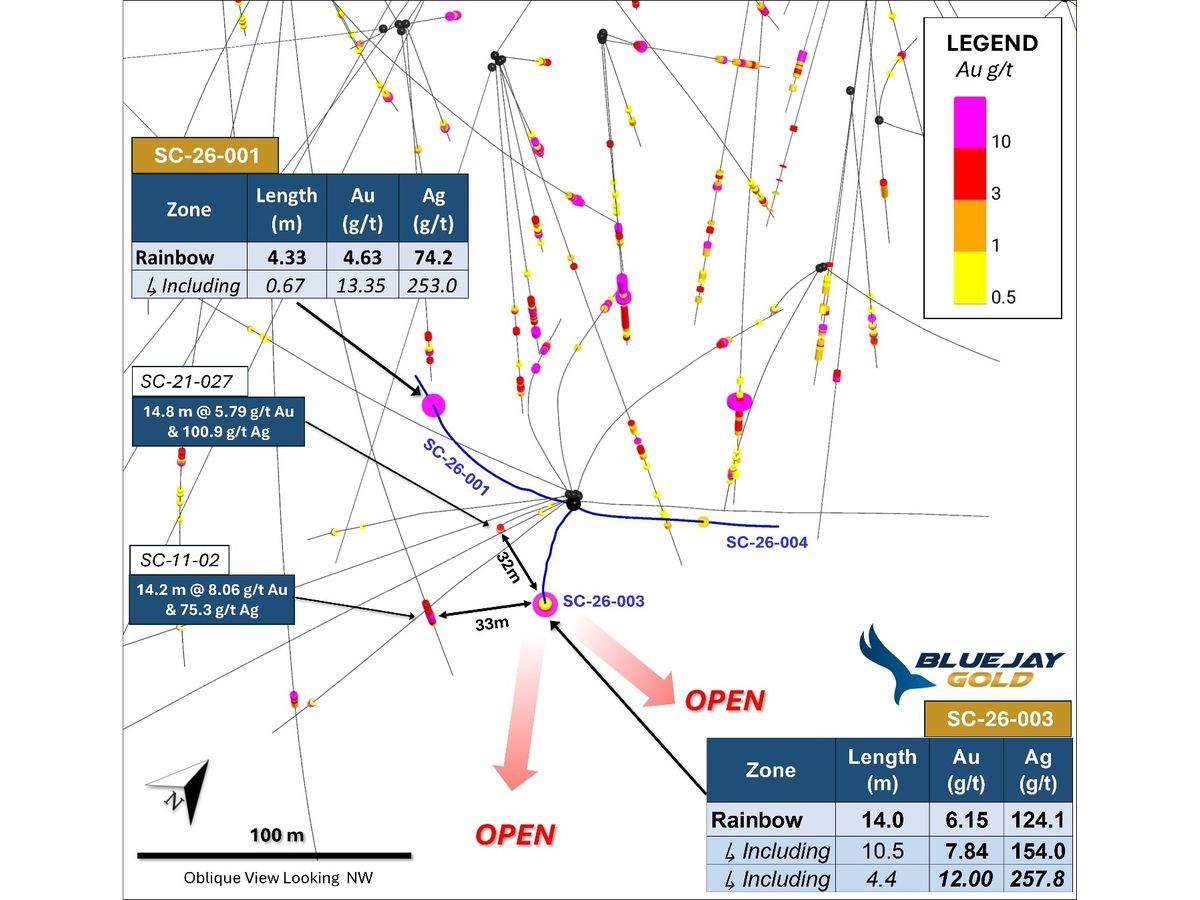
VANCOUVER, British Columbia, Sept. 14, 2026 (GLOBE NEWSWIRE) — Blue Jay Gold Corp. (TSXV: JAY) (OTCQB: JAYGF) (FSE: JAY) (“Blue Jay” or the “Company”), is pleased to announce the first assay results from its maiden 2026 diamond drill program at the Steller Gold Project (“Steller” or the “Project“) in the Yukon Territory. Hole SC26-003 returned 14.00 metres (m) of 6.15 grams per tonne (g/t) gold (Au) and 124 g/t silver (Ag), or 8.04 g/t gold equivalent (AuEq), from 495.00 m, including 10.50 m of 7.84 g/t Au and 154 g/t Ag (10.19 g/t AuEq). The intersection represents an approximate 32 m down-plunge extension of the mineralization intersected in drill hole SC21-027, which returned 14.8 m of 5.79 g/t Au and 100.9 g/t Ag in 20211. The results highlight continuity of the mineralization and its host structure across multiple intercepts, with room for further expansion. The system displays an intermediate sulfidation epithermal style comparable to giant districts such as Fresnillo, Zacatecas and Pachuca in Mexico. Intercepts extending from surface to over 500 m down dip demonstrate the continuity and scale potential of the Skukum Creek system. Initial drilling at Mt. Skukum, the site of historical gold production between 1986 and 1988, returned 0.5 m of 57.4 g/t Au and 44.1 g/t Ag from 160.8 m in hole MS26-001. The historical high-grade production at Mt. Skukum, combined with the presence of multiple undertested vein sets, points to resource growth potential on this target corridor. The Company has identified similar potential for expansion along strike at other target areas across the Project’s 170 km² land package.
Article contentWe apologize, but this video has failed to load.Try refreshing your browser, or
tap here to see other videos from our team.Article content
Story continues below
This advertisement has not loaded yet, but your article continues below.
Article content
“SC26-003 is the kind of result we underwrote when we bought this project,” said Geordie Mark, CEO of Blue Jay Gold. “It confirmed mineralization more than 30 metres down-plunge of SC21-027, drilled in 2021, with effectively the same width, grade and grade distribution. That is what continuity looks like: not just a string of separate hits, but a zone you can follow. We identified this area as being completely open to depth and down-plunge. That was the call, and we have delivered results that exemplify our thesis.”
Article contentArticle content
Most exploration programs start with a blank map. Steller handed us one already partly drawn, aided by historical drilling, 7.5 kilometres of underground development, and a high-grade resource in the ground. What has never existed is a structural framework that explains where the grade goes, and a hydrothermal model that predicts where other mineralized systems could be.”
Article content
“Hyperspectral core logging is central to how we are building it,” added Mark. “We have now put roughly 18,000 metres of historical core through the scanner system, reading alteration mineral distribution and chemistry directly from the core ahead of assay results from the lab. It shows a consistent, zoned alteration envelope around the mineralized structures that points toward mineralization. Every metre we scan turns rock we already own into data we can use to refine targets.
Article content
Story continues below
This advertisement has not loaded yet, but your article continues below.
Article content
At Mt. Skukum, our first hole returned a high-grade intercept at the site of the former Mt. Skukum mine, which produced gold between 1986 and 1988. Seeing grades of that order in our own first holes tells us the system at Steller is not confined to a single deposit.
Article content
We are only about 3 months after listing, and the picture we formed in due diligence of Steller is holding. Rigs are turning and assays are pending on further holes. Today’s results are the first assay confirmation that the framework we are building points the right way.”
Article content
Highlights
Article content
- High-grade down-plunge extension at Rainbow Zone at Skukum Creek: 14.0 m of 6.15 g/t Au and 124.1 g/t Ag (8.04 g/t AuEq) from 495.0 m in SC26-003, including 10.50 m of 7.84 g/t Au and 154.0 g/t Ag (10.19 g/t AuEq), approximately 32 m below SC21-027 (14.8 m of 5.79 g/t Au, 100.9 g/t Ag) (Figure 1).
- Mineralization is continuous within the structure between drill holes: SC26-003 returned essentially the same width and grade as SC21-027, which is >30 m up-plunge. The structure carries consistent gold and silver tenor between the two holes rather than occurring as isolated lenses.
- Our interpretation, now drill-tested: we projected that this zone was open. SC26-003 is the first drilling phase to test it and has unearthed that reality.
- Hyperspectral logging of 18,000 m of core has produced a vectoring tool: a consistent, zoned alteration envelope wrapped around the mineralized structures, measurable directly in core and applicable to material already in the core yard. It has generated new targets along the Skukum Creek Structural Corridor.
- First drilling at Mt. Skukum returns high-grade gold: MS26-001 returned 0.5 m of 57.4 g/t Au from 160.8 m, on the site of the former Mt. Skukum gold mine, which recovered 77,790 ounces of gold between 1986 and 1988.
- Initial batch of many: 5 holes are reported today, with assays pending for further holes that have been completed. Mineralization at Skukum Creek remains open down-plunge and along strike, and rigs are turning.