
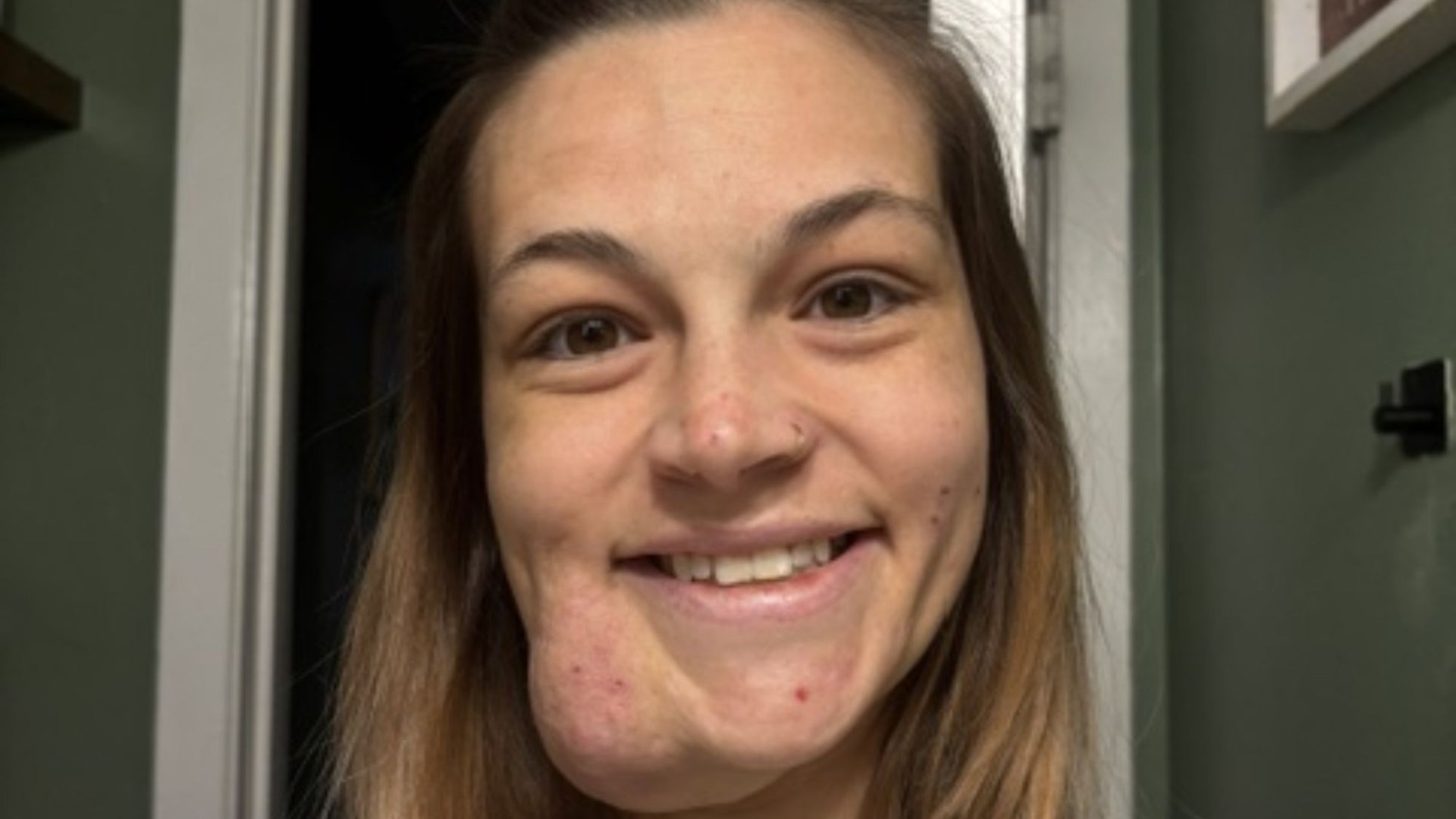
A MUM with a throbbing growth on her face that says it hasn’t stopped growing for 19 years says it started as just a pimple that she’d tried to squeeze.
Hope Schiefer has been bullied over her appearance for years, cruelly compared to Quagmire from Family Guy.
5
5
Removing the growth carries serious risks as it is attached to a major vein, so Hope has opted against surgery.
Hope, 32, was later with a hemangioma – a rare vascular growth or tumour involving the blood vessels in her face, which is akin to a large blood clot.
She can feel a pulse – which is something visible – through it, and in recent years, it has spread down her neck.
After years of torment, she is reclaiming her story, even naming the growth Betty.
Read more real life
STARTING OVER
I lost all 4 limbs after what I thought was a UTI – now I have a donor hand
MY SHAME
Paedophilic thoughts made me want to die…then I found it’s a disorder affecting 1m
“After spending so many years viewing the tumour as a weakness or flaw, I wanted to give her a name that represented strength – I chose the name Betty because it sounded powerful to me,” Hope, a cleaning technician from College Station, Texas, US, says.
“Betty reflects everything I have survived – the medical procedures, physical discomfort, bullying, and years of struggling with my self-worth.
“She is visible evidence of my strength and a reminder that I am still here.
“Naming Betty gave me a way to reclaim some control over something that had controlled my self-image for years.
Most read in Health
SUBTLE CLUE
My baby started puberty at 10 months – I just thought she was adorably chubby
OP TRAGEDY
Glam influencer, 27, dies before liposuction op at clinic as cops launch probe
LETHAL PLATE
Man, 64, given hours to live after eating pub roast led to multi-organ failure
STANDING TO ATTENTION
Erection pill Viagra prescribed to nearly 9k UK troops in past decade
“Instead of describing her only as this frightening tumour or flaw on my face, I could talk about her with personality and even humour.”
‘Betty’ first appeared when Hope was 13 and going through puberty.
She says: “I didn’t actually notice Betty myself – someone at church pointed her out during one of our classes.
“At first, it appeared to be a lump on my face.
“I initially thought it was a cyst or a particularly bad pimple, so I tried squeezing it.
“Nothing happened, and it became clear that it wasn’t an ordinary spot.”
She went to the doctor and was referred to a vascular surgeon for further investigation.
There, she was told it was a form of deep vein thrombosis, called a hemangioma.
Hope says: “I didn’t fully understand what it would mean for my future.
“At that age, I hoped the doctors could treat it and that life would return to normal.
“It was only as Betty continued to grow – and other people began acting cruelly to my appearance – that I understood it wasn’t going to be a simple medical issue.
“It would affect my physical comfort, self-image, mental health, and the way people treated me.”
5
What is a hemangioma?
A haemangioma is a collection of small blood vessels under the skin.
A congenital haemangioma is one that is present from birth and has grown to its maximum size while the baby is developing in the womb.
It is not known what causes a congenital haemangioma, they are not inherited and affect boys and girls equally.
Congenital haemangiomas are classified into three types:
- rapidly involuting congenital haemangiomas (RICH),
- noninvoluting congenital haemangiomas (NICH) and,
- partially involuting congenital haemangiomas (PICH)
RICH:
These have reached their maximum size by the time the baby is born and start to shrink quickly.
They usually flatten within 12 to 18 months, often leaving little sign that they were ever present.
However some may leave behind an indentation and prominent veins, which may need treatment at a later stage to improve their appearance.
NICH:
NICH may continue to grow after birth in proportion with the baby.
Unlike the RICH type, NICH do not have a shrinking stage.
PICH:
These are a combination of both RICH and NICH types.
For example, what might have initially appeared to be a RICH may start to shrink but then stop or one that appeared to be a NICH might start to shrink after some time.
It is not known why this occurs.
Over the years that followed, she has undergone MRI, CT and targeted ultrasound scans to see how closely it was connected to important blood vessels in her face.
Hope has had two surgeries with the goal of blocking or reducing its blood supply.
But ‘Betty’ continued to grow and swell, and doctors have since told Hope that attempting further surgery would carry serious risks, given Betty’s attachment to a major vein in her face.
It could either move into her brain, lung or heart, or cause paralysis on the right side, she says.
As a single parent, it’s a risk Hope won’t take.
She says: “As much as I struggle with how I look, I’m a mother and my son needs me alive and present far more than he needs me to have a conventionally ‘perfect’ face.”
Hemangiomas, which mostly start at birth, are a type of growth that happen when clusters of blood vessels grow and bunch together incorrectly.
It’s not clear why they occur, though there are risk factors.
Hope was diagnosed with the autoimmune disease, antiphospholipid antibody syndrome (APS), aged 27.
It can cause blood clots to form more easily, which Hope says may be partly related to her growth, and also why she can’t have the growth operated on.
She says ‘Betty’ changes from day to day.
“During my time of the month, it is larger and more tender due to blood flowing faster throughout my body,” she says.
5
5
“Some days, she throbs continuously. I can feel the blood flowing through it, and at times the pulsing is visibly noticeable.
“After I gave birth to my son, Betty migrated farther down toward my neck and became more prominent.
“The blood flow in that area can also be seen.
“Overall, the area feels heavy and tender. Some days are physically more uncomfortable than others.”
Sadly, Hope has been subject to cruel taunts and bullying since ‘Betty’ became a part of her.
She says: “People have stared, whispered, commented on my face and made me feel as though I was constantly being watched and judged.
“As a teenager, I began skipping school, pretending to be sick, and acting out because I did not want to face another day of humiliation.
“The cruelty did not completely end when I became an adult.
“On social media, strangers have made ‘giggity’ comments [referring to Family Guy’s Quagmire], created or shared hateful memes, insulted my appearance, and even told me to kill myself.
“It made me feel worthless.
“I went from being a fun, wildly free girl to someone who wanted to hide.
“The bullying did not simply hurt my feelings – it changed the way I saw myself and stole years of confidence and happiness from me.”
But Hope, who fears how her face might continue to change, refuses to let it stop her living.
She says: “Learning to make peace with Betty has taken many years, and it is still an ongoing process.
“Acceptance does not mean I suddenly love every aspect of my appearance or that cruel comments no longer hurt.
“It means I am learning that my appearance does not determine whether I deserve love, dignity, happiness, or a full life.
“For a long time, I wondered why this happened to me.
RECOMMENDED STORIES
“Now I think about what my story can teach my son and other people – that a flaw that is visible does not make someone less deserving of love.
“Looking different, thinking differently, or moving through the world differently does not reduce your worth.”