
“They see it as content.”
That is how Andrew McGinley describes the online commentary and speculation that has surrounded his family in the years since his children, Conor, Darragh and Carla, were killed by their mother, Deirdre Morley, in January 2020.
“It’s all about money. It’s all about clicks. It’s all about their ad revenue. It’s all about their subscribers, and it’s all at the expense of my children’s murders,” Mr McGinley said.
In recent months, their story has been drawn into a new wave of online speculation.
RTÉ Clarity traced how comparisons between the deaths of Conor, Darragh and Carla in January 2020 and the case of Lindsay Clancy, a Massachusetts mother accused of killing her three children exactly three years later, developed into an international conspiracy narrative viewed millions of times.
Some of the similarities identified by social media users are factual. There is no evidence that the two cases are connected.
Mr McGinley deliberately avoided coverage of the Clancy trial and did not wish to comment on the case itself.
But he is familiar with what happens when strangers online take details of his family’s tragedy and use them to attract attention.
“You have to get your head around that somebody is trying to gain likes or be controversial so that they get a few more follows,” he said.
“The more controversial they are, or the more I’d even go as far as saying the more sadistic they are, the more outlandish, outrageous they are, then people follow them and click and subscribe.”
RTÉ Clarity examined how that process unfolded in this case, tracing the comparison back through thousands of posts and comments across social media.
Early comparisons
The earliest comparison identified appeared on 16 June.
An Irish user left a short comment beneath a Law&Crime Network YouTube video about the Clancy case.
“This is identical to the Deirdre Morley case in Ireland, bizarre,” they wrote.
Morley was found not guilty by reason of insanity after the deaths of her three children, at their family home in Newcastle, Co Dublin, in January 2020.
Both women were nurses, both had three young children and mental illness became central to the legal proceedings in both cases.
As the discussion spread, however, users began identifying increasingly specific points of comparison.
Similar comments became increasingly visible in YouTube comments during the summer.
Initially, there was little suggestion that users believed the similarities pointed to anything suspicious.
On 22 July, another Irish viewer made the comparison beneath a YouTube video by Drop Dead Serious, a true-crime podcast.
This time, the comparison was used to ask questions about criminal intent.
“How do psychiatrists tell the difference between psychosis and intent when someone can still function and do organised things?” they asked.
“I’m trying to understand psychosis vs postpartum depression vs intent.”
Four days later, the comparison appeared on Reddit.
A post on r/DuxburyDeathsFreeTalk, a Reddit community dedicated to discussion of the Clancy case, drew attention to the Morley case and described it as “eerily similar”.
Professor Tim Schatto-Eckrodt, a communication researcher at the University of Hamburg who studies how conspiracy theories emerge and spread online, said simply noticing an unusual pattern or asking why it exists does not in itself amount to a conspiracy theory.
People naturally try to find explanations for things that appear unusual, he said, adding that the search for an explanation can often provide a starting point from which conspiratorial interpretations develop.
“The alternative explanation of coincidence just isn’t as interesting,” he said, as an explanation which suggests that “something happened here”.
From comparison to conspiracy
By early August, the comparison between the cases was attracting more attention on Reddit.
On 8 August, a new thread on the same r/DuxburyDeathsFreeTalk subreddit compared the two cases in considerably greater detail, while also stressing that there were important differences between them.
The discussion underneath continued to expand the comparison, with users adding further similarities and debating what they might mean.
Several of the details that would later feature in viral posts on X were now being brought together in the same discussion.
Some users even anticipated how the growing list of coincidences might later be interpreted by conspiracy theorists.
“For all the conspiracy theorists out there…with Deirdre’s kids, two of their names started with letter ‘C,’ and one with the letter ‘D.’ Just like Lindsay’s. Completely irrelevant, but still an odd coincidence,” one wrote.
Another then added the date and wondered whether Clancy could have known about the Irish case.
“The murders were also exactly three years apart, no doubt the ‘copycat killer’ people will go crazy for that one…”
There is no evidence that Clancy was inspired by the Morley case.
The growth in discussion was already visible. RTÉ Clarity identified 18 mentions linking Morley to the Clancy case during July. In August, that rose to 299.
Most of the August discussion remained on Reddit, which accounted for 209 mentions, compared with 69 on X.
The analysis does not include TikTok or Instagram, which are not accessible through the tools used by RTÉ for this type of analysis.
Towards the end of August, that balance began to shift and the comparison increasingly appeared on X.
There, similarities and suspicions that had developed across longer discussions began to be condensed into individual posts, presenting them as a single, coherent narrative.
And some users were no longer simply observing the similarities.
Unsupported suggestions that one case had inspired the other were joined by more elaborate claims. Some described the similarities as evidence of a “psyop” or incorporated them into broader conspiracy theories.
On 28 August, US-based Owen Benjamin described the Clancy case as an “energy harvesting psyop” in a post on X, pointing to the similarities with the Morley case.
Benjamin had previously been banned or suspended from Twitter, YouTube, Facebook and Instagram for violations of those platforms’ policies.
On 2 September, Benjamin’s post was shared by another US-based account with more than 300k followers. That post was ultimately viewed more than one million times.
“Everything Owen says here is accurate,” the account wrote, citing a Grok AI answer that was not included in the post as evidence.
The following day, RTÉ Clarity identified 643 posts and comments mentioning both Morley and “psyop” — the highest daily total between 1 and 10 September.
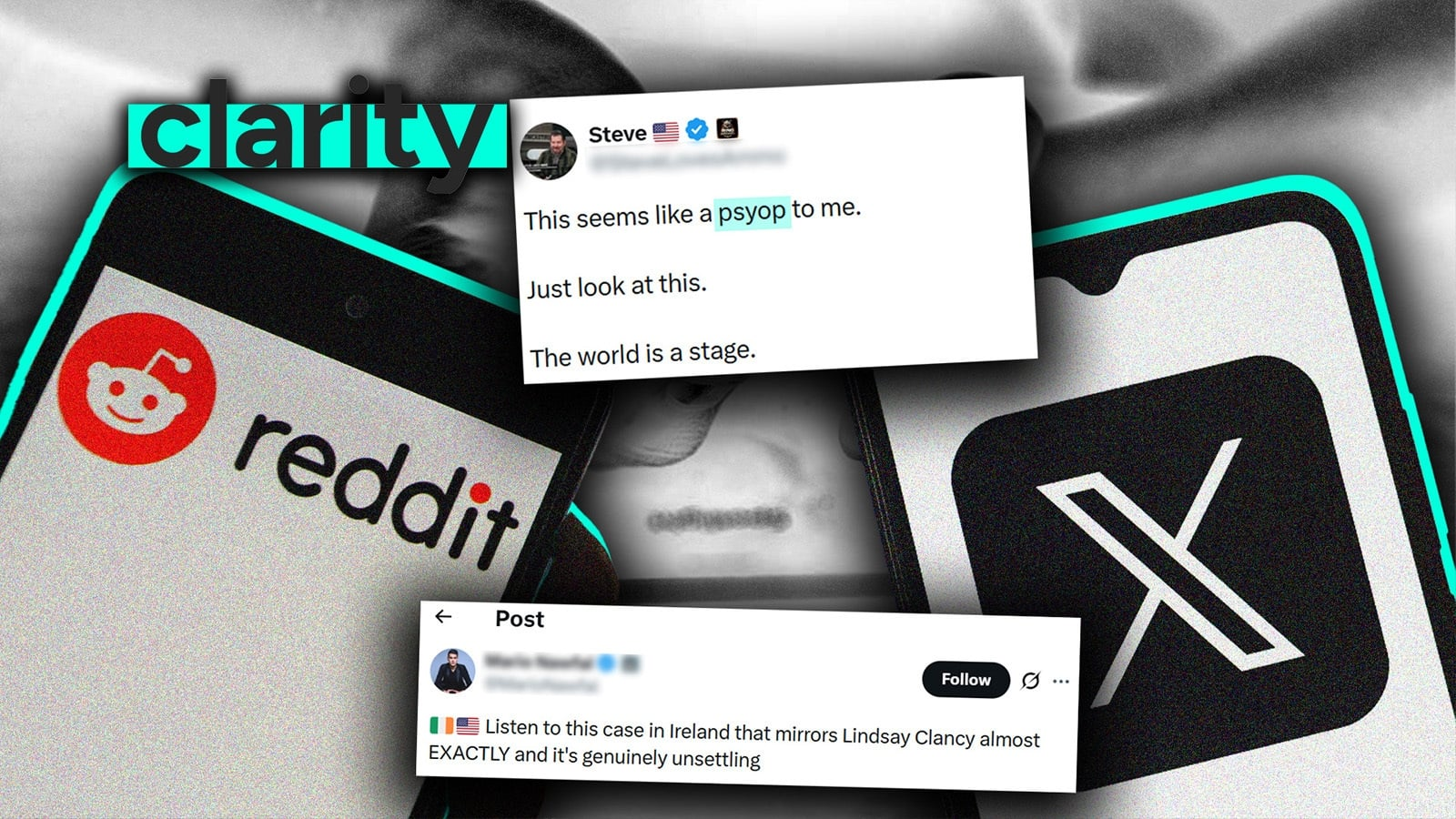
The claim continued to circulate. On 4 September, one X account with more than half a million followers shared the comparison with the message: “This seems like a psyop to me. Just look at this. The world is a stage.”
In total, RTÉ Clarity identified more than 1,100 posts and comments mentioning both Morley and “psyop” between 1 and 10 September, almost all of them on X.
In online conspiracy communities, a “psyop” is an event or piece of information alleged to have been deliberately staged or manipulated to influence public opinion.
There is no evidence to support those claims.
Prof Schatto-Eckrodt said the shift towards conspiratorial thinking can occur when uncertainty is reframed as evidence that information is being deliberately concealed.
“You take the scepticism and then package it in a way where you say, ‘the reason why this is weird and there’s no explanation for it is not that it is a coincidence, but the fact is that someone is actively hiding something from you’,” he said.
It is at this point, he said, that an unexplained observation can begin taking on the characteristics of a conspiracy theory.
As narratives move between platforms and communities, he said, they can also be repackaged in ways designed to appeal to different audiences.
On X, that can include accounts with a financial incentive to attract engagement with conspiratorial content.
“They have a financial interest in taking this kind of story and putting it in the aesthetic format and in the overall conspiracy theory narratives that already exist to make it attractive for the audience.”
The use of Grok as apparent evidence in Mel’s post illustrated another feature of how the narrative was developing.
Other users had also begun asking the AI chatbot integrated into X to verify individual details circulating about the cases.
In one response, Grok told a user that “the key parallels check out”, before confirming details including the date, the names of the children and the women’s professions.
But confirming those individual facts did not establish that the cases were connected.
“There’s this interesting mix of confirming facts and then assuming that because a fact that you use for your explanation is confirmed, that essentially your explanation is also confirmed,” Prof Schatto-Eckrodt said.
“The facts might be correct,” he said, “but the conclusions that are drawn from them are often the bigger step, the larger stretch.”
By 5 September, the comparison was reaching a much larger audience, extending beyond posts explicitly describing the cases as evidence of a “psyop”.
On that day alone, RTÉ Clarity identified more than 600 mentions linking Morley to the Clancy case.
At 12.50am Irish time, the HodgeTwins, a US-based account with 3.4m followers on X, posted a podcast clip drawing together the similarities between the two cases. The video was viewed more than 1.3 million times.
Just over two hours later, shortly before 3am, another large X account, Mario Nawfal, amplified the video, telling his followers that the Irish case “mirrors Lindsay Clancy almost EXACTLY”.
By then, details that had accumulated across weeks of online discussion were being presented to new audiences as a finished narrative.
In the first week of September, RTÉ Clarity identified more than 1,600 mentions of Morley in the context of the Clancy case. Around 1,440 were on X.
What had begun with individual comparisons on YouTube, before developing through longer discussions on Reddit and being repackaged on X, was now reaching an international audience.
‘Doing it for them’
For Mr McGinley, the phenomenon is familiar. He has previously seen people make claims about his family online with little consequence.
“You just don’t have any recourse,” he said.
“Unless you get into an online dispute with some random person who you don’t know who, there’s absolutely nothing you can do — you have to just sit there and take it. And it shouldn’t be that way.”
He said he has seen people online claim to be friends of the family before making statements about what happened.
“I’m looking at their profiles and I go, no, you’re not,” he said. “I don’t even know who you are.”
Mr McGinley previously used social media extensively to campaign and promote projects in memory of Conor, Darragh and Carla, but has stepped back from much of that activity in recent months.
He has continued working on projects intended to remember his children.
His latest is a children’s book based on a character originally created by Conor and Darragh, and which he said was also influenced by Carla. It is due to be released later this year.
“I’m bringing that character to life,” he said.
“I’m doing it for them.”