
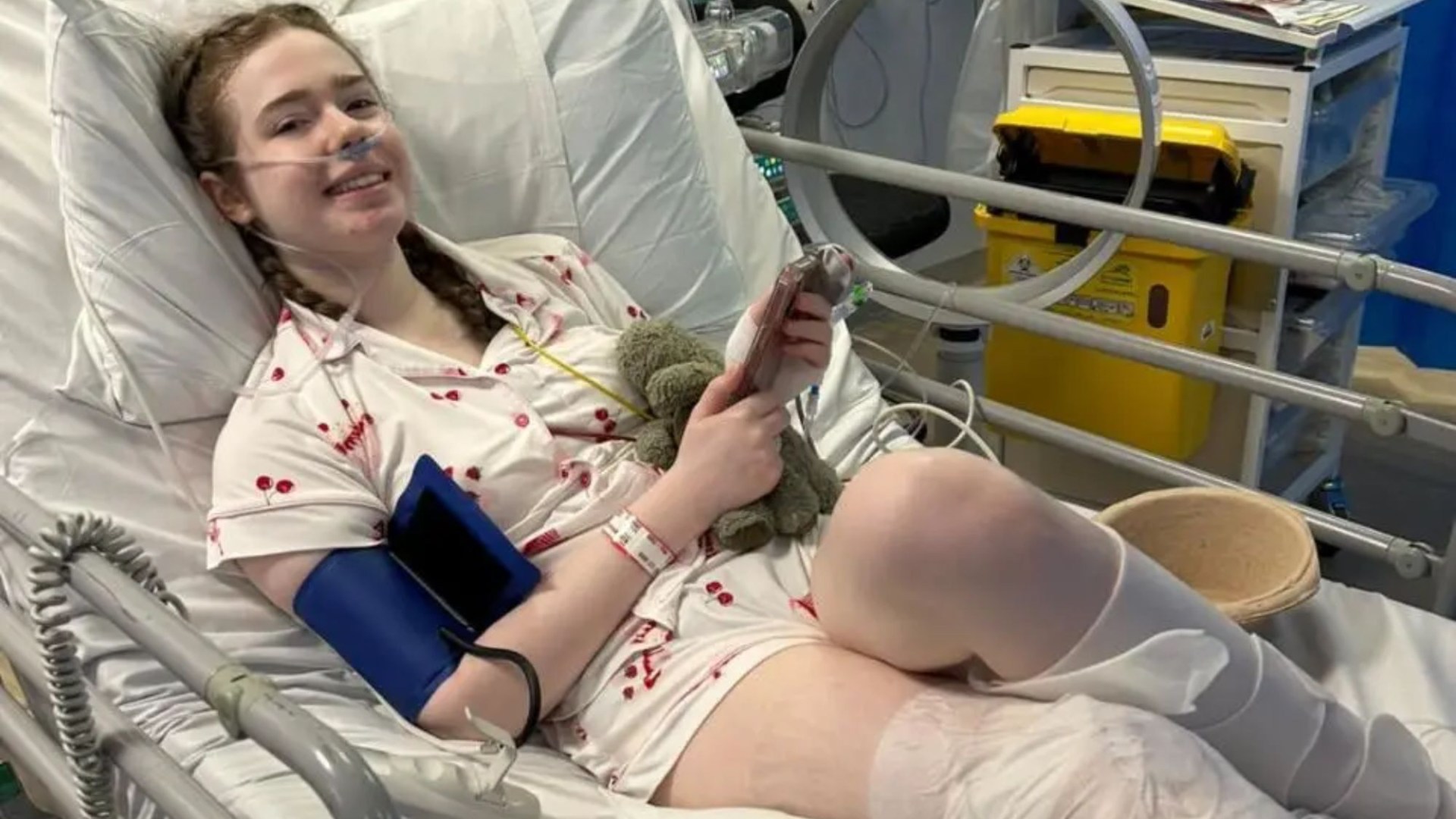
A 20-YEAR-old woman has chosen to have her leg amputated to relieve her from so-called ‘suicide disease’.
It took two years for Jess Burkinshaw to persuade doctors it was the best choice and she is now living with less pain.
7
7
Jess was in so much agonising pain that at one point, she was unable to leave her home for eight months.
She was diagnosed with complex regional pain syndrome (CRPS) at age 15, a condition which causes severe and persistent pain and can develop following an injury or damage to the nervous system.
At its worst, Jess says the pain could feel as though she was “burning alive” one moment before being “thrown into an ice bath” the next.
“I’ve never known a life without pain,” Jess, from Leeds, West Yorkshire, told Sun Health.
Read more on health
LIFE SAVER
Teen with ‘suicide disease’ becomes UK first to get pain-relieving spine implant
AGONY
‘Suicide disease’ feels like I’m on fire – it’s most painful condition known to man
“When I was around 14, I just couldn’t ignore the pain anymore, it was taking over my life.”
Jess had lived with juvenile idiopathic arthritis (JIA) since she was just 16 months old, when she developed swollen joints, fevers and severe pain and even stopped walking and crawling.
The condition is when arthritis starts far earlier than is typical, and ‘idiopathic’ means the exact cause is unknown.
But when she was 15, the pain in her right ankle suddenly became dramatically worse.
Most read in Health
LETHAL PLATE
Man, 64, given hours to live after eating pub roast led to multi-organ failure
BRAVE
We thought son’s stuffy nose was hay fever but he died – I’m honouring his last wish
HEARTACHE
I blamed my son’s shoulder pain on his college bag – now he’s got weeks to live
Nearly half of Brits have tried social media hacks to improve sleep
Jess initially believed she was suffering a particularly bad arthritis flare-up before she got her CRPS diagnosis.
CRPS usually affects just one limb, but can spread to other parts of the body.
The NHS says the skin of the affected body part can become so sensitive that a slight touch, bump or even a change in temperature can cause intense pain.
It can lead to depression, anxiety and sometimes suicidal thoughts, with patients in so much distress that CRPS earned its reputation as being the ‘suicide disease’.
7
7
The cause of CRPS, which is thought to be ‘uncommon’, is unknown, but for many people it’s thought to be the result of the body reacting abnormally to an injury.
Jess said: “On a daily basis, my pain level would never drop below a seven out of the one to 10 pain scale.
“It felt like my whole foot was bruised and it was continuously being stabbed, burned and electrocuted.”
The debilitating pain took a huge toll on Jess’s education and social life.
She said: “It has massively affected my life in terms of studying.
“I sat my GCSEs at home as I was in too much pain to leave the house, and I missed over half of my last year of school due to the pain.
“I had very few friends as I wasn’t there seeing them in person to keep the friendship going.
“Leaving the house has always been my biggest struggle, as I was unable to wear a sock or shoe due to my CRPS.
“This meant I was completely unable to go out in winter as the cold was so intensely painful.
“My lowest point during my illness was a couple of years ago when I wasn’t able to leave the house for eight months, and I was barely leaving my bedroom due to how severe my pain was.”
Jess says years of crippling pain and medication also had a devastating impact on her mental health.
She said: “I have been on so many different medications to try and combat the pain, but no one ever seems to warn you about the effect they can have on your mental health.
7
7
“I was depressed, anxious and experiencing hallucinations due to the medication I was taking, mixed with my severe lack of sleep due to the pain.”
Jess spent years trying different treatments in a desperate bid to regain control of her life.
These included an ankle fusion and a spinal cord stimulator trial, but nothing worked.
Eventually, after more than two years of discussions with surgeons, she decided to have her right leg amputated.
Jess underwent the life-changing operation in April this year.
She said: “An amputation may seem like a worse outcome to most people as they are used to their limbs being pain free and functional.
“I think if they felt what it’s like to be in horrible pain 24/7, even just for a day, they would be much more understanding and would beg for anything just to lessen the pain even a bit.
“My quality of life has improved so much mainly because I’m in less pain.
“I can leave the house more, I feel more independent, I’m sleeping much better, and I feel more like myself.”
Doctors had differing opinions over whether amputation was the right option because of Jess’s young age and CRPS.
She saw three different surgeons, two of whom supported the procedure, while another was more cautious.
The decision ultimately took more than two years.
What is Complex Regional Pain Syndrome (CRPS)?
Complex regional pain syndrome (CRPS) is a poorly understood condition where a person experiences persistent, severe and debilitating pain.
Although most cases of CRPS are triggered by an injury, the resulting pain is much more severe and long-lasting than normal.
The pain usually only affects one limb, but it can sometimes spread to other parts of the body.
The skin of the affected body part can become so sensitive that a slight touch, bump or even a change in temperature can cause intense pain.
Affected areas can also become swollen, stiff or undergo fluctuating changes in colour or temperature.
CRPS often gradually improves over time. But some people with CRPS experience pain for many years.
The pain may feel like a mix of burning, stabbing or stinging. There may also be tingling and numbness.
In addition to chronic pain, CRPS can also cause a range of other symptoms.
These can include:
- strange sensations in the affected limb – it may feel as if it does not belong to the rest of your body, or it may feel bigger or smaller than the opposite unaffected limb
- alternating changes to your skin – sometimes your skin in the affected limb may be hot, red and dry, whereas other times it may be cold, blue and sweaty – changes to skin colour may be harder to see on brown and black skin
- hair and nail changes – your hair and nails in the affected limb may grow unusually slowly or quickly and your nails may become brittle or grooved
- joint stiffness and swelling in the affected limb (oedema)
- tremors and muscle spasms (dystonia)
- difficulty moving the affected body part
- difficulty sleeping (insomnia)
- small patches of fragile bones (osteoporosis) in the affected limb – although there’s no evidence this could lead to fractures
Source: NHS
7
Jess knew there was a risk the operation might not reduce her pain, but says she had reached the point where she was willing to take that chance.
She said: “An amputation was the best shot of having less pain and better functionality with a prosthetic over my other options, and I was willing to do anything to lessen my pain to improve my quality of life.
“When I was finally put on the waiting list for my amputation, I just felt so much relief.
“I was definitely worried that my pain wouldn’t lessen after my amputation, but I knew I couldn’t be any worse off than I already was.
“I’d either stay in the same amount of pain I was already used to, or I had the chance of it improving.”
Jess is not yet using a prosthetic but had a cast made for one recently.
In the meantime, she has been working hard with physiotherapists and using a PPAM aid – a rehabilitation device which allows lower-limb amputees to practise walking before receiving a prosthetic.
She now uses social media to educate others about disability and accessibility and raise awareness of what it can be like to live with chronic pain.
How to get help
EVERY 90 minutes in the UK a life is lost to suicide
It doesn’t discriminate, touching the lives of people in every corner of society – from the homeless and unemployed to builders and doctors, reality stars and footballers.
It’s the biggest killer of people under the age of 35, more deadly than cancer and car crashes.
And men are three times more likely to take their own life than women.
Yet it’s rarely spoken of, a taboo that threatens to continue its deadly rampage unless we all stop and take notice, now.
If you, or anyone you know, needs help dealing with mental health problems, the following organisations provide support:
- CALM, www.thecalmzone.net, 0800 585 858
- Heads Together,www.headstogether.org.uk
- HUMEN www.wearehumen.org
- Mind, www.mind.org.uk, 0300 123 3393
- Papyrus, www.papyrus-uk.org, 0800 068 41 41
- Samaritans,www.samaritans.org, 116 123
And Jess has no doubts she made the right choice.
She added: “It was definitely the right decision, no doubt about it.
“I had full trust in my surgeon and I knew it was the best way forward.
“The relief was a gradual process as I had targeted muscle reinnervation which meant the nerves were a lot more sensitive in the first month post amputation.
“I got relief after about two months.
“For me, it wasn’t a difficult decision to be made.
RECOMMENDED STORIES
“I have a very logical mindset and it was the only option that could actually lessen my pain.
“My friends and family were happy I was getting what I needed to help my pain as they saw how much I was struggling with my pain.”