
Advertisement
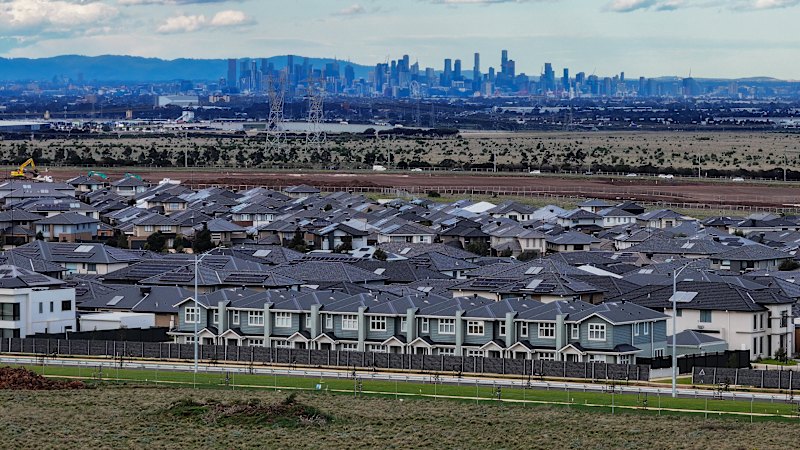
Almost half of Melbourne’s new housing approvals are concentrated in the city’s outer growth corridors, despite Labor’s push to prioritise building new homes in established suburbs and curb urban sprawl.
There were 20,252 dwellings approved across Melbourne’s seven growth-area municipalities in the last financial year, accounting for 48 per cent of all metropolitan approvals, according to the Australian Bureau of Statistics.
Labor wants at least 70 per cent of new housing to be delivered in established areas, with just 30 per cent in greenfield growth areas. The policy is designed to put more homes closer to existing jobs, public transport and services.
The government committed to the split in its 2023 housing statement, which also relaxed planning controls and fast-tracked approvals in an effort to drive up housing stock in existing suburbs.
Advertisement
But three years on, the government’s seven designated growth area councils – Melton, Wyndham, Casey, Hume, Whittlesea, Cardinia and Mitchell – still account for about half of Melbourne’s housing pipeline.
Together, Melton and Wyndham accounted for about 20 per cent of new homes approved in Melbourne as a whole.
The remaining 52 per cent of approvals were spread across Melbourne’s 25 established council areas included in the metropolitan housing target.
While many established suburbs struggled to attract new housing projects, the City of Melbourne stood out among established suburbs with 3966 dwelling approvals, the third highest of any Melbourne municipality.
Advertisement
Urban Development Institute of Australia chief executive Linda Allison said the latest figures showed industry was struggling to deliver new homes in established Melbourne suburbs.
“Growth areas have traditionally supplied at least 50 per cent of new homes, and this trend hasn’t changed,” Allison said.
“The government can create policies about density and targets, but policy alone doesn’t change the way people feel about where they want to live, and the type of housing they prefer.”
Allison said about 60 per cent of buyers in growth areas were migrant families, predominantly from India, Sri Lanka, Pakistan or the Philippines, where multi-generational living is common.
Advertisement
“These buyers do not move to Melbourne to live in a two-bedroom apartment. They want their own detached home.”
She said high construction costs, interest rates, weak consumer confidence and Victoria’s property tax settings meant many apartments and medium-density projects were not financially viable and described Labor’s 70:30 split as “unachievable” under current policy settings.
The council-level split is not a direct measure of Labor’s 70:30 target because the seven growth municipalities also contain established suburbs, meaning not every approval is destined for a greenfield development.
The government has also set a 2051 housing target for every local government area as part of its plan for an extra 2.24 million homes to be built by 2051.
Advertisement
If those targets were spread evenly over 26 years from 2025 to 2051, most of Melbourne’s growth municipalities recorded enough approvals last financial year to reach or exceed their targets, but established suburbs lagged.
Melton recorded more dwelling approvals than any other Melbourne municipality last financial year with 4563, followed by Wyndham with 4049.
In Glen Eira, which takes in the activity centres of Caulfield and Bentleigh, 831 new homes were approved last year, against an annual pace of about 2440 needed to reach the municipality’s 2051 housing target of 63,500 extra dwellings.
A similar shortfall was also recorded in Maroondah and neighbouring Whitehorse in Melbourne’s east, where approvals were running at less than one-third of the annual pace needed to reach the government’s 2051 target.
Advertisement
In Boroondara, which takes in Camberwell, Canterbury and Hawthorn, the government wants an extra 65,500 additional homes by 2051 – equivalent to about 2520 a year over 26 years.
Last financial year it approved 769 new dwellings, less than one-third of the annual pace needed to reach that goal.
Boroondara Mayor Wes Gault told The Age that while he supported a boost to housing, targets had to be matched by support and services.
“Instead of focusing on housing targets, the state government should focus on how many homes can actually be built and whether the transport, schools, health services and open space are there to support growing communities,” he said.
Advertisement
“If the state government wants to see 65,500 additional homes in Boroondara, it needs to address the real barriers to development, including construction costs, infrastructure investment and market conditions.”
Overall, Victorian dwelling approvals rebounded 9.7 per cent in July in seasonally adjusted terms, but the underlying trend measure fell 1.2 per cent, compared with NSW where approvals were up 2.4 per cent and Queensland where they rose 2.1 per cent.
Despite the rebound, Victoria’s approval pipeline remains well below the pace needed to reach Labor’s separate target of 800,000 net new homes between 2024 and 2034.
Victoria recorded 55,798 dwelling approvals in the past financial year, about 30 per cent below the 80,000 net additional homes a year required to deliver the 800,000 homes promised over the next decade to 2034.
Approval rates offer an early measure of the future housing pipeline because not every approval results in a completed home.
Advertisement
A state government spokesperson said Victoria continued to build and approve more homes than any other state, but that there was “more to do”.
“Boroondara has experienced some of the slowest housing growth in Melbourne over the past 30 years, despite strong access to public transport, jobs and services. This has led to the population of people under 65 going backwards and school enrolments falling.
“We’ll continue to pull every lever we can to enable more homes to be built where Victorians want to live.”
Opposition planning spokesman David Southwick said Labor’s 70:30 ratio “has no basis in the real world”.
Advertisement
“They [Labor] will try and tell Victorians where to live – we will let them decide.”
Southwick said a Wilson-led government would scrap the 70:30 ratio and “let Victorians decide where they want to live”.
Start the day with a summary of the day’s most important and interesting stories, analysis and insights. Sign up for our Morning Edition newsletter.
You have reached your maximum number of saved items.
Remove items from your saved list to add more.
More:
Annika Smethurst is the Victorian affairs editor for The Age.Connect via X or email.AdvertisementAdvertisement