
Colin Sheridan: We watched 9/11 happen. Then we forgot what the pictures were telling usFrom Afghanistan and Iraq to Gaza, Colin Sheridan argues that 9/11 exposed a failure to recognise every victim’s humanity Sat, 12 Sep, 2026 – 01:00Colin Sheridan
Twenty-five years later, there are still new ways to watch the end of the old world. New angles emerge. Previously unseen footage is uploaded. Found footage emerges from an attic, or something recorded from a rooftop in Brooklyn is digitised, and once again the plane enters the frame, the fireball erupts, and eventually the towers fall.
September 11, 2001, may be the most watched atrocity in human history.
Nearly 3,000 people were killed that morning. The number is familiar enough now to have become almost administrative, which is one reason the images retain their power. They restore the individual human beings concealed within the flaming arithmetic.
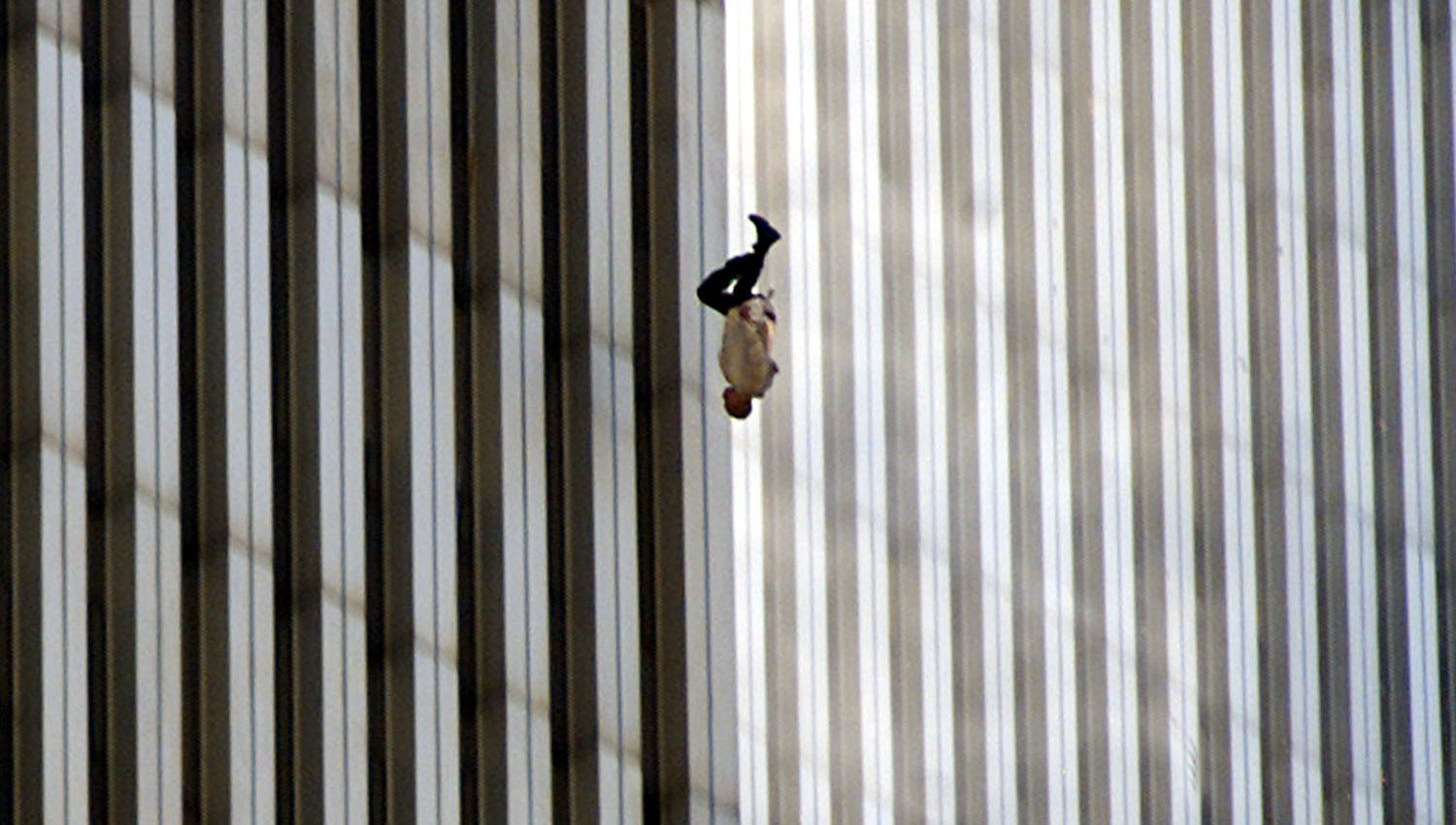
None does so more brutally than Richard Drew’s photograph of the man falling from the North Tower. Tom Junod later wrote beautifully about the photograph in Esquire, and about the discomfort it caused.
It disappeared quickly from many newspapers.
There was something almost indecent and perverse, people felt, about looking at it. Perhaps because there was nowhere to hide in the image. Here was one human being who, between fire and air, had been presented with an impossible choice.
That photograph, and our difficulty looking at it, seems worth thinking about a quarter of a century later. Because September 11 did not only change geopolitics, it changed how the West looked at violence and vengeance, how it remembered victims and, eventually, how it decided which victims counted.
Read More
25 years on from 9/11: The profound loss suffered by New York’s Irish community
25 years on from 9/11: Shock, grief, and resilience as New York is attacked from a clear blue sky
The immediate reaction was sadly predictable. The United States had suffered a spectacular act of mass murder. There was grief, fear, rage, and an enormous surge of patriotism.
Some of it was moving. I will, for example, defend one moment of George W Bush’s presidency without qualification. On October 30, 2001, Bush walked onto the mound at Yankee Stadium before game three of the World Series wearing an FDNY jacket and a bulletproof vest.
Derek Jeter had reportedly warned him not to bounce the ceremonial first pitch because the New York crowd would let him know about it. Bush threw a strike. Politicians, celebrities, and even professional athletes have made a lifelong habit of making a balls of ceremonial first pitches.
Bush, carrying rather more pressure than most, delivered. For one evening he understood precisely what America needed from him: Presence, nerve, symbolism, no speech required. Just don’t bounce the fucking baseball.
4.5m deaths in America’s post 9-11 wars
Unfortunately, throwing a baseball down the middle proved considerably easier than determining where America should throw its military power.
What followed September 11 was not simply Afghanistan.
It was Iraq, Guantánamo Bay, Abu Ghraib, extraordinary rendition, torture, drone warfare, mass surveillance, extrajudicial killings, and the Patriot Act.
The language changed too. There was an “Axis of Evil”. You were either with America or against it. Shock and awe became something you could watch on television, and high-five whilst doing it. Brown University’s Costs of War project estimates that the post-9/11 wars caused at least 4.5m deaths, directly and indirectly, across the countries in which they were (often illegally) fought.
That figure includes the enormous reverberating consequences of conflict: Disease, hunger, destroyed infrastructure, and shattered health systems.
Read More
Book review: Fisk’s sobering view of the Middle East bites with truth
Abu Ghraib guard ‘whistled, sang and laughed’ during abuse
Prisoner torture ‘included sex assault with broomstick’
History won’t forgive Donald Rumsfeld for his deceit and warmongering in Iraq
But, 25 years after September 11, surely those dead belong somewhere in its accounting too.
Culture began making sense of all this almost immediately.
Jeffrey Melnick has written about the extraordinary cultural canon that grew from 9/11: Television, literature, music, satire, photography.
There was Rescue Me and Team America: World Police, MIA’s Paper Planes, and Don DeLillo’s Falling Man.
And there was Spike Lee’s 25th Hour.
Released little more than a year after the attacks, it was not really a film about September 11 at all. Yet September 11 is everywhere in it. Ground Zero appears outside an apartment window. Grief hangs over New York like an insidious cloud. The city is wounded but carrying on.
Perhaps that is why it has aged better than more explicitly patriotic artefacts of the period. It understood trauma as something that seeps into ordinary life rather than something conquered by flags.
Did 9/11 affect us because it was televised?
The real legacy, though?
For a long time, we told ourselves there was something uniquely powerful about September 11 because we had watched it happen. There is truth in that.
The massacres of Sabra and Shatila were not live-streamed, when thousands of Palestinian and Lebanese civilians were massacred in Beirut in 1982. Srebrenica did not unfold minute by minute on smartphones.
Many of humanity’s worst crimes occurred beyond the gaze of the people who might have stopped them. Perhaps we took some comfort from that. If only people could see! If only we knew!
But we can see atrocities in Gaza too
Gaza, and Israel’s genocide there, has destroyed that self-congratulatory myth.
For almost three years, we have been able to watch, in real time, Palestinian children being pulled from rubble and incinerated in tents. We have watched parents carrying dead toddlers in plastic bags. We have swiped north as neighbourhoods disappear, hospitals dismantle, families displace, and people scratch through dirt for grains of rice.
The pictures got out. We saw them, not after it happened — as it was happening.
Perhaps the darkest lesson of the last 25 years is that seeing was never the problem.
The Falling Man matters, apparently, because he was a human being. The ordinary bloke trapped between sky and ground, an inferno in between. The firefighter climbing upwards while everyone else came down mattered. The passenger aboard Flight 93 mattered. And the child beneath concrete in Gaza matters for exactly the same reason.
Twenty-five years later, we have watched those towers collapse so often that we might imagine there is nothing left for the pictures to teach us. But there is.
The lesson of September 11 was never merely that American lives mattered enormously on that bright Tuesday morning. The lesson should have been that all human lives do.
The history of the quarter-century since is defined by our collective failure. By how often we have forgotten the difference.
Read More
Colin Sheridan: To live in Beirut is an act of love
Thirty years on, Srebrenica still lives under the shadow of genocide
x
185th Anniversary Offer
Six months of digital access for €18.50
Already a subscriber? Sign in
No obligation. Ts&Cs apply.
CONNECT WITH US TODAY
NEWSLETTERS
NOTIFICATIONS
Be the first to know the latest news and updates
The Deirdre O’Shaughnessy Podcast: The lasting impact of 9/11 on the people of New York
25 years on: 14 documentaries and films to mark 9/11 anniversary and where to watch them
25 years on from 9/11: ‘Suffering did not end’ once the smoke and dust cleared, New York mayor says
More in this section
Shona Murray: West can no longer ignore the grave transgressions perpetrated by Israeli state
Gareth O’Callaghan: JD Vance doesn’t mind if the end times come — which god is he working for?
David O’Mahony: When it comes to books I’m OK with being cringe, as long as I’m the lord of it
#911#Israel-Palestine